
My God-Hunger-Cry – by Sri Chinmoy
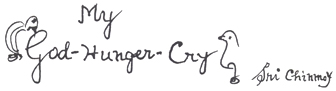
In October of 2005, Sri Chinmoy began a series of prayer-poems entitled My God-Hunger-Cry. We are delighted to feature them here and hope they bring you joy and inspiration.
My God-Hunger-Cry – by Sri Chinmoy
In October of 2005, Sri Chinmoy began a series of prayer-poems entitled My God-Hunger-Cry. We are delighted to feature them here and hope they bring you joy and inspiration.
Inspiration-Letters 9
Book Reviews
Dear Reader,
 This issue is devoted to book reviews, the most essential form of literary criticism. When we pick up a new book, often many questions nag at the back of our mind: Is this a good book or a bad book? Should I read it? Will other people enjoy reading it, or will they think me a fool for reading this and enjoying it? There are so many reasons why we turn to reviewers, critics and scholars to settle our opinions for us about life and the world.
When I go out to eat in nice restaurants, I ask the waiter to recommend to me the four most delicious dishes. Then I scrupulously avoid ordering any of them. I am myself a waiter and I recommend people the tastiest dishes. But when I dine out, I am invariably disappointed when I order along the lines of the waiter’s suggestions. I almost get the feeling they recommend food that I should like, because it’s expensive or fashionable, rather than on how it tastes.
And how should a book taste? Or sound? I was listening to Beethoven’s last string quartet (and last composition), Opus 135 in F major, on the radio one night in the kitchen. They were playing the next to the last movement, a long, beautiful piece. One of my cousins entered the room and told me that the music had a deep blue color.
Speaking of books with a ‘blue’ theme, I have read Moby Dick, by Herman Melville, many times. The book is mantric and long and strange and wonderful. I like the opening scene in the novel. The narrator describes how, at the end of the workweek on late Friday afternoons, Manhattan shipyard workers, accountants, servants and schoolteachers used to congregate by the water, and just look at the vast ocean for hours and hours- how people are invariably drawn towards water, like iron filings to magnets. And I like how the author sells everything he has for the chance to be a member of a whaling party. He doesn’t want to see the world, or get rich through being a whaler. He simply wants to live and work in the water. And that’s what the spiritual life means, to put aside everything you know to be immersed in the beauty and the fragrance of the unknown.
The book that had the biggest influence on me is Beyond Within, Sri Chinmoy. It is one of those books that’s simple and clear and deep. Interestingly I would not have been so moved by Sri Chinmoy’s beautiful prose and simple but haunting ideas if I hadn’t at that time been terribly sad at not having gotten into the college of my choice. In that awkward moment of self-doubt, I found this book to be so uplifting. Beyond Within deals with how to have a connection with God while fulfilling all of our day-to-day obligations.
We Inspiration-Letters-writers are extremely grateful to be able to share with you our thoughts and ideas on the art of book reviewing. I hope these articles inspire you to revisit your favorite books with a fresh perspective.
Mahiruha Klein Editor
Title photograph: Pavitrata Taylor


Musashi by Eiji Yoshikawa
Sumangali Morhall
This is ostensibly a book of swordsmanship, and includes its share of martial combat, but that element is neither gratuitous nor glamourised – it serves to support rather than blemish the story’s purpose. Musashi transforms himself from a brute and selfish thug, to a hero of great depth and honour. Through the teachings of Takuan Soho and through his own self-discipline and one-pointedness, he transcends his natural capacities in the pursuit of his life’s mission.
Although Musashi was the maven of martial arts in his time, Yoshikawa portrays his many human aspects so as to bring his character into real and living relief – not a mere legend, but a man struggling with failings and weaknesses, in whom one can surely glimpse one’s own self. Never coldly observing from outside any character, Yoshikawa becomes the character and writes straight from that beating heart, or racing mind, or pulsing body. Each character has its place in the tale and its own unique lesson for the reader.
Yoshikawa’s research is such that every angle of the culture and every level of the social hierarchy is revealed in robust detail. The writing is complete and completely satisfying, pristine and elegant. No single word is superfluous, yet no detail is trivial enough for exclusion. One may well take any sentence from any of the 970 pages and let it stand as a striking, intriguing work of prose.

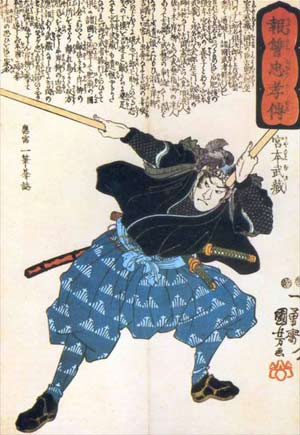
More graceful than grisly, this is the account by one master of another master's life. Whether you choose to read this book for its historical content, its study of martial arts, its celebration of Japanese culture, its portrayal of human transcendence, or simply as a heroic piece of writing, you will not be disappointed.
Sumangali Morhall York, England
Grace by Sri Chinmoy
Jogyata DallasI have been reading Sri Chinmoy’s little book called Grace, one of a mini-quartet that also features Love, Compassion and Forgiveness. Head-nodding vigorously at the lovely insights and illumining explanations packed onto every page. Looking back over a personal life that has included many wrong turnings and foolishness I can see quite clearly the unmistakable signature of grace, bucket loads of it, taking me firmly by the hand and turning me away from both the folly of an empty career or a hideaway life of seclusion to gift instead a spiritual life — or attempts at this — with a wonderful living master.
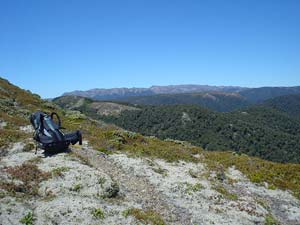
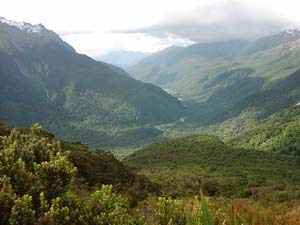
I first stumbled across evidence of grace in my life about ten years before it set me on my present course – I was a safari guide and one winter my employer flew me in a little two-seater plane into the remote heart of a wintering mountain range in New Zealand. Looking at deer and trout populations for summer clients to harass.
“Did I ever tell you the one about the Scotsman who lost his kilt?” asks Ken the laid-back bush pilot, trawling through an endless anthology of dubious jokes. “No”, I say, inwardly sighing, “No I don’t believe I’ve heard that one.” Ken is about to launch into another salacious narrative when there’s a sudden blast of static on the radio, a voice coming into the cockpit, weather warning, mountain winds and cloud coming in up ahead, get in and out fast. The tiny Cessna skims over treetops, a saddle between rising mountains towering on either side, drops down into the valley. Ahead the grey shingled braids of the Ngaruro River, the northern catchment snaking among manuka and tussock before disappearing at the top end of the valley into a wall of beech forest. “Bandit at nine o’clock,” says Ken, and sure enough, down below out the left cockpit window a young red deer stag is skedaddling across the shallow water, geysers of spray, scrambling up an embankment and swerving through scrub for the cover of trees. Ken dipping one wing in mock pursuit, a strafing run…
Grace is a lovely book. It describes the love and compassion of God responding to personal effort and falling unconditionally like rain on agnostic and believer alike. Personal effort, magnet-like, always attracts grace – and grace increases our hunger, deepens our meditation, clears away the blocks and obstacles to expedite our progress.
For most of us the concept of grace with its assumption of the existence of God has little reality. Either we do not believe in God or, overly conscious of our blemishes and wrongdoings, we cannot believe that a God could love us constantly and unconditionally. But the opposite is true and Sri Chinmoy writes: “Personal effort cannot live by itself even for a minute, because its inner nourishment is the Grace from Above… God’s Grace is responsible for everything. This moment it is using our hands, next minute it is using our legs, next moment it is using our mind, next moment our breath or our heart.”
Grace is one of the elusive, powerful mysteries of God’s love, the key to that great alchemy that transforms ignorance into knowledge, disbelief into devotion, seeker into saint.
Ken Dooley, cool as a cucumber, shot down eleven times in Vietnam as a chopper pilot, sole survivor twice – charmed life or jinxed? – sidestalls down to lose altitude quickly, hard banking in the narrow valley, the small plane turning on a dime, lurching and jumpy in the wind then we’re lining up for a rough touchdown on the banana shaped makeshift runway, hand grubbered on a river terrace out of yellow tussock, pumaceous earth. A jarring impact, a hooter alarm sounds briefly in the cabin, we’re bouncing ten feet up again, Ken whooping like a rodeo bull rider, then down and hard braking, charging left around the curving strip and every rivet in the fuselage groaning. “Bingo!” says Ken, flashing rows of expensive smiling teeth. Now we’re unloading gear, two weeks food, then Ken’s back in the pilot seat shouting wisecracks – “Back in a month or two if I remember, sure hope I can find this place again.” Grins, thumbs up, then he’s off in a roar of throttled engine, dust and flying leaves, climbing up and banking in front of the mountain wall, turning down the valley for another run to gain altitude, waggling his wings overhead before clearing the saddle and gone, a tiny droning fly.
Belief or disbelief in grace does not alter its reality any more than our expectation of a sunny day might stop a sudden downpour — and an open mind/open heart will gradually reveal its existence. As we become more conscious of grace in our life, a direct personal experience, our faith and surrender and our feeling of being God’s child deepen. Anxiety disappears, love and patience come, everything is being taken care of by God the infinitely loving parent. This is not a dogma or a philosophy or an idea but Reality. You know it, live it, feel it.
Sri Chinmoy writes: “God’s greatest adamantine Power is His Grace. The moment God uses His Grace for an individual, He offers His very Life-Breath to the seeker. If we approach God with the heart and the soul there can be no dryness, only a constant shower of love and Grace.”
I have broken a cardinal rule of the mountains. Last night, one hour before light drained out of the valley I went up through thick beech forest behind my camp, left my small daypack with emergency supplies behind. A sika stag was roaring up on the ridge and I sneaked closer for a look, excited, though knowing I was on the edge of darkness. When it slipped down the side into the catchment of another river, I followed. Big mistake. Hurrying back to beat a black night in which you cannot see or move, I took the wrong spur, ended up in a streambed taking me away from my camp, a different river system. No food, matches or rifle and thirteen hours of darkness till daybreak. Rain falling. Have to find a way to stay warm, to last the night. No rock face for shelter, no fallen trees or caves; cutting long fronds of mamaku fern with my sheath knife and building a flimsy lean-to, keep out the worst of the rain. In the morning after a sleepless freezing night, feeling half dead with exhaustion. And now a primal struggle to survive.
Many people talk of a relentless causality that governs our lives. From the alignment of planets astrologers also make charts that predict what will happen. But grace can nullify everything. Sri Chinmoy reminds us that “there is a world which is infinitely higher than the planets. From there we can easily create, and we can also delete anything in our fate… then we can add something new. Your fate can also be adjusted by the Grace of the Supreme.”
A pea-soup fog blankets the mountains, snowdrifts fill the creek sidings, zero visibility but have to keep moving, backtracking to stay warm. Snatching mouthfuls of water, the bitter stringy pulp of punga fronds for energy, keeping at bay the constant menace of death by cold. Forcing myself not to panic, to stay calm – an errant step here, a broken ankle or bad fall would be the end. Nobody would ever find you. Man down.
Grace especially permeates our being when we are in the field of aspiration, even to the point of nullifying or changing our karma. Sri Chinmoy uses the analogy of a child who does something wrong then runs to the father to avoid the consequences. The father has compassion for the child. He knows the child has done something wrong but safeguards the child from the consequences.
Comments Sri Chinmoy: “In the case of an ordinary, unaspiring person, karmic dispensation is unavoidable, inevitable. The law of karma is always binding: like a snake it will coil around him. He has to pay the toll, the tax; the law of karma is merciless. But again, there is something called divine Grace. If I shed bitter tears and pray for forgiveness, then naturally God’s compassion will dawn on me. Divine grace plays the role of the father. If the father wants to protect the son, he can.”
Day three. Prospects are bleak – I need a miracle. Winter’s relentless rain and snow, lack of food, bitter cold, wet clothes freezing on my skin have reduced me to a stumble. I have to sit a lot. Mind, ego, self have all gone, worn away. This close to death you don’t care about yourself anymore – glad to get it over with. But sad all the way through for my family, especially my parents. Here at the end, agnosticism also falls away, the proud and shallow constructs of the mind tumbling like a house of cards. I’m starting to pray, plea bargain with God, get me out of here and I’ll start over, no more hunting, no more of this, I promise, I promise. Half an hour later I’m still praying, last chance, half dead in the clearing of golden tussock in a creek bed, middle of nowhere. Then as suddenly as a light turned on something incredible happens - I know where I am. I’m being shown how to get back to the camp, I recognise this place, I know exactly what to do to make it out of here. I can make it.
“He who chooses the Supreme has already been chosen by the Supreme. God has chosen each of us before we even dreamt of accepting Him. But now that we are consciously aware of His acceptance, we need not stumble, we need not walk, we need not march; we can run fast, faster and fastest, because our awareness itself is God’s infinite Grace.”
Sitting in the yellow tussock, worn down to nothing, I stare out at an exquisitely beautiful world as though for the first time, a child’s awe, eyes streaming with tears. Stretching out in a cocoon of huge gratitude on the earth, all of myself merged into the mountains, trees, water, no ‘I’ left. A cloudburst of heart tears, a full hour unmoving.
“When we aspire with our heart’s tears, we see that God is coming down to us from Above. The heart is crying and yearning like a mounting flame burning upward. This flame of the heart wants to go beyond the mind, so it is always rising. And God is constantly descending with His Grace, like a river flowing downward. Ours is the flame that always burns upward; God’s Grace like a stream, is coming down from the Source. When aspiration and Grace meet together, we come to experience the divine fulfilment of union with God.”
“Jeez,” says Ken, “you look like hell! What happened?” A wild and desperate epiphany of tears, torment, grace, gratitude, elation. My whole life changed in three days. The plane labours up through skeins of wispy cloud then clear sky, the strip soon a tiny brown scar in the endless folds of earth, big distances stretching out of the cockpit window. From up here it all seemed simple enough, the jumbled hills untouched by the harsh geometry of manscapes, headwaters of wide rivers starting out in lonely shingled valleys, the flanking upthrusts of mountains like wrinkled calico, their scree slides tumbling down through dark forests as though gouged by a monstrous claw, topography laid out in an ancient asymmetry of order; and my own life clear and simple too, stepping back in altitude and distance to see the sense of it, its purpose unveiled by a near-death to this bright clarity. A feeling of the almost perfect inevitability of everything, all creation flowing towards some final and grand and peaceful fulfilment. Looking down at the snow-capped ranges, my harsh but grace-filled school room, feeling the diminution of self imposed by landscape, ridgelines stepping back into bluescapes of beyond, saying goodbye because I won't be back, at least not as this person who came here two weeks before. Remembering the moment when I stumbled out into that forest clearing and some veil parted, seeing everything as though for the first time, everything unfiltered by mind and custom—a grace-filled benediction—being shown something far beyond anything ever imagined. “Brace!” says Ken and we tense up against back rest and fuselage, no seat-belts in this old bird, banging down carelessly on the runway at Taupo. Stepping out onto the tarmac into the sweet cold air, hoisting up my pack and walking away, feeling a lovely freedom.
“God’s love gives us first a free access to His inner Existence, then a most complete intimacy or oneness with His inner Will and finally, ecstasy or delight, which is the universal and transcendental Reality which God Himself is.”
Jogyata Dallas Auckland, New Zealand
The Funniest Book Ever Written
by Noivedya JudderyWhat is the funniest book ever written? Humour is a personal thing, so I can only provide a personal answer. What book has made me laugh me laugh the most?
A pity that’s the question, because that means I can’t provide some kind of highbrow answer from the annals of classic literature. The works of Juvenal and Chaucer, the comedies of Shakespeare, Jonathan Swift’s Gulliver’s Travels... I’m familiar with them all, to a varying extent. They are all apparently hilarious. Unfortunately, I’ve rarely laughed at them. They lose something in translation. It is not merely the language, which has of course changed considerably. It’s true that “the past is another country” – and in these cases, a very distant country. You can learn the language, study the customs, even model a village (Disneyland-style) to resemble these countries – but there’s not a single airline that will take you there. If anyone today claims that they find Jonathan Swift much more side-splittingly funny than, say, Dave Barry, chances are that they are merely showing off.
For those who have not read Gulliver’s Travels, the title character doesn’t merely visit Lilliput (the land of small people, as seen in numerous children’s cartoons), but several other lands, where the people are equally unusual (in different ways). It was written in 1726, not as a children’s book, but as a satirical novel. Though much of the satire is still potent, it is based on the mores and government of eighteenth-century European society. Today’s people are similar in many ways, but society has changed just enough for Swift to lose his power. Like the political humour in a 30-year-old episode of Saturday Night Live, it doesn’t make so much sense if you weren’t there at the time.
Shakespeare presents its own problems to me. Twelfth Night, for example, is full of clever gags and witty one-liners, which I realised from reading the footnotes of a paperback edition I once bought. Of course, once a joke has been explained and analysed, you might “get it”, but it loses all appeal.
So for me (or anyone else), the funniest book is one in which the jokes make immediate sense, the laughter is spontaneous, and the voice is recognisable. With that in mind, I have to say that the funniest book ever written is Doctor Who: The Completely Useless Encyclopaedia (Virgin, 1996), by Chris Howarth and Steve Lyons – perhaps the only book I’ve read where the expression “laugh a minute” would come regularly. That’s just my opinion, of course.
Sadly, most of my friends could not share in the joy. This book was a snide glimpse into the world of Doctor Who fans. That was usually my favourite television show as a kid, and I was well acquainted with the organised fan community. When I bought this book, I was laughing at a world I know. (Howarth and Lyons later wrote a similar book attacking Star Trek in a similarly affectionate fashion. I found this one funny, as I’m familiar with Star Trek and I’ve known a lot of Star Trek fans, but not nearly as funny as their previous Doctor Who volume.) It’s a bit like sharing a joke among friends about people you know. However much she is making you laugh, you probably don’t say to your sharp-witted friend, “Say, you should be writing humour for a living!”
Away from the devoted but rather limited audience of the very talented Howarth and Lyons, the books that make me laugh the most have mostly been written in my lifetime, geared to (and satirising) the societies I know. Ben Elton’s Stark (and indeed, any of Elton’s earlier novels), any “Discworld” novel by Terry Pratchett (they all blur into one very long, very funny fantasy tome), Santo Cilauro, Tom Gleisner and Rob Sitch’s Lonely Planet parody Molvania, Douglas Adams’ Life, the Universe and Everything… You would be unlikely to find those on any literary scholar’s list of the greatest works ever written, or even the greatest works of humour. (Where’s James Thurber on that list?) Yet for this reviewer (and scores of other people, I might point out), they worked perfectly.

Fortunately, some humour has survived the test of time – for decades, if not yet centuries. If asked to name my favourite book, and keen to name a “classic” to prove my literary smarts, I would name Joseph Heller’s Catch-22. A brilliant anti-war satire (for those two or three people who didn’t already know), it has some moments that seriously had me in the classic situation of laughing uncontrollably in public. (I don’t know if I was in a train, but people noticed, with smirks of delight rather than frowns of concern. Perhaps, when they saw what I was reading, they just thought “Oh, fair enough…”)
But then, Catch-22 is equally memorable for its dark moments, in which the only laughter would be nervous (or pretentious). So if asked to recommend a humorous, pre-Gen-X book to a friend, I would suggest Jereme K Jerome’s Three Men in a Boat (To Say Nothing of the Dog) .
This was written in 1889, so Jerome was a contemporary of Mark Twain and Oscar Wilde. While I enjoy the works (and of course, the pithy one-liners) of those two gentlemen, I believe that Three Men in a Boat has dated even better. Like Twain and Wilde at their best, Jerome focused on the whimsical nature of humanity rather than on politics and current events. This book tells of a boating holiday down the Thames with two friends, in which… nothing much happens. No matter, as Jerome must have been a fine raconteur. He continually digresses to other anecdotes about everything from cheese to opera singers, before pulling himself back to the story at hand, such as it is. If this has lost anything with time, it must have been a dangerously funny book when it was first published.
I know little about Jerome. He wrote other books (including a wonderfully-titled collection of essays, Idle Thoughts of an Idle Fellow), which I have somehow never sought to read. He claimed that the stories he so colourfully collected in Three Men in a Boat were completely true, but I’m not totally convinced. Whatever the case, to put the matter to rest, I feel confident in saying that he wrote the Funniest Book Ever Written (that wasn’t related to Doctor Who). Once again, that is only my not-so-humble opinion.
Noivedya Juddery Canberra, Australia
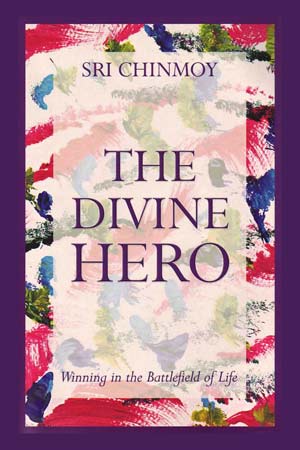
The Divine Hero by Sri Chinmoy
by Sharani RobinsSri Chinmoy’s book on spirituality, The Divine Hero, boldly encourages us to embrace the challenge of living as a hero – to bravely embark on a spiritual journey and discover that “we came from the Blissful. To the Blissful we shall return with the spontaneous joy of life.” The Blissful to which he refers is the spark of God deep inside waiting to be revealed and manifested.
Each one of us has a special role to play in God’s “divine game” but rarely do we achieve it. What keeps us from knowing and expressing these profound truths? Sri Chinmoy states it is because “in each human being there is a constant battle going on between the divine and the undivine.”
This book provides a detailed exploration of this interplay of light and darkness within ourselves and in the world around us. A definitive guide to both the barriers and helpers which “transform our suffering into joy and our darkness into light,” an entire chapter is devoted to each tool that helps us win in the battlefield of life. These helpers are simplicity, sincerity, purity, aspiration, dedication and surrender. Likewise, he sheds light on the qualities which create serious obstacles in our journey towards self-conquest: insecurity, fear, doubt, lethargy and self-indulgence.
As we read about these issues all too recognizable in the frustration they cause in our lives, Sri Chinmoy patiently and convincingly insists that if we can discover and manifest our unique divine mission on earth, satisfaction is bound to dawn in our life.
He encourages us in our mighty conquest by assuring us that “the path of world-acceptance is undoubtedly the path of heroes. We have to fight against doubt, worry, fear, obstruction, limitation, imperfection, bondage and death. But if we really love God, then nothing is difficult. Everything becomes very secure and safe. This is the easiest and most fulfilling path for the sincere, for the totally dedicated, for the brave souls who are ready to walk, march, run and fly along the path of Eternity.”
The style of Sri Chinmoy’s writing encourages confidence as well. While the book offers an in-depth treatment of lofty and profound spiritual concepts, it is rooted in understandable language and includes instructional stories, poems and aphorisms. All in all, The Divine Hero is a potent tool that inspires bravery at the same time that it demystifies life’s thorniest difficulties. Once read, you will be inspired to dive deeper in your own hero journey.
Sharani Robins Rhode Island, USA
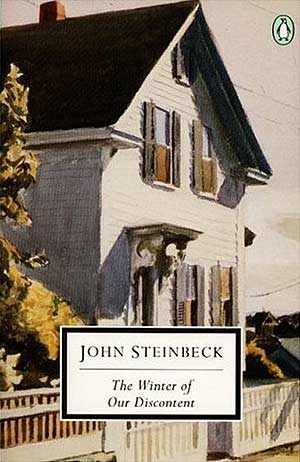
The Winter Of Our Discontent by John Steinbeck
by Alf ZolloSteinbeck: a mighty icon of American literature with a prolific output. A close observation of this life lived in words allows us to trace the personal evolution of the author. His best-known works are The Grapes Of Wrath and Of Mice and Men. The Grapes of Wrath is a testament to unyielding sorrow and Of Mice and Men deals convincingly with hope and disillusionment. The Winter of Our Discontent arrives to herald the triumph of hope. We can discover in it the song of the heart’s victory.
It is the story of a man living in a small town in New England. His name is Ethan Hawley. A man without a lot of ambition, he lives a simple existence but feels burdened by the many obligations imposed upon him by his family, friends and community. The seeds of self-betrayal are sown when he asks himself, “Suppose for a limited time I abolished all the rules, not just some of them. Once the objective was reached, could they not all be reassumed?”
His choice is to discard the voice of conscience in the pursuit of power. Once he betrays his own ideals he finds himself betraying his best friend, his wife and his boss. All of these events serve as a mirror to the social change occurring in America. Steinbeck uses Hawley’s experiences to critique the preoccupation of contemporary western societies with money and power. This aspect of the book is illustrated by his own son’s involvement in a competition and the outcome.
Ethan is a man who takes refuge in his own inner life. His being is populated with characters from his past that he calls upon for advice. There is a Great Aunt and the Old Captain who represent aspects of his own experience and wisdom. He defers to them in times of need, conversing with them in the moments before sleep when the boundaries of other worlds become elastic to consciousness. These intriguing passages show the fertile power of imagination and its sustaining quality in human life.
Within the book, there are contradictory representations of women. On the one hand is Ethan’s nurturing, patient, sweet wife, whom he adores but is unable to fathom. She represents Mother Nature, with all its vast reserves of patience and tolerance. At the opposite extreme is the calculating Margie, who seeks only to exploit others in all her relations. Between these two representations is Ethan’s own daughter, yet to blossom into womanhood. She serves as the catalyst to save him when he finds himself devastated by his actions and incapable of living in his world.
We are with Ethan when he realises that the hopes and dreams at the core of each heart is what ties human beings together — despite the apparent loneliness of life. The vicissitudes of existence are wont to obscure them but briefly. At the end of the book, we climb out of the “mind-prison” with Ethan and know that the strength exists within us to continue our journey despite the past. This is our destiny.
Steinbeck was deservedly garlanded with the Nobel Prize for Literature the year after The Winter of Our Discontent was published. Even the casual reader will find much in it to appeal - Steinbeck has a wonderful ability to reveal the layers of humanity we all possess. I hope you enjoy this book.
Alf Zollo Canberra, Australia
The Tale Of Genji: The World's First Novel
by John-Paul GillespieWritten by the Japanese noblewoman Murasaki Shikibu in the early eleventh century, The Tale of Genji is a classic work of Japanese literature concerning the son of a Japanese emperor, his romantic life and the customs of aristocratic society at the time. Called alternatively the world's first novel, the first modern novel or the first novel to be considered a classic; precisely which is a matter of debate by those who make a living debating such things. Nobel Prize winning novelist Yasunari Kawabata named The Tale of Genji "the highest pinnacle of Japanese literature. Even down to our day there has not been a piece of fiction to compare with it."
The Tale of Genji was written for Japanese women of the yokibito, or aristocracy, and possesses many of the elements found in novels today: a central character, major and minor characters, well-developed characterisation, psychological insight, complexity, sequential events taking place upon a timeline based upon the central character's lifetime. Rather than using a plot, events just happen and characters evolve simply by growing older, much as in real life. The internal consistency of Genji is a notable feature, and evidence of Murasaki's skill; all characters age in relation to each other, and relationships between them remain consistent throughout chapters.
Unusually, none of the characters are referred by name in the novel, a complicating factor for modern readers and translators alike; they are referred to instead by their function, role, honorific or relation to other characters; for example 'Minister of the Right,' 'His Excellency' or 'Heir Apparent.' Lack of names was a feature of Heian era court protocol, which decreed their use in a public forum as unacceptably familiar.
There is debate over how much of the Genji was actually written by Murasaki Shikibu herself, with some of the novel's later chapters containing discrepancies in style and rare continuity errors, with scholars suggesting that Shikbu's daughter Daini no Sanmi may have completed the novel. A further complication is the fact that the tale ends abruptly, in mid-sentence, probably not as intended by the author herself.
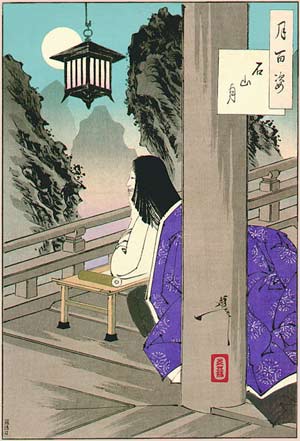
Written to entertain women of the aristocracy in eleventh century Japan, the novel employs Heian period court Japanese: highly inflected language with extremely complex grammar. Poetry is often used in conversation, as was the custom in court life, with classic poems modified or rephrased according to the situation at hand. Of the classic Japanese tanka form, the poems would have been well known to the intended audience, and are often left unfinished as if thoughts unsaid, the reader expected to complete a word or sentence— a complicating factor for a modern readership unversed in Heian era poetry.
Intended for a female audience and by a female author, the novel was written entirely in Hiragana script, so-called a "women's hand" at the time. All official documents, essays and works of history were written in Chinese characters and only by men, producing the paradoxical situation where men wrote mostly in bad Chinese while their spouses produced excellent works in native Japanese. Women's prose and poetry from this period, of which The Tale of Genji is pre-eminent in same manner as Shakespeare in English, form the basis of what in time became a truly national literature, as poets switched from Chinese to the new Japanese scripts for their elegant simplicity and flexibility.
John-Paul Gillespie Auckland, New Zealand
The Year of the Horse by Sam Mahon
by Barney McBrydeEvery weekday morning in 1984 I rose and drowsily guzzled down my lumpy porridge before pedalling off across the dark and sleepy city to Canterbury University. I could do the whole distance with my arms folded if I put my mind to it. Once there, I laboured to the very top of the James Height Library Tower, to the rarefied realms of the Classics Department, where, in a little room at the end of a corridor, a small group of students gathered around she who was called ‘Kate’ by the fearsome Professor Lee, but who we deferentially addressed as ‘Dr Adshead’. She sat there each morning in her neat hounds-tooth suit and taught us ancient Greek.
Ah! To read Plato and Sophocles in their original tongue; to leaf through the New Testament and read the words of Christ in the language they were written in!
It is interesting to note that one of the reasons that the upper, educated classes of ancient Roman society did not noticeably adopt the new religion of Christianity was that they found its scriptures to be offensively badly written. To ears attuned to the high rhetoric of Cicero, the poetic flights of Virgil, the ancient exactitudes of the Greek philosophers; the mundane and pedestrian narrative of events in distant Palestine held little appeal. The jottings of provincial tax collectors and fishermen did not appeal to the literati of the glittering capital of the world. Today people expound upon the glorious literary heights of these same scriptures. How our standards have fallen since the days of Cicero and Pliny! But we live now in the post-literary age. The twenty-first century wants a picture to look at not a text to read. On the BBC the experts discuss the ‘YouTube generation’ wherein a thousand words in not even an option.
I was recently in a bookshop and my eye chanced upon a startling volume – ‘The Manga Bible’; the attenuated Japanese figures of Christ and His disciples ‘biff’-ing and ‘pow’-ing across the pages. There it was: Cicero’s worst nightmare – an age in which the words that he and his ilk had found so wanting were considered just too high flown and demanding that they needs must be whittled down to a few pictures with speech bubbles. I picked it up and leafed through it. “Coooool. Colon, close brackets,” I thought, in my best post-literary fashion.
If nobody reads a book with words in, what then is the point of a book review? A book review, surely, is merely a formalisation of that most natural responses to reading a good book: telling your friends about it and encouraging them to read it, that they may share the experience which you have had with the book. If nobody reads, we could spare ourselves the trouble of producing a book review.
But wait! There remains one place on earth wherein the book still reigns, where literature is treasured and valued. There is a place where the citizens buy and read more books than in any other place on the globe. Where is that place? Surely some cultured nation steeped in the ancient traditions of literature. In the shadow of the Acropolis? On the banks of Shakespeare’s Avon? In Dostoevsky’s Russia? The cafes of Paris where the greats of French literature once gathered? No. The nation where the book is read most is . . . the land of rugby and beer, the pioneering land of the rugged laconic outdoors man, the land of the hardy sportsman and the gimlet-eyed mountaineer, the land where sheep outnumber humans by 20 to 1 – New Zealand.
This being the case, if we are to review a book – best that we consider a book by a New Zealander.
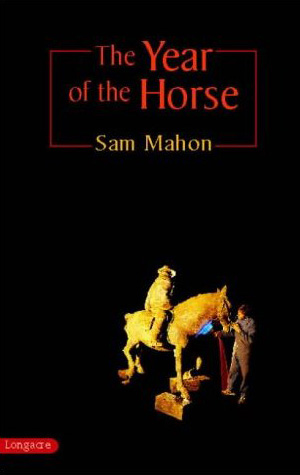
If you fly into Dunedin – the small city which is the centre of the southern half of New Zealand’s South Island; the city called ‘the Edinburgh of the South’ for its origins in Scottish settlement, not to mention its bleak weather and dour inhabitants – you exit the airport terminal building and cannot help but notice to one’s left a life-size bronze statue of a man on a horse. In another country an equestrian statue would be of some pompous national hero or military figure from the past, noted for his skill in butchering the enemies of his homeland. Here it is of a rough shepherd mounted on a rather tubby old work horse. The statue has been there for some years now. There are those who have never liked it much, but since we aim here at a book review and not art criticism let us pass by without expressing any judgement. The work was sculpted by a noted New Zealand sculptor: Sam Mahon. ‘Noted sculptor’, but one might add ‘noted author’. Sam Mahon’s first book was called The Year of the Horse and is an account of the year in which he was commissioned to produce the horse, constructed it, cast it and installed it. So far so dull, but Mahon is an artist of words as much as of clay and metal. His account is more like a poem than dull prose. The life of art, the life of rural New Zealand, the ethos that New Zealanders admire and excel at of mucking in and getting things done with a welding torch and a piece of number eight fencing wire – it all sings from the pages, as does his love of the river; the mountains; the sky; the hard, tough grind of making art.
I have long maintained that the greatest sentence ever written was Tolstoy’s describing the death of Anna Karenina. There is a sentence in The Year of the Horse that, for me, challenges the primacy of that sentence. You will have to read the book yourself. I recommend it. And what is the alternative – the Manga Bible?
Barney McBryde Auckland, New Zealand
An Extraordinary Egg by Leo Lionni
by Mahiruha KleinOne of the most interesting courses I took in college was devoted to children’s literature. It was so interesting because it was totally different from my expectations. I thought books for children should be light, fun and easy to read.
The professor, an amazing scholar and thinker, explained to us that really great literature for children is exactly that- real literature. People who write good books for children seek first and foremost to write; and they write out of a love of language or a need to communicate their ideas. Their books are works of art.
Bad children’s literature, on the other hand, is clumsy, cutesy, redundant and intellectually offensive to children and adults alike. I can reel off a list of books and movies for kids which fit these adjectives to a tee!
Of all the writers we studied, I came away most impressed by two: Maurice Sendak and Leo Lionni.
Maurice Sendak wrote the wonderful Where the Wild Things Are as well as the incomparably great works We Are All In the Dumps with Jack and Guy and In the Night Kitchen.
I once saw a print of one of Sendak’s sketchbooks. It was filled with scribbles, miniature cartoons and interesting urban landscapes. Under each drawing or image, he wrote what piece of classical music he had been listening to while he worked. I was not surprised by this. His work is musical, fantastical and yet always convincing- heartfelt even in its most outlandish flights of fancy.
I went to the Queens Central Library the other day and picked up An Extraordinary Egg by Leo Lionni. It is a story about three frogs, Marilyn, August and Jessica. Marilyn, the oldest, “knows everything about everything”. August keeps silent in the story, he is just an observer. Jessica, the youngest frog, is an explorer, a restless wanderer. One day she finds what she thinks is a pebble, unusually white and smooth.
When Jessica eagerly rolls the pebble back to where the three frogs live, her sister Marilyn informs her self-righteously that she hasn’t brought back a pebble, but a chicken egg. The egg hatches, and sure enough what emerges from it is an alligator. None of the frogs have ever seen an alligator themselves, so when the baby ‘gator emerges, Marilyn can crow triumphantly “I was right! It is a chicken!”
Jessica and the baby “chicken” become fast friends. The “chicken” can swim surprisingly well and even saves Jessica’s life one day when she waded into too-deep water.
Jessica and her little faux-chicken friend have lots of good times together until one day a little multi-colored bird spots them and lands right beside them. It tells them that Little Chicken-Not’s (my phrasing!) mother has been looking desperately all over for her. The bird guides the two friends to where her mother, a giant alligator, is taking a siesta. Upon sensing their presence, she “slowly opened one eye, smiled an enormous smile, and, in a voice as gentle as the whispering grass said, ‘Come here my sweet little alligator.’”
Jessica tells her buddy that it’s time for her to go, but asks her to come visit her and the other frogs soon, and to bring her mother with her. When she returns home, she tells her friends that the “chicken’s” mother referred to her daughter as a “sweet little alligator.” The story ends with the three frogs doubled over with laughter, as her mother can’t tell that her own offspring is really a chicken, albeit a green chicken with scales, a long tail and razor sharp teeth.
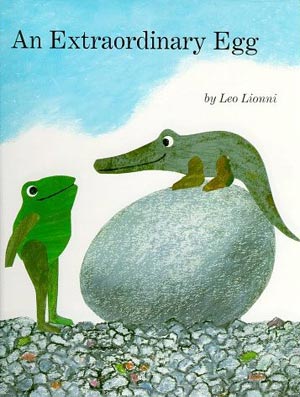
Like almost all of Lionni’s stories, this book encourages the reader (not necessarily only the child reader) to examine and to question authority. I mean, Marilyn thinks she “knows everything about everything” but she’s actually just ignorant and decisive- a good recipe for disaster!
There’s something mysterious and elegiac about Lionni’s use of color which reminds me of Gaugin. I especially like the way he shows the impact of light by lightening or deepening colors- especially greens- from frame to frame.
He also uses color to imply emotion. When Jessica first rolls the “pebble” up the little mound where the frogs live, the cluster of flowers on the top of the mound are rendered in deep but brilliant crimson, with a rich blue light between the stems to bring out the effect of the red. On the next frame, the reddish color is airier and more subdued, and there is no more blue color between the stems; the frogs have recovered somewhat from the surprise that this newly discovered egg has brought them.
I really admire and enjoy the stillness and dignity of Lionni’s writing. Towards the beginning of the book we have this beautiful passage: “One day, in a mound of stones, she found one that stood out from all the others. It was perfect, white like the snow and round like the full moon on a midsummer night.”
I like Lionni’s use of symbolism and imagery. When Jessica and her friend encounter the mother alligator, we see the same red tulip-like flowers again- perhaps indicating the degree of their surprise or alarm. The title An Extraordinary Egg is intriguing because of the connotation of eggs, and what comes from them- in this case, chickens. Eggs can be symbolically associated with many things, including life, dreams and mystery. Chickens are associated with sacrifice. It’s interesting how Marilyn, the know-it-all, puts all of the frogs in mortal danger by being so sure of the alligator’s identity. I mean, the story ends with Jessica and her friends laughing about how the mother alligator could be so stupid in miscalling her child “alligator”; but the joke is emphatically on them!
Sendak and Lionni are two great writers whose books surprise and enlighten children and adults alike with their depth and vision. I’ve certainly grown as a human being by reading and enjoying their work.
Mahiruha Klein Philadelphia, USA
Inspiration-Letters 8
Great Poets Issue
Dear Reader,
 I think great poetry is usually simple and sincere. It comes from the heart and it touches our heart because it is honest and true. Even great epic poetry or the great poetic Shakespearian tragedies endure in our conscious appreciation because they show us what life is. If great poetry often describes great people and great events, it also always allows us to step into those roles, to feel what they feel.
One famous commentator said that he feels that it is because of Shakespeare’s compassion that he is still remembered and loved. I think he is right because when I read Shakespeare’s vast work, I see how deeply he inhabited all of his characters. Their joys and, often, untold sorrows became his own.
Sri Chinmoy has written nearly one hundred thousand poems, an amazingly prolific output no matter which standard we might choose to apply. I like his poetry for its tremendous variety and scope. At the start of his literary journey, now more than half a century ago, he chose a lyrical, imagistic style to convey his ideals and experiences. More recently, he has adopted a more aphoristic expression. These newer poems are usually concise but compact, and they speak with an understated power.
I like what Ralph Waldo Emerson wrote in his essay entitled ‘Nature’ (1836), “To speak truly, few adult persons can see nature. Most persons do not see the sun. At least they have a very superficial seeing. The sun illuminates only the eye of the man, but shines into the eye and the heart of the child. The lover of nature is he whose inward and outward senses are still truly adjusted to each other; who has retained the spirit of infancy even into the era of manhood.”
Emerson is stating here that when children see the sun or beauty in the natural world, that that beauty actually becomes a part of them; they assimilate it in the depths of their being. Good poetry is practical. It becomes a part of us and it teaches us how to live.
Maybe that’s why the holy scriptures of so many different traditions are often great poetry. I’d be hard pressed to find a greater epic poem than the Bhagavad Gita, or more heart-wrenching lyrics on love and loss than the Song of Songs. The many narrators of the Gospels assume a simple, reportorial style that is moving for its frankness and humility.
Sri Chinmoy wrote in 1962 that “In the bright days that are dawning upon the earth well may we look for the leaven of transcendental poetry to uplift the whole human mass.”
The idea of referring to poetry as “leaven” is very interesting. Leaven is something that will help us to rise and to grow into our truest, fullest selves. I suppose that this is the loftiest aspiration of poetry.
For people interested in Sri Chinmoy’s poetic work, I would eagerly refer them to his wonderful Seventy-Seven Thousand Service-Trees Series, which is at this writing more than halfway completed.
This series belongs to his recent, pithy style of simple and often instructional verse. They are far from didactic, however, as they express universal truth with deep feeling and imagination. Some of the poems hit home without the use of imagery:
Humanity’s patience
Is wearing thin.
This is, indeed,
A great tragedy.
–Sri Chinmoy
(Seventy-Seven Thousand Service-Trees #20385)
In other poems, he incorporates vivid imagery:
There is no bird above me.
There is only one blue-gold bird
Inside my heart,
And its name is my soul.
—Sri Chinmoy
(Seventy-Seven Thousand Service-Trees #9764)
And, in some of these poems, the imagery is implied:
The wisdom of all the sages:
Never see darkness
In any human being.
—Sri Chinmoy
(Seventy-Seven Thousand Service-Trees # 32,679)
God’s first Smile was born
The day humanity awoke
To His Light.
—Sri Chinmoy
(Seventy-Seven Thousand Service-Trees #1421)
Our comedies reach God’s Mind-Door.
Our tragedies reach God’s Heart-Room.
—Sri Chinmoy
(Seventy-Seven Thousand Service-Trees #23138 and #23139)
In Macbeth’s eulogy to his wife, Shakespeare also expresses intense, visceral feeling almost without any images at all:
She should have died hereafter.
There would have been a time for such a word.
Tomorrow, and tomorrow, and tomorrow,
Creeps in this petty pace from day to day
To the last syllable of recorded time...
—William Shakespeare
In an article I wrote for the Sri Chinmoy Inspiration Group, I discussed the mantric power and grace of Sri Chinmoy’s poetic work in some detail.
While in prose, it’s the content that matters, in poetry, it is the graceful struggle between form and function which gives it its unique thrill and interest.
I like what Rabindranath Tagore said on poetry: “I wonder why the writing of pages of prose does not give anything like the joy of completing a single poem. One's emotions take such perfection of form in a poem, they can be taken up by the fingers, so to speak. While prose is like a sackful of loose material, incapable of being lifted as you please.”
I wish the reader good luck in finding good poetry, whether it be in the form of a poem, or a noble sacrifice, or an amazing insight into what life really means.
I cannot resist the temptation to close with Walt Whitman’s conclusion to his masterpiece, Leaves of Grass:
I bequeath myself to the dirt to grow from the grass I love,
If you want me again look for me under your bootsoles.
You will hardly know who I am or what I mean,
But I shall be good health to you nevertheless,
And filter and fibre your blood.
Failing to fetch me at first keep encouraged,
Missing me one place search another,
I stop somewhere waiting for you.
—Walt Whitman
Further Reading
www.poetseers.org
www.writespirit.net
www.srichinmoylibrary.com
America In Her Depths by Sri Chinmoy | SriChinmoyLibrary.com
Mahiruha Klein
Editor
Title photograph: Other Lives by Pavitrata Taylor
Sharani Robins
Rhode Island, USA


Emily Dickinson referred to herself as a pagan. Some biographers would go so far as to label her a druid for her worship of nature. But was this apparently stubborn heathen life really built on atheism?
On the surface what seems a blatant rebellion against the Christian reforms sweeping New England in the 19th Century could be misinterpreted as a lack of spiritual inclination. If we look beneath even a single veneer we will undoubtedly find true spirituality at the heart of her endeavour; far from snubbing God, but simply insisting on no less than a first-hand experience of Him.
The poet shunned religious doctrine, but did she shun religion? Certainly not as a whole, and even then it may be merely a matter of syntax. The words 'religion' and 'spirituality' may at times be used interchangeably, and at others a fine distinction must be made. Charles Anderson chooses to make no distinction, using the word 'religion' in its broadest, and perhaps most primal sense:
"The final direction of her poetry, and the pressures that created it, can only be described as religious, using that word in its 'dimension of depth.'"
Emily inherited the Puritan traits of austerity, simplicity, and practicality, as well as an astute observation of the inner self, but her communication with her higher Self was much more informal than her God-fearing forefathers would have dared. The daughter of the 'Squire' of Amherst, she came from a line of gritty, stalwart pioneers, carrying what was almost considered the blue blood of America. Her family was far from poor, but she did not lead a lavish life, for the Puritans abhorred luxury and waste (even a waste of words, which trait the poet may have done well to inherit).
She accepted the Puritan ideals of being 'called' or 'chosen' by God, and fully embraced the merits of transcending desire, but not the concept of being inherently sinful:
"While the Clergyman tells Father and Vinnie that 'this Corruptible shall put on Incorruption' it has already done so and they go defrauded."
She had faith in her own divinity, so perhaps she was yet more certain of God than her peers. She did not claim to fully understand Him, or even to have perennial faith in all His Ways—her poetry bears a continuing strain of doubt—but she certainly did not fear Him. The inner freedom this afforded her—rare for a woman of her time—brought her to the point of being almost cheeky in her familiarity and certainty. This confidence fed her poetry sumptuously, and gave it the well-known child-like quality. To her, truth was in nature. In that beauty she could see and feel God directly:
"Some keep the Sabbath going to Church —
I keep it, staying at Home —
With a Bobolink for a Chorister —
And an Orchard, for a Dome —
Some keep the Sabbath in Surplice —
I just wear my Wings —
And instead of tolling the Bell, for Church,
Our little Sexton — sings.
God preaches, a noted Clergyman —
And the sermon is never long,
So instead of getting to Heaven, at last —
I'm going, all along."
Emily did actually attend church regularly, sometimes traveling to hear some of the rousing and charismatic preachers who stamped their mark on that era. She was often moved by these sermons, perhaps as compelled by the speaker's delivery and the construction of words as the message within them. But this was not enough to entice her to succumb to the fierce religious revival. One by one her friends received an inner calling and were 'saved,' officially accepting Christianity. Members of her close-knit family eventually followed suit, including her strong-willed father, and finally her brother, Austin, perhaps her closest ally. Emily would not commit to something she could not sincerely feel, even under the unthinkable social pressure that surrounded her.
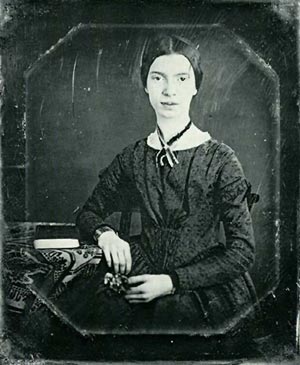
Until the age of 30 she continued going to church, although she was excluded from certain meetings and services open only to those who had been 'saved'. She became increasingly reclusive throughout her 30s. It is tempting to see her seclusion as further evidence of spiritual asceticism. Her spiritual path was certainly intensely lonely in such a social climate, but she craved aloneness more and more, and seclusion somehow formed a symbiotic relationship with her art. Increasingly her art became an expression of her spirituality.
Immortality ("the Flood Subject" as she called it) consumed Emily's consciousness. Dwelling on death was natural in those times as illness and general hardship frequently took lives around her, her awareness heightened further by the many years spent in a house adjoining a cemetery. But dwelling on death was also almost a spiritual practice, a 'graveyard meditation,' a means of focus, breathing life into the concepts of Eternity, Infinity and Immortality.
Poet and philosopher Sri Chinmoy said of the poet:
“Emily Dickinson wrote thousands of psychic poems. One short poem of hers is enough to give sweet feelings and bring to the fore divine qualities of the soul.”
“With a deep sense of gratitude, let me call upon the immortal soul of Emily Dickinson, whose spiritual inspiration impels a seeker to know what God the Infinite precisely is. She says:
“The infinite a sudden guest
Has been assumed to be,
But how can that stupendous come
Which never went away?’”
What drove her consistently was that she needed truth, and at any cost. She needed to see it with her own eyes and feel it with her own heart, not grasp at it in the words of a clergyman but explain it to herself through her own words. It seems she was even ready to die for her cause:
"I died for beauty, but was scarce
Adjusted in the tomb,
When one who died for truth was lain
In an adjoining room.
He questioned softly why I failed?
“For beauty,” I replied.
“And I for truth, -the two are one;
We brethren are,” he said.
And so, as kinsmen met a night,
We talked between the rooms,
Until the moss had reached our lips,
And covered up our names.”
Emily's truth-seeking was a spiritual quest that governed her inner life, and naturally blossomed through her poetic works. Her own words, in a letter to a friend, succinctly claim Eternity and Immortality as her own. Perhaps they also presage the enduring spiritual appeal of her writing, far beyond the short span of her life:
“So I conclude that space & time are things of the body & have little or nothing to do with our selves. My Country is Truth.”
Sumangali Morhall
York, England
At the end of the last century, BBC Radio conducted a survey to choose the greatest songs of the past 100 years. When the votes were counted, the number one song was “Yesterday”, credited to the great songwriting team of John Lennon and Sir Paul McCartney (though as most fans of the duo would know, that particular song was all McCartney’s work). Music critics often talk about a “perfect” pop song. So what made this one more perfect that anything else?
Surely it was the melody. In a story he used to enjoy repeating, McCartney heard it in a dream, and awoke with some deeply inane lyrics: “Scrambled eggs” was his original title. He changed the lyrics not due to profound inspiration, but because they matched the tune.
The three-minute popular song, the one that echoes in your head, has long been a standard. With the songs that have lasted the decades, the melodies can be sublime, or at least wonderfully catchy. The lyrics, however, are usually less than profound, inserted so that we have something to sing rather than simply hum. In a love song, we can somehow predict that anyone who is waiting (or indeed, waitin’) will also be anticipating (or anticipatin’), simply because it rhymes. Common, two-syllable words will miraculously gain extra syllables, in order to match a tune, when phrases like “doo-be-doo” and “sha-la-la-la-la” simply won’t do. Most of it isn’t really poetry – or at least, the “poetry” is no weightier than the nonsensical limericks of Edward Lear.
But there are exceptions. Just as some great pop songs have been written by great composers, they have also been the work of great lyricists. It seems terribly unfair to discover that, in some cases, a songwriter has been miraculously blessed with both capacities. Yet some of the great pop songs have demonstrated such genius.
Like Keats and Shelley (or Mozart and Chopin), many of the great songwriters peaked while they were young. The melody of “Yesterday” might have single-handedly elevated it to greatness, but McCartney demonstrated a penchant with both music and poetry when he wrote “Hey Jude” four years later. At the time, he was 25. There was nothing complex about this song. Both music and lyrics were disarmingly simple. Advice for a friend, an offer of consolation.
“Hey Jude, don’t make it bad.But how could poetry appear in a pop song? Aren’t such songs constrained by a melodic structure? Moreover, aren’t they simplistic by their very nature? Shouldn’t great poetry be complex, in order to be deep?
Take a sad song, and make it better.”
Some would say so. Some would say that pop songs “cheat”, using music to add strengthen to their poetry. But at times, it is the very simplicity of pop music, in all its notoriety, that makes a song so powerful.
Paul Simon was 26 when he wrote “Bridge Over Troubled Water”. Another ode to friendship. Another song whose lyrics and melody merge perfectly.
“When you’re weary, feeling small,Once again, simpler than the simplest – and when combined with Simon’s melody, powerful enough to leave a strong person shaking like a leaf. The lyrics make a beautiful tune even more moving than it would otherwise be. The music takes the lyrics and turns them into poetry. Music lovers have long thumbed their noses at the shameless simplicity of pop music, preferring to analyse their Rachmaninov or their Wagner. In some cases, however, simplicity makes a song profound.
When tears are in your eyes, I will dry them all.
I’m on your side, when times get rough.”
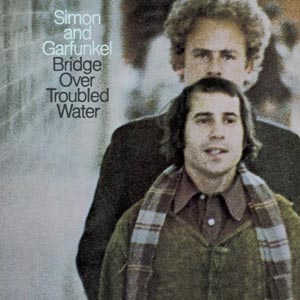
Pop songs were not always so simple. The first popular song, using the imperfect logic that “popular” means sales of over a million copies, was “After the Ball”, written by a songwriter-for-hire named Charles K. Harris. In 1892, it sold five million copies of sheet music. (Recording technology wasn’t quite advanced enough at the time.) Though Harris could neither read nor write music, he worked out the rather sophisticated tune on his banjo. It was a love song, but with considerably more detail (in both words and music) than “Yesterday” or “Hey Jude”, or indeed, most popular love songs you can name from the past seventy years. It told a story: Boy meets girl, boy sees girl kissing another man, boy feels cheated and leaves, girl dies of a broken heart because she loved boy deeply the other man was only her brother. (Yes, the story even had a twist worthy of Saki or O Henry.) Songs at the time were far more complex creations, in which each verse advanced a tale of misery or joy.
Harris survived on the royalties of “After the Ball”, so he never needed to write another song. (In the days of sheet music, he was perhaps a precursor to the “one-hit wonders” of later decades.) Yet “After the Ball” survives. Chances are you can hum it, or at least recognise the melody. The same probably can’t be said of other popular songs from the 1890s. They might have caught the mood of the time, and had beautiful tunes, but did they have the perfect blend of music and lyrics that Harris’s composition can boast?
“Many a heart is aching, if you could read them all. Many the hopes that have vanished, after the ball.”Of course, it will never be known whether Harris had the capacity to write more than one great song. But the greatest songwriters, masterful as both poets and composers, are still an exclusive group. Irving Berlin was a superb tunesmith, and could certainly think up catchy lyrics to go with his melodies, but he wasn’t exactly a poet (even if “no business” and “show business” make such a contagious rhyme). Bob Dylan wrote scores of powerful lyrics, but less powerful tunes. Some of the most celebrated composers in the songwriting world – George Gershwin, Richard Rodgers, Elton John – usually had others to write their lyrics.
Yet the idea that popular music is too simplistic for poetry is, well, overly simplistic. It is in simplicity that some of the world’s great poetry has been revealed. Moments of poetic brilliance can be heard almost everywhere — and occasionally, they have even been heard in the Top 40.
Noivedya Juddery
Canberra, Australia
Once, long ago, I could be found every Monday night in the lounge bar of the Albion Tavern on Wellesley Street across from St Matthews-in-the-City. It was ‘Poetry Live’ night. It must be admitted that the poetry interested me a lot less than the beer did. Admittedly, after a couple of pints of Lion Red the poetry did seem to get quite interesting too. (Of course, after accepting the spiritual life seriously, I completely gave up alcohol). My friend Nick was a poet and would read his work there.
Were any of the men and women at the microphone on those nights, sending their verses out across the smoky, alcoholic air, ‘great poets’? Some of them were ‘famous poets’ but who could judge if they were great? Probably only another great poet could tell – certainly I couldn’t; I could only tell that the beer was good.
I had come across a few poets who I thought might be pretty great.
The fact that Gerard Manley Hopkins was a Catholic priest gave him a certain appeal for me, but it was the sheer voluptuousness of his language that hooked me when we studied his verse in my last year at school.
...Down roughcast, down dazzling whitewash, wherever an elm arches,Later I stumbled across John Betjeman. Whether the fact that he was the Poet Laureate—charged to write on demand for the Queen—meant he was really a great poet or meant that he was really not a great poet, I couldn’t judge, but to me he was great for he could make one nostalgic for days which one had never lived; wistful for a lost era which one had never experienced. I never had a nanny; I never grew up in that England of public schools and misty cycle rides on the heath, but having read his poem of that name, how could I not fall in love with ‘Myfanwy’—with the wide-eyed, adoring love of a child?
Shivelights and shadowtackle in long lashes lace, lance, and pair.
Delightfully the bright wind boisterous ropes, wrestles, beats earth bare
Of yestertempest’s creases; in pool and rut peel parches
Squandering ooze to squeezed dough, crust, dust; stanches, starches
Squadroned masks and manmarks treadmire toil there
Footfretted in it. Million-fueled, nature’s bonfire burns on.
But quench her bonniest, dearest to her, her clearest-selved spark
Man, how fast his firedint, his mark on mind, is gone!...
Then what sardines in half-lighted passages!
Locking of fingers in long hide-and-seek.
You will protect me, my silken Myfanwy,
Ring leader, tom-boy, and chum to the weak.
At University I studied Classics. I read and studied the work of many Greek and Roman authors long judged to be great, but the one who struck me most was Virgil—Publius Virgilius Maro. Of the epic writers, it was cool to prefer Homer, but I recall sitting in the kitchen of my flat in Christchurch when my flatmates were—thankfully—out, the tears streaming down my face as I read Book II of Virgil’s Aeneid—his account of the fall of Troy.
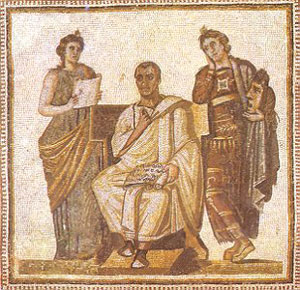
The poem had been written 2,000 years before I read it; had been written in a world completely alien to my experience and about events ancient and lost even then; had been written at the command of a dictatorial ruler (Augustus) as a straight piece of propaganda to bolster the legitimacy of his government, and yet... and yet it hit me with a visceral impact. It spoke across ages to the universal human experience. Sir Laurens van der Post once asserted that all humans are psychologically either Greeks or Trojans. I had no doubt which I was as I hunched weeping over the pages of Virgil, reading of the destruction of my home town.
It certainly seemed that a trend was emerging in poets I considered great. It helped to be dead!—and perhaps—judging from Virgil—the longer the better.
The poets at the Albion Tavern on a Monday night seemed to be perhaps a little too alive to be great.
When I spoke at the funeral of my friend Nick I said:
‘...But Nick always seemed to me a quester after truth. He would never confess to have found any or even claim to know quite what it was but, like a figure in a fairy tale, he followed the tracks of that truth. He pursued it, and those glimpses of it through the trees - glimpses that we read about in his poems—those glimpses inspired him to keep pursuing it. He pursued it with a sincerity and a seriousness that may have masqueraded as frivolity but was real...’Perhaps now, nine years in his grave, he too begins to inch towards greatness.
Once he wrote:
I walk not alone,
But hand in hand
With the child
That I also am,
Who chatters
And wonders;
Whose fears
Shake me,
Whose innocent,
Watching eye
Can fill
Mine with
Tears.
Barney McBryde
Auckland, New Zealand
“I'm suggesting poetry or Great Poets as the theme for this upcoming issue of Inspiration-Letters.”
“Hah!” the involuntary sound originated deep in my belly. This month’s topic is out of my league. The exclamation was exasperation. I like poetry but do not go out of my way to pick up a book unless it is one written by Sri Chinmoy or Panorama, a semi-annual book written by my fellow students of Sri Chinmoy. I have, ahem, contributed.
With the wave of a hand, I put the idea of an article out of my mind. Then, I remembered Hafiz.
I came home one day to find a surprise in my mailbox. A friend from the past sent me a copy of I heard God Laughing: Renderings of Hafiz by Daniel Ladinsky. Who is this Hafiz? I dismissed the gift and sung-sighed, “A poetry book, great.”
Some days, maybe even weeks later, on a deeply troubled night, I randomly picked it up from the pile of unread books on the floor beside my bed. I looked at the face of the man in the illustration. I first saw Hafiz as being bent over, but when I really looked that was not so. Bent over is not befitting Hafiz. Instead, he was serenely sitting next to a stream holding a staff and petting, of all things, a deer. Dressed in a long cloak and a hat embraced by a scarf, this old man with a well kept fuzzy beard had the audacity to be the personification of calm, have love in his eyes and a goofy, knowing grin. Why was this Hafiz smiling at me like that when I was feeling blue? Curiously, why was I feeling his love? “This is an illustration,” I told myself, “Get a grip.”
The very first words of Hafiz I ever read were:
“I wish I could show you,Stop, take a breath, absorb. I was stunned.
When you are lonely or in darkness,
The Astonishing Light
Of your own Being!”
Except for the poem, “The Absolute”, by Sri Chinmoy, few other poems I had read affected me to my core like these did. It could have been my vulnerable state at the time, but no. When I just typed them, I got the same feeling, deeply personal, deeply loved, as if Hafiz had written them solely for me to make it crystal clear my soul is astonishingly beautiful. Your soul is astonishingly beautiful. Could there be any greater wish as we struggle through the challenges of life today?
These few lines made me take stock and contemplate my soul from the standpoint of the beauty of the universal light and that it is my soul’s light that is the link to God, my true self. It gave me instant peace and joy to momentarily realize who each of us is: a spark of God.
Daniel Ladinsky, the interpreter of this volume of Hafiz’ ghazals says that each one is a short love song about the length of a sonnet. His interpretations of the literal translations of H. Wilberforce Clarke in 1891 are called “renderings”. Because of the difficulties in translating from Hafiz’ native Persian, Ladinsky endeavors to “reflect the sweetness and profundity” keeping the spirit rather than the form of Hafiz’ words. To this I say, “Bravo, well done. Mr. Ladinsky”. For one who can write with so much sincerity that the reader feels the heart of the words again and again hundreds of years after they were put to paper is the sign of greatness.
Hafiz lived c. 1320-1389 and continues to be a beloved poet in the Persian world. He was a wanderer and sung or recited his poetry spontaneously while others wrote it down. His insights appreciate the struggle of our never ending need to grow and transform from human love to divine love. His words convey the deep, universal love of what Hafiz calls the Divine Beloved who supports each and every human being whether we believe it or not. His writing has a light, playful tone which makes his profound poetry fun, clear and easy to read.
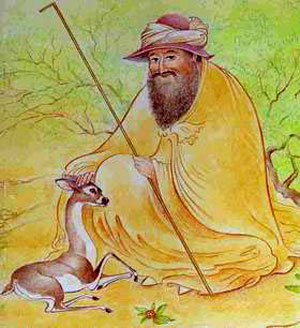
The following is the rest of the poem that the above verse belongs to and a few more selections from I Heard God Laughing.
MY BRILLIANT IMAGE
One day the sun admitted,
I am just a shadow.
I wish I could show you
The Infinite Incandescence (Tej)
That has cast my brilliant image!
I wish I could show you,
When you are lonely or in darkness,
The Astonishing Light
Of your own Being!
PULLING OUT THE CHAIR
Pulling out the chair
Beneath your mind
And watching you fall upon God—
What else is there
For Hafiz to do
That is any fun in this world!
YOU DON'T HAVE TO ACT CRAZY ANYMORE
You don’t have to act crazy anymore—
We all know you were good at that.
Now retire, my dear,
From all that hard work you do
Of bringing pain to your sweet eyes and heart.
Look in a clear mountain mirror—
See the Beautiful Ancient Warrior
And the Divine elements
You always carry inside
That infused this Universe with sacred Life
So long ago
And join you Eternally
With all existence—with God!
Palyati Fouse
Alaska, USA
The name of Sri Aurobindo will reverberate in the hearts of truth-seekers and poetry-lovers alike. As a spiritual Master and possessor of the highest states of consciousness he fed the spiritual hunger and quenched the spiritual thirst of countless aspirants who yearned for the fruits of the spirit. His silent, yogic gaze, wreathed in compassion, directed many a wandering soul to the Heart-Home of God. As a poet he conveyed the message and essence of the highest Reality through divinely inspired and soul-stirring words, illumining the searching mind and thrilling the aspiring heart.
Sri Aurobindo was a seer-poet par excellence. A seer-poet is he who not only sees and feels a higher and divine truth, but also is endowed with the capacity to make others see and feel that truth, by virtue of his inspired poetic voice. Sri Aurobindo is one of those rare, mystic poets whose words bring down a higher reality and by dint of their intrinsic mantric quality make that reality tangible and palpable. The words themselves build a world of spiritual perfection and awaken an inner urge in the aspiring reader to attain that heavenly kingdom, which resides deep within his own heart.
The voice of Sri Aurobindo’s poetry is powerful; the body of his poetry is subtle. His poetry is indeed steeped in satyagraha or soul-force, making it a splendid vehicle for spiritual upliftment and fulfilment. Each line rings with a melodious beauty; every stanza resounds with a powerful truth. When reading Sri Aurobindo, one sometimes feels a majestic greatness stir deep within:
“Rose of God, like a blush of rapture on Eternity’s face,
Rose of Love, ruby depth of all being, fire-passion of Grace!” [1]
Sometimes a deep, soulful and peerless beauty, as in these lines:
“Who was it that came to me in a boat made of dream-fire,
With his flame brow and his sun-gold body?” [2]
And always an all-encompassing and all-knowing wisdom, born of inner mystical experience:
“This world behind is made of truer stuff
Than the manufactured tissue of earth’s grace.” [3]
Throughout his life Sri Aurobindo strove for a poetry which was loyal to the inherent and natural laws of metre, rhythm and rhyme, yet was not bound by them in any immutable or rigid way. Sri Aurobindo studied metre extensively and composed many poems that followed new and previously unexplored schemes of metre in the English language. He devised his own set of laws for the proper use and purpose of metre. In his sublime essay “On Quantitative Metre” he exposes his theories, arguing that metre and poetic rhythm are not things to be caught in fixed, hard-and-fast rules of quantity, but should rather be subtle, flexible and willing to bend to the suggestions of the inner ear. He felt strongly that metre should serve the poetic inspiration by heightening and sublimating it, not vice versa by dictating and governing the poetic speech. As he himself so eloquently puts,
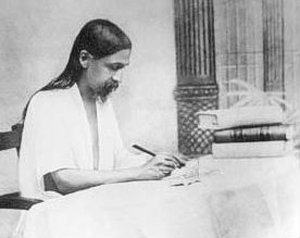
“The poet least of all artists needs to create with his eye fixed anxiously on the technique of his art. He has to possess it, no doubt; but in the heat of creation the intellectual sense of it becomes a subordinate action or even a mere undertone in his mind, and in his best moments he is permitted, in a way, to forget it altogether.” [4]
In his highly informative and thought-provoking book “The Future Poetry”, Sri Aurobindo gives his own enlightened ideas not only on the technique of poetry, but also on the very nature, essence and ultimate goal of poetry. The role of the poet then, according to him, is to serve as an instrument or a channel of the divine Ananda, the delight of the soul. The seer-poet is he who most succesfully brings down this delight from its higher regions into the essence and substance of his poetry. In Sri Aurobindo’s own words,
“A divine Ananda […] is that which the soul of the poet feels and which, when he can conquer the human difficulties of his task, he succeeds in pouring also into all those who are prepared to receive it.” [5]
One must read Sri Aurobindo’s poetry and read it again and again to fully grasp its richness, vastness and inner profundity. For the secret wealth of the soul is hidden within its lines. To read his poetry then becomes a spiritual exercise, nay, a spiritual experience, more than anything else.
Abhinabha Tangerman
The Hague, The Netherlands
[1] Excerpt taken from “Rose of God” by Sri Aurobindo
[2] Excerpt taken from “The Dream Boat” by Sri Aurobindo
[3] Excerpt taken from “The Inner Fields” by Sri Aurobindo
[4] Excerpt from “The Future Poetry” (pg. 12) by Sri Aurobindo
[5] Excerpt from “The Future Poetry” (pg. 11) by Sri Aurobindo
The best selling poet of America in 2006 was not Whitman, Dickinson, Frost or Emerson but a Sufi mystic; Jaluddin Rumi, who was born in Afghanistan, on the borders of the Persian Empire (Iran). Rumi is one of the best known Sufi poets but digging deep into the realms of Persian literature we find a wealth of Sufi poetry which even today retains a universal and timeless appeal.
Sufism is the mystical branch of Islam. It has its roots in the Qu’ran and the Islamic tradition, but at the same times encompasses the universal mysticism that we see in other spiritual traditions. The essence of Sufism is the simple path of loving God. The Sufi Masters sing of the all-pervading love which inundates their being when they become one with their “beloved”. If there is just one goal of Sufism, it is to overcome the attachment to the binding ego and attain liberation through realising one’s identity with God. And thus the Sufi poets speak of dying to be born again, a concept similar to other mystical traditions.
Often the great Sufi poets lived during times of religious fundamentalism. The authorities censored them, because they openly taught that man could have a direct contact with God. As a result poets such as Hafiz developed an increasing array of metaphors and synonyms to describe God. Frequently we come across references such as Friend, Beloved, Father, Mother, the Wine seller, the Problem giver, and the Problem solver. This ambiguity in describing God served a dual purpose. Firstly it made it difficult for his poetry to be censored for its unorthodox mystical ideas. It also illustrates the inherent difficulty a poet has in describing the nature of God. The infinite is beyond all name and form, how can the poet describe that which is beyond words?
In love, nothing exists between heart and heart.However, despite the difficulties of describing their experiences, the words of the Sufi Seers still tease, cajole and inspire us to look beyond the page and into our own hearts. For those who love words, it is necessary to have poetry, which can take us beyond the domain of the intellect. Hafiz beautifully describes the purpose of a poet.
Speech is born out of longing,
True description from the real taste.
The one who tastes, knows;
the one who explains, lies.
How can you describe the true form of Something
In whose presence you are blotted out?
And in whose being you still exist?
And who lives as a sign for your journey?
—Rabia al Basri (1)
“A poet is someone who can pour light into a cup, then raise it to nourish your beautiful parched, holy heart.” (2)Frequently the Sufi poets use worldly imagery to describe their mystical experiences. Hafiz talks of visiting the wine seller to become inebriated with the overflowing cup of wine.
“Look! There is wine in the glass eye of the Winebringer
That intoxicates reason and leaves you with a hangover of happiness!” ( 3)
Here the wine refers to the nectar of divine ecstasy. The wine seller is the Giver of Divine Grace. Madness is merely a reference to the inner ecstasy of communion with God. It is delightful paradox that the Sufis use worldly imagery to describe that, which is beyond the world.
The Sufi masters believed that outer religious forms were useless, unless they inspired the inner devotion. Poetry was their tool to poke fun at the pompous and arrogant. They took great delight in exposing hypocrisy, pride and vanity.
“O hypocrite, you are so perfect, why do you criticize the lover of wine? Don’t worry, the sins of others won’t count against you in the Good deed book of God.” (4)
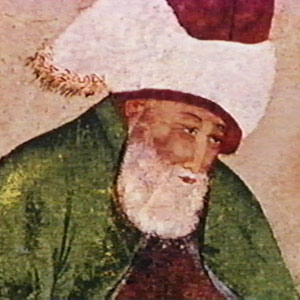
Their poetry is also a reflection of their unconventional, direct approach to God. The poems of many Sufis follow no obvious course. They have not been planned by a thinking mind; they flit effortlessly from one subject to another. We not do feel we are reading about a personality of say Hafiz or Rumi. We feel we are reading only about an inebriate devotee of God. The opinions of the world leave no effect on the poet who has transcended the norms and conventions of society. The poetry is a living expression of the timeless nature of the mystic. It comes from the source of all inspiration and requires no explanation to expand upon it.
“A mystic knows without knowledge, without intuition or information, without contemplation or description or revelation. Mystics are not themselves.” (5)An overriding theme of Sufi poetry is the expression of the relationship between lover and beloved. It is strongly reminiscent of the devotional bhakti tradition of Hinduism. At times they express the pain and agony of separation, at other times we get a tantalising insight into the unimaginable bliss of divine communion.
—Attar
“I have found nothing in all the world that could match his love”The Sufi poets combined a rare combination of lyrical eloquence with a profound mystical revelation. There words are timeless, appealing to the hearts of those aspiring for truth and beauty.
—Rabia al Basri. (6)
“All year round the lover is mad,
unkempt, lovesick and in disgrace.
Without love there is nothing but grief.
In love.. what else matters?
—Rumi
To be or not to be
Is not my dilemma.
To break away from both worlds is not bravery.
To be unaware of the wonders
That exist in me,
That
Is real madness! (8)
—Rumi
Tejvan Pettinger
Oxford, England
(1) Rabia al Basri – “Reality”
(2) Hafiz The Subject Tonight is Love—Daniel Ladinsky
(3) In Wineseller’s Street by Thomas Crowe p.57
(4) In Wineseller’s Street by Thomas Crowe p.38
(5) Attar— The Hand of Poetry— 5 Mystic Poets of Persia— Lectures by Inayat Khan, Translations, Coleman Barks p.59
(6) Rabia al Basri “Brothers, my peace is in my loneliness.”
(7) Rumi – Whispers of the Beloved – Maryam Mafi and Azima Koln p.20
(8) Rumi – Whispers of the Beloved – Maryam Mafi and Azima Koln p.48
Walt Whitman's status as poetic innovator and father to American verse is undisputed today, but while alive he enjoyed little public acclaim and only minor distribution—and much notoriety. But Whitman was critically acclaimed right from debut; Ralph Waldo Emerson, so-called "father of American literature" wrote to the poet personally upon receipt of “Leaves of Grass”, proclaiming "I greet you at the beginning of a great career," and later described Whitman's poetry as "a remarkable mixture of the Bhagvat Ghita and the New York Herald."
Lauded and republished around the world—especially so in England—Whitman never saw a broad appeal or readership at home—the main subject of and intended audience for the majority of his poetry—albeit in a single poem which, ironically, the poet himself thought very little of: "O Captain! My Captain!"
O Captain! my Captain! our fearful trip is done;With layout set deliberately to resemble a ship approaching a destination, “O Captain! My Captain!” is a masterful but rare example of rhymed, rhythmically regular verse by a poet renowned for innovative form and structure. There is no doubt the use of rhyme was intentional; written as immediate response to the assassination of Abraham Lincoln in 1865, it served to create a fittingly sombre, exalted effect; a bitter-sweet elegy of commiseration and commemoration.
The ship has weathered every rack, the prize we sought is won;
The port is near, the bells I hear, the people all exulting,
While follow eyes the steady keel, the vessel grim and daring.
But O heart! heart! heart!
O the bleeding drops of red!
Where on the deck my Captain lies,
Fallen cold and dead.
The poem was published to immediate acclaim in the New York City Saturday Press, and was widely anthologised during Whitman's lifetime. He would be asked to recite the poem in public lectures and readings so often that he is quoted as saying "I'm almost sorry I ever wrote [it]," although it had "certain emotional immediate reasons for being."
Envisioning Lincoln as archangel captain, the poet is said to have dreamed the night before the assassination of a ship entering harbour under full sail, an image dominant throughout, and the poem was deliberately typeset to appear on page like a ship approaching its destination.
It could be argued that in Lincoln Whitman saw the living embodiment of his poetic ideals: uniter of the nation, kindred opponent of slavery, harbinger of a future golden—a future of universal freedom and brotherhood which the poet envisioned as American destiny; tangible reality as well:
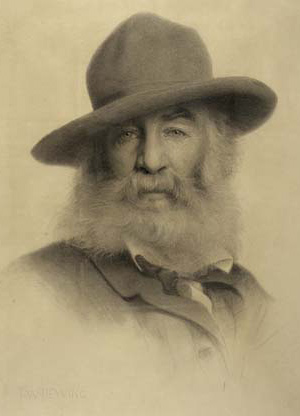
I am of old and young, of the foolish as much as the wise,Poet Sri Chinmoy succinctly describes Walt Whitman's poetic and national vision as interchangeable: "When the wind and storm of today bring in the golden Tomorrow, Whitman will shine forth, haloed in a new glory on the new horizon. His poems and his nation's consciousness are inseparable."
Regardless of others, ever regardful of others,
Maternal as well as paternal, a child as well as a man,
Stuff'd with the stuff that is coarse and stuff'd with the stuff that is fine, One of the Nation of many nations, the smallest the same and the
largest the same
(Song of Myself)
Lincoln's death was a violent blow to Whitman's American vision and confident proclamation. Already traumatised by the division of the just ended Civil War, “O Captain!” was written at a time of great despondency and personal soul-searching.
The poem saw its first official publication as an addition to Whitman's Drum-Taps Civil War poems. He wrote, a little later, another poem for Lincoln, his famous “When Lilacs Last in the Door-yard Bloom'd”.
Ever the perfectionist, Whitman revised “O Captain!” in 1866 and then again in 1871, a trademark practise of continual revision and never-ending improvement. His life work, Leaves of Grass, was revised continually from first publication in 1855 until 1892—the year of his death; the name for the final, definitive version, which included “O Captain!” is thus 'the Deathbed edition.'
John-Paul Gillespie
Auckland, New Zealand
“Poetry is an echo, asking a shadow to dance.”
-Carl Sandburg
Words for this article finally began to flow when I was spontaneously moved to tears upon reading two-time Pulitzer prize winning American poet Carl Sandburg’s comment, “Poetry is an echo, asking a shadow to dance.” It only seemed fitting that I should begin an article about poetry with tears and pangs in my heart. Having written numerous poems on my love of poetry, it is so dear to me that I sometimes get a little crazy on the subject of it. Somewhat unoriginal in my affections -- the likes of swans, rainbows, nature’s palette and places like Paris pale in comparison to my exuberance for writing and reading poetry. I came across Sandburg’s words when I was browsing through quotes of famous thinkers and poets on the subject of poetry. I was spontaneously moved to tears because his definition of poetry embodied my feelings so perfectly.
His talk of echoes and shadows hints at hidden and unknown realms that are brought to the fore through concepts gathered together into a family of words called a poem. The echo could be an echo/shadow of emotions and memories that one is trying to resolve or an echo/shadow of beauty and sublimity that the poem is trying to make manifest. Because poetry reaches for realms beyond the mundane, calling it a dance with the shadow emphasizes the hidden and even unknowable worlds found in ordinary viewpoints. Pulitzer prize and National Book Award winner Wallace Stevens shares Sandburg’s sentiment when he states,
"The poet is the priest of the invisible."
-Wallace Stevens
Despite the artistic building blocks of echo, shadow and the invisible, I’m left by the side of the road when it comes to highbrow poems that are not accessible without great explication and analysis. A friend of mine, herself a Radcliffe alumna, told me that one time she asked a Harvard professor what type of poetry Harvard likes to publish. The professor answered her by saying in essence - poetry that doesn’t rhyme and that cannot be easily understood.
My love of poetry veers away from the strains depicted by this professor and embraces rhyme and simplicity. For underneath the veneer of simplicity one can often find profundity and wisdom as well. This almost child-like style is the type of poetry that I love to read and write the most. Inside its practice, I find two powerful aids to the quality of my life – poetry as therapy and poetry as vision’s promise. The prolific poet Sri Chinmoy’s following words evoke this continuum,
“A poem starts in streaming tears and ends in soaring smiles.”
-Sr Chinmoy
In the composition of poetry, I find a palliative remedy to process life issues with which I am grappling – the “streaming tears.” It also serves as well as a tool to open up a broader visionary horizon filled with the promise of greater possibilities – the “soaring smiles.”
Poetry as Therapy
Some of the poems I have written are cathartic exercises giving voice to inner battles. Their therapeutic value rests in the permission to carve out space for acceptance as the first step of the journey towards wholeness. By voicing the struggle, I legitimate all parts of my being.
Is my neediness
the trembling foghorn
revealing the shore
underneath the mists
of public me?
Hiding a giant
in a jelly jar
preserves
a sweet and sour
harvest.
Jealousy ruins like
the streets of Pompeii
or a buried Atlantis
drowning
all glimmer
of transformation
day.
While my cathartic poems find me face-to-face with demons from my past, writing poetry also holds out a glimmer of light in the darkness. My following poems hint that in my spiritual seeking, the act of reaching out to God leads out of the wildnerness.
A crown of criticism
my seeming sovereign Lord
Bottle fed
from childhood up
knowing only
prickers and thorns
If I never manage
to succeed
in this
transformation play
May I love God
more and more
around the corners
of the boulders
in the way.
Were you hiding
in a barrel?
all your problems
cured in brine.
Give yourself
lock, stock
and barrel.
God’s Love
will finally
you entwine.
Even when problems loom large, writing poems taps into an altered consciousness that becomes my lantern in the night. A little research discovered that I am not alone in my perception of the therapeutic role poetry can play in our lives. Originally called bibliotherapy, the use of poetry for emotional healing has gained increased acceptance within the therapeutic community. While most are probably more familiar with art therapy as a tool for growth and learning, I could only nod in recognition when I learned that there is an entire organization called the National Association for Poetry Therapy. Poetry therapists facilitate group discussion of one’s reaction to evocative poems as well as encouraging clients to express themselves in writing their own poetry. The organization’s website tells us that in America they trace their origins back to treatment ideas proposed by Benjamin Franklin in the first hospital in America, founded by him as well. Their website also tells us that Dr. Benjamin Rush, considered the father of American psychiatry, included the writing of poems by his patients as part of their treatment.
Poetry as Vision’s Promise
While my poems that articulate inner struggles facilitate greater self-acceptance, Sri Chinmoy’s words about poetry remind us that poems are also meant to end “in soaring smiles.” In his book Poetry: My Rainbow-Heart-Dreams, he states,
“A poet is he who envisions the ultimate, absolute Truth.”
-Sri Chinmoy
As if tuning into a higher frequency, some of my poems – especially those expressing my love for poetry – reach towards vision’s beckoning call. I wrote a poem in this vein 13 years ago.
When we dance with poetry
truth waltzes into our living room
reality dons its Sunday best
and the dew holds the promise
of a glorious morning.
One of my whimsical poems also addresses the impact poetry can make upon individuals and society.
Poetry is a teacher
in the life learning book.
It changes your perspective
and even how you look
at a hidden
corner nook.
Poetry is a dreamer
who sits upon a perch
and brings a revolution
that can rival any church.
Indeed I find that I can sift through my poems scratched on scraps of paper, printed from the word processor or etched in my memory and feel that some sort of guardian angel is speaking to me and trying to teach me life's greatest intent if I can only listen carefully enough.
For this reason, I always come back to poetry. My inexplicable love of it brings a smile to my lips in moments of tribulation and I can find guidance and answers to my problems in stanzas written more than ten years ago or as recently as today. Some of them offer at least a glimpse and shadow of sparkling vision and promise. My following poems harken to this aspect of Sandburg’s poetry dance.
Who knew that life itself
could spring up on its toes
like a ballet dancer
pirouetting from
illusion darkness
into God’s
ever-beckoning love.
Jump the staircase
to Heaven
three steps
at a time
when you
fly the kite
of devotion
with God-longing twine.
The crayon box opens
for a colour waterfall
Watercolours spill
into puddles of light
No boots no umbrella
a heart thunderstorm.
Writing and reading poetry convincingly offers a prescriptive and hopeful role in our lives. With tongue in cheek, I will write out an RX on the prescription pad which states,
Next time you are feeling blue
instead of crying boo-hoo
just try to write a poem or two.
If you experiment with this approach, I am sure you will find that Sri Chinmoy’s following poem can spell out truth in your own life as well.
“Poetry has proved,
In my case at least,
To be a sunlit and shortcut way
To my destination.”
-Sri Chinmoy
He wanted the eighth day to be just like the seventh. And then just like the ninth, tenth, ten millionth. To lean back, put his hands on the back of his head and watch and wonder silently. Without interfering. By then the skylarks and vultures have tried out their wings, the wind knew how speedily or skulking he has to move in order to slightly stir oak tree branches or to sweep away all the golden leaves from the ground.
While having a cup of milk he watched the sun pushing up his orange-red head on the east horizon, and thought of the evening when he would be watching it sinking down on the west. But around noon he had a strange feeling. Still there was something that wasn’t there. Around 4 p.m. he had to admit clearly: something was indeed missing. The job is not yet done. In fact everything was as good as he had wanted, even his own little unplanned surprises came out very well, but somehow the soup needed salt. He needed someone to confirm that things went well so far, that the lush green of the nearby forest was the shade exactly suitable for whispering secrets and that the vine grapes turned the right hues of purple.
He stood up with a sigh and clapped. There came the nicely combed boys, clearing their throats, adjusting lutes and guitars. It was clear that the sunrise and the lush green of the bush had efficiently inspired them. They could flawlessly, tangibly reproduce it. One could feel the air draft created by the wing of a hawk, one could shut his eyes and yet see the perfect bright orange blaze of that morning... Yet he sighed. He made a dismissive hand movement and let them go back to the garden. It wasn’t their fault. He couldn’t explain to himself either what was not to his liking. After all, they perfectly depicted all he had done and seen.
He lay back again and concentrated. First with a question mark (what exactly do I miss?), then with a growing certainty (Yes, I want them not to faithfully describe my deeds. I want them to add that salt in the soup!). So, he created poets.
Soon he found himself in an old armchair on his terrace, amidst dozens of them, and the dozen dozens of their wine flasks, fulfilled and shattered dreams, dry and fresh cut flowers and pens and knives and blades and photographs and magnificent or senseless life stories, agreements and arguments, lost and won battles, lost and won women... He had a great time. They all spoke differently, they seemed to agree, although never really listened to what the other speaker had uttered, then they seemed unable to find a common point. But they all seemed to have something to say to him, even the one who notoriously shunned his eyes and tried to escape his view. Some wanted to ask for little or big favours, some just complained, some just explored his terrace and house. He was actually quite pleased to imagine the dozen dozens of different versions of the same sunrise he had watched the same day, interminably long hours before they gathered at his place.
Nevertheless, by 6.30 p.m. on this late September day (the Eighth day) he knew again, that he was still unsatisfied. The soup tasted salty enough, but it was a heavy feeling he had. So many things taste salty, things like blood, sweat and tears. He had wanted that salt in its pure form. Lightly, without the feeling of guilt or approval, without the blood, sweat and tears that accompany the great things of life. He wanted the essence from beyond all these.
He didn’t mind the guests praising, complaining, swearing, cursing, wanting, yearning, longing, adoring or hating any of the things and beings they wanted. But he had an increasing uneasiness at the bottom of his stomach. ‘It looks like they don’t get the point’, he thought, but didn’t say a word. Somewhere deep beyond his gaping sense of void he liked them. But in an unnoticed moment he managed to retire from the terrace, on tip-toe he moved across the salon, went down the stairways, silently opened the back door and escaped out in the never ending garden that ended however in a never ending forest. And there, already close enough to his natural bush fence he saw the unhurriedly moving fellow in dark grey suit, almost camouflaged by the descending twilight. There came Kosztolányi. Dezső Kosztolányi from Szabadka or Tátraszéplak or Budapest or maybe even Vienna. He leisurely wandered across the September afternoon and the garden-cum-forest. Their eyes met and they both felt a surge of happiness welling up from deep. He now knew what he had been missing earlier that afternoon.
‘Where have you been? You missed most of the discussions.’ He asked Kosztolányi. The poet replied:
“Drinking the cellar dry is not for me,
no dinner tempts me, nor patisserie.
I’d sooner raid that storehouse of belief
eternity has hoarded and defy
the void with never ending signs of life.
You bring on the ripe clusters of the vine,
my patron and protector, hand of fate;
bring me on too, I tremble on your line,
but look my spirit and my spine are straight.
My arm still has the power to command;
another draught, another, ever fill
and ever gild, immeasurable hand;
my head’s unbowed, no autumn shows there still.
The melon yields her ripeness; white as milk
her baby teeth are sparkling in the gum;
exhausted wasps find shelter in the silk-
soft garages of flowers in full bloom;
the grapes are almost splitting with their sweetness;
struck dumb with joy, the mouth is rendered speechless.”
‘I see,’ he said, ‘continue my son, just go on. What else do you want to tell me?’
“The earth has never been so richly tinged
with madness and enchantment, the trees prattle,
the sky drops loops of crazy colour, fringed
with bright vermilion flaming into purple,
the dusk blows kisses to the mist and sinks
with her in one enormous wave of pink.
Tell me, if you can, what place this is,
What lost domain of childhood fantasies?”
For the first time on this eighth day, while facing this fellow, he finally felt sincerely happy. He looked at the poet and wondered whether it was the right thing he had done to Kosztolányi. But in the poet’s eyes there was no reproach. Two years had passed since he became aware of his mortal disease, thirteen years have passed since he lost a friend but managed to make a great novel out of it, seventeen years since he lost his homeland annexed to another country with his relatives still living there, and only days and hours since the continuous little losses of his everyday life. Nevertheless, Kosztolányi was smiling. He had that little mysterious smile that strikes through his portrait pictures.
He smiled too. He was one step ahead and knew what was next and after next, but then something came to his mind. ‘Actually, one more year, why not? Let’s give him enough time to write it down. Otherwise I will be the only one who has heard all this.’ But he didn’t say a word.
For some time they looked at each other. He knew that the poet was temporarily feeling better, out of hospital, able to do this long walk across the fields and meadows and orchards and vineyards and bushes and village pathways... The poet knew it too that this was TEMPORARY.
At this thought a big realisation dawned on him. He almost turned pale when he suddenly understood that Kosztolányi knew something more than he did. Yes, Kosztolányi knew indeed the meaning of TEMPORARILY, even the stem, the root of the word: TEMP.
‘Yes, he knows TIME. And that’s what I don’t. To me it’s the same whether the seventh day or the eight or the ninth or the eighteen thousandth... Now that I got what I wanted... But this poet does know the difference between day seven and twenty seven of this September. And surely does he know the difference between 1917 and 1927. He just doesn’t know 1937 and he won’t know it ever’, he thought and smiled back to Kosztolányi.
‘You may want to ask something, if you have covered such a long journey. You have some question, haven’t you?’
‘No, thanks. Oh, still, yes, actually there’s so much to ask’, said the poet.
“So tall a sky, such wonder beyond reason.
Why are the stars so huge today, of all days?
Each afternoon the kitchen is ablaze
with crockery delightful to the senses.
What is one to do with confidences
of this nature? Whose epiphanies
are these? Who buffs the hills and scours the sky?
What pantheistic store of memories
invites me to relive the centuries?
Orion’s helmet – is it sparkling still?
Why are all things laundered in this thick
celestial vapour? Whose responsible?
Why stare, enchanting one? It’s only magic.
Sweet flame of being, may your fire be drawn
however aimlessly, through dusk and dawn,
arrest the clock and calendar, destroy
this rotting intellectual granary,
and raise my flag of youth, in attitudes,
of grace, above the festive altitudes.”
(Szeptemberi áhitat, Pieties for September)
‘Fine, you don’t need to come in, but before you go back, at least quench your thirst here by the spring. And as long as you can, be my guest at 3 a.m. in your Budapest window. I like your “Dawn drunkenness”, he said loudly.
‘Oh you mean that poem?’, replied Kosztolányi, sure I can still quote it, I still feel so. He began reciting his own poem written on an early dawn...
“I also realise there is time for leaving,
but in my racing heart one string held firm and bent
to song, and I began to sing the firmament,
that unlocated Unlocatable,
out of reach and unobtainable
in life or death. My muscles slacken,
already, my friend, intimate
with much more dust and clay than I can reckon,
yet I was a guest at the party of a great anonymous potentate.’
They both smiled and nodded. It was late, the dusk turned on chilly breezes on this eighth day of creation.
Kamalika GyörgyjakabLuxembourg
The quoted translations are from one of the rare geniuses able to transliterate our sophisticated language, George Szirtes and they were originally published in the bilingual anthology of Hungarian poetry entitled: The Lost Rider, published in 1997 by Corvina Books Ltd., Budapest
It wasn't at all like the glossy travel brochures. On the beach in front of the Swiss Garden Hotel near Kuantan, Malaysia, the waves were a dull caramel brown, not blue, muddied by rivers swollen with silt and rain and falling on grey, not golden, sands. This dawn it was still raining and after thirty minutes of running along the hard sand the Swiss Garden had disappeared into the mist far behind me.
Even in this desolation there was a kind of beauty and you revelled in the emptiness and solitude – to be alone in this wilderness of sea, sky, endless shoreline reminds us of a truth about ourselves that is both certain and finally consoling.
At the far end of my outward journey I stopped at a derelict picnic spot on an embankment above the tide – here a dilapidated table, wads of old newspaper, an abandoned wicker basket, a broken plastic chair chained absurdly to a tree. On the table an English language newspaper was smoothed out, the only deliberation in this pathos of scattered things. It was as though smoothed down by a careful hand, quite immaculate in presenting itself to my curious eyes.
And then a jolt to see there, row after row, the faces and photographs of so many dead children, laid out on the memorial pages in epitaph. Some were melancholy as though some premonition of their end had come upon them, others smiling in their best clothes and bright with life, unsuspecting and innocent of what would surely come. Beneath each the sentiments of mourning families, some touching, others platitudes dulled by convention yet all that could be said in the face of such despairing grief. And no explanation as to their sudden demise.
Sitting there in the rain, poring over each child’s face, you wanted to reach out with your arms as though to protect each one from life's harshness – how it touched the heart, the neat rows of dead children, the random arbitrariness of life.
In the face of such a monumental sadness your own petty things fly away and you are left with a sense of wonder to be among the living, the consciousness-spark between the darkness at each end of physical existence. Confronted by the portraits of the departed children you are reminded of the sacredness and brevity of your own life, that brief moment of sunlight, and you understand more clearly that each little thing you can do, or just to call out to God with an absolute sincerity, counts for something and finally measures your life's worth. Yes, each and every such moment is a powerful, redemptive thing and finally all that will remain of you.
The dead help us and remind us of what is real in our living. Beneath your wet skin you feel the slow drumbeat of your heart – your sudden tears, as much for yourself and the somber, hard mystery of human life as for the neat rows of dead children, dissolve into the rain and merge into the grass.
Jogyata Dallas
Auckland, New Zealand
Photograph: Kedar Misani
There are a few poems that I like a lot. One of my favorite poems is a little masterpiece by Ben Jonson. It is called “On My First Son”.
Farewell, thou child of my right hand, and joy ;Many people consider Ben Jonson to be the greatest poet of his age, after Milton, Donne and Shakespeare. So, I suppose that would make him the fourth greatest poet of his time.
My sin was too much hope of thee, lov'd boy.
Seven years thou wert lent to me, and I thee pay,
Exacted by thy fate, on the just day.
Oh, could I lose all father now ! For why
Will man lament the state he should envy?
To have so soon 'scaped world's and flesh's rage,
And if no other misery, yet age !
Rest in soft peace, and, asked, say, Here doth lie
Ben Jonson his best piece of poetry.
For whose sake henceforth all his vows be such
As what he loves may never like too much.
Of course to be considered the fourth greatest poet, during the era in which the very greatest of all English poetry was produced, is in no way a mean feat!
I suppose this poem, a twelve-line masterpiece, is one of the poems on which Jonson’s reputation so securely and justly rests.
I think this poem, while very moving even upon a casual reading, offers more and more insights as we read and reread it.
I like how Jonson tries to restrain himself as much as possible in this poem, but sometimes he cannot. I mean, he read and admired the Roman Stoics, and their ideal that the best way to brave life was to maintain poise and dignity under all circumstances.
When I look at the first two lines, we see Jonson trying to maintain his composure even in the face of terrible loss, in this case of his beloved son:
Farewell, thou child of my right hand, and joy;“Farewell, thou child of my right hand…”
My sin was too much hope of thee, loved boy.
The line starts out almost as if he were a lawyer drafting some kind of dry official document, or a soldier dismissing his subordinates. But after the comma we get “and joy”.
The second line also begins very formally: “My sin was too much hope of thee”. But then he writes “lov’d boy”. It is almost as if Jonson is fighting within himself, trying to maintain his dignified and stately public persona while grappling with these overwhelming feelings of grief and longing.
The next two lines are also very interesting:
“Seven years thou wert lent to me, and I thee pay,I find it interesting because in this couplet he maintains a very correct, legal tone. It is almost as if he were reading some passage from the Book of Common Prayer.
Exacted by thy fate, on the just day.”
But we see in the next line:
“O could I lose all father now! For why”We saw in the first two lines of the poem that Jonson was unable to maintain his cool demeanor for even a single complete line of poetry. But in the next two lines, as I have just said, he kept the feeling completely impersonal. Here, however: “O could I lose all father now!” his composure abandons him.
I’ve always been struck by this phrase in this poem: “O could I lose all father now!” There is such a big difference between the statements “I wish I had never been a father” and “I wish you, my son, had never existed”. In a sense, he is mourning himself, the part of himself he had invested and identified with his son.
If we go back to the first line of the poem, “Farewell, thou child of my right hand, and joy” it is almost the loss of his son is equivalent to the loss of a bodily limb, his right hand. Michael Vance in his wonderful essay, Heaven’s Due, talks about this idea convincingly and eloquently.
When I lost my mother, some ten years ago, I did not, at first, feel much emotional grief. Rather, I felt a terrible pain in my chest and abdomen that lasted for weeks and weeks. It was only after some therapy and meditation that I realized I wasn’t really allowing myself to feel the pain of her death, the impact of her death, on me. And that is perhaps a normal reaction. I felt terrible physical pain because I wasn’t able to accept the emotional hurt that losing her meant. It was only after I allowed myself time and space to grieve that the physical pain left me.
Perhaps Jonson was referring to a similar phenomenon when he bid goodbye to his “right hand” and cried, in anguish, “O could I lose all father now!”
This line:
O could I lose all father now, for whyIs also interesting to me for its use of enjambment. The words “for why” stand alone, almost like an existential plea for comfort and explanation.
In the next lines :
“Will man lament the state that he should envy?We know that part of the Christian liturgy during Jonson’s time involved references to the three main enemies of man: the World, the Flesh, and the Devil (please see Jonquil Bevan’s article Ben Jonson’s ‘On My First Son’ and the Common Prayer Catechism from Notes and Queries (March 1997 v44 n1 p90 (3)). But here, Jonson can only mention the World and Flesh. He cannot bring himself to even think of the idea of his son in hell.
To have so soon ‘scaped world’s and flesh’s rage,
And if no other misery, yet age.”
“Rest in soft peace, and asked, say here doth lie
Ben Jonson, his best piece of poetry.”
These two lines yield a lot of interesting ideas when carefully examined. I mean, ‘piece’ and ‘peace’ rhyme. If I think of ‘peace of poetry’ instead of ‘piece’ I immediately think of a lullaby- a peace poem.
It is also significant that Jonson named the child after himself. So when he says “here doth lie/Ben Jonson...” we do not know if he is referring to his son or to himself. Somehow, when I read these lines, and their intentional ambiguity, I can almost think of the poet getting into the grave with his son, his arms wrapped around him. Of course, that may very well be a purely subjective response on my part.
What surprises me about these lines also is that they are deeply moving, but they are not sentimental. In the first two lines of the poem, we saw Jonson struggling to find the right tone, between clinical stoicism and unabashed emoting. Here, at last, he has found it. We see how Jonson’s classical restraint allows him to call his son “his best piece of poetry” and it is heartfelt, perhaps even devastating, and yet totally believable and convincing.
In the last two lines of the poem:
“For whose sake, henceforth, all his vows be suchThe conclusion fits in perfectly with the opening lines of the poem: “Farewell, thou child of my right hand, and joy/My sin was too much hope of thee, loved boy.”
As what he loves, he never like too much.”
Perhaps Jonson is suggesting that everything in human life is ephemeral and fleeting. We cannot really attach ourselves to anyone or to anything, because everyone is mortal.
But he is not saying that he will not love anymore; he is just saying that he will try not to “like” what he loves too much. There is a difference between liking someone and loving someone, I suppose. But I would be hard-pressed to pin down what exactly that difference is. I mean, to like someone immensely is to love him, as well.
I wonder if Jonson is dealing with the difference between disinterested, abstract love, and ordinary, human love. I like what Sri Chinmoy says about the difference between pure divine love and love on the ordinary plane:
“First of all, let us try to know what love is. If love means to possess someone or something, then that is not real love, not pure love. If loves means to give oneself, to become one with everything and everyone, then that is real love. Real love is total oneness with the object loved and with the Possessor of love. And who is the Possessor of love? God. Without love, we cannot become one with God. Love is the inner bond, the inner connection, the inner link between man and God, between the finite and the infinite.”Rainbow-Flowers
—Sri Chinmoy
It is also possible that Jonson might be using “like” in a different sense- not in the sense of to be fond of something, but rather as a variant on the word, “liken” to make one think “like” something else.
Jonson was a classical scholar and probably knew that in the ancient Jewish tradition, people did not name their children after themselves because it was bad luck. The Angel of Death might get confused and take the child rather than the parent, as both have the same name. I’m stating this speculatively, as I don’t know how well acquainted Jonson actually was with Jewish traditions and rites (there were no Jews in England at that time except for a very tiny Sephardic community in London). But it is an interesting possibility and Jonson at least knew enough Hebrew to make a pun on his son’s name, Benjamin, which is literally “son of my right hand”.
When I read this poem out loud, I am surprised at how affecting and moving it is to actually hear it. It seems written for the stage, for public performance, but the feelings it contains are utterly personal and intimate. That is to be expected, because Ben Jonson was the most famous and celebrated poet of his day (and was made what we would call the English poet laureate in 1616), and yet he also wrote many pieces of a very personal and heartfelt nature. In this poem we see a perfect combination of the two sides of his unusual personality.
Jonson was a remarkable individual, to say the least. He was a priest, a soldier, a courtier, a linguist and a playwright. His poem “To The Memory of My Beloved Master William Shakespeare” is probably the most beautiful and gracious tribute ever penned by one master poet to another.
If his reputation these days takes a back seat to that of Shakespeare, Milton and Donne, then I can say with true confidence that Jonson did pen poems, like “On My First Sonne” to which all three of these great men would certainly have bowed in utmost reverence and admiration.
Mahiruha Klein
Philadelphia, USA
Inspiration-Letters 7
Dear Reader,
 The first time I ran a marathon, back in ’02, I discovered something special at, and after, mile 19. Pain is real. Yes, it’s real, it’s undeniable, and no amount of Forrest Gumpian gumption and can-do will can make it go away. So I played a game. I started running backwards, I started skipping and singing silly songs to myself and laughing at the birds and the deer as they came to watch and possibly laugh at me.
But I wanted to finish and so like countless millions of people before me who have hit the Wall, I just gritted my teeth and sang to myself and I did finish.
That was almost five years ago, and I’ve run a marathon practically every year since then. I run each one slightly slower than the previous one. But I’ve learned a few things:
- The discipline, the training and the effort that we put into anything can never be wasted. I’ll never qualify for Boston but so what? I think I get more from my weekly practice runs than I’ve ever gotten from any single race. Remember, fellow slow-pokes, we’re running a good sight faster than the people who never risked showing up at the starting line in the first place.
- While running a race, don’t worry about your finishing time. But you still have to do everything you can to finish as fast as you can! I remember one year I ran the Philadelphia Marathon. I hadn’t trained much, so I thought that I would just enjoy the beautiful scenery and not worry about my time. But after a few hours, I didn’t care about the damn scenery anymore. I just wanted to finish. I focused from that second on covering each mile as quickly as I could, and I enjoyed the last few hours more than the time I had spent “sightseeing”.
- Running can help you meditate better and be more peaceful. When I compare the regularity with which I meditate now, with how I used to meditate before I started running seriously, there’s just no contest. I often have wonderful experiences of being at one with nature, with the sun and the earth, when I run. It’s a simple activity which connects so perfectly with the central metaphor of the spiritual life: seeker-runners running tirelessly towards that distant shore of peace, satisfaction and fulfillment.
Please enjoy these remarkable Letters from our worldwide family of explorers, athletes and adventurers. May they inspire you to go beyond the boundaries of the known and the mundane, and to shake hands with impossibility’s glowing dreams.
Here's a poem on running by Sri Chinmoy, who has inspired many people to accept life's challenges with courage and enthusiasm:THE RUNNER IN ME
In the inner life,
Hope is good
for the beginner runner in me,
Certainty is good
for the expert runner in me,
Triumph is good
for the champion runner in me.
By Sri Chinmoy
From Transcendence Perfection
A very warm welcome to our 7th issue!
Mahiruha Klein
Editor
Title photograph 'Jade' by Pavitrata Taylor


Whether it is worth it or not, you only come to know long after you have already started the game...
Only when you have left everything behind... The last and lost roads where man-made means of conveyance can take you, the last pathways where diligent or hysteric four-legged porter friends would be able to step, the last marked and then unmarked paths, the last slopes where birds still venture up, the last heaps of stones only humans can struggle themselves up to before beginning an arduous trudge on cracking ice... the last somewhat secure solid ground below your feet. Yet later you will have left behind even the insecure grounds of snow with black hollow spaces opening in treacherous crevasses. Whatever comes afterwards still offers you some place for your ice axes and for the front spikes of your crampons. You are getting closer to the point.
You have to leave behind everything that has to do with horizontal in order to meet with horizon itself. The last few meters, the end of it will at last make you feel whether it was worth doing. When the exposed trackless route into the sky itself has taken its toll on your entire being, and the rarefied air hardly can quench your gasping lungs, when a nameless, discrete grace from beyond the veils of headache and muscle pain helps you higher and higher till your eyes reach to the same level as the ridge and when you get the first glimpse of all that is behind it, you will surely know that it's well worth it.
That is the most breath-taking moment maybe, already before you can plant both your feet on the summit, or sit on it as in a saddle. This is the moment when you first get to see what is on the other side, beyond the ridge-curtain. At first you see only summits emerging above the facing valleys, then entire mountain ranges before the totality of a valley or rather of a huge gap reveals itself beneath you. This is the precious moment you are initiated in views the other side can offer, a sheer quarter second before you instinctively prevent yourself from stepping further out on the edge. Oh, yes, watch out as it may only be a brim of blank snow that may break down below your weight and may take you into the void... If you have consciously lived a moment like this in its full intensity, you know that the happiest moment of a climb and the moment of standing on the absolute top do not necessarily coincide even if they usually are connected.
It's worth the trouble, now you know. However, to accomplish the journey, you make the final ritual steps, until nothing more is above you. Here you may do the rest of your personal ceremonials, you may feel proud or lonesome, may smile or may cry, may be overconfident, may cherish self-contempt, may be grateful or forgetful, may be a hero copied from magazine covers or may be yourself...
"Here man can visit, but cannot live", writes Sri Aurobindo when talking about the higher regions, the worlds above our mind's understanding. So true, even in the physical and geographical sense, too. You are standing at the place you so much yearned for, you so much strove for. And your only reward is a drift of cold wind splashing icy crystals in your face. Eventually a piece of chunky chocolate or some lukewarm tea still left in the bottom of your thermos. In the very last case, a thought of God, with the slight hope that God is also thinking of you exactly at the same moment…
You are standing at the place that once became your goal, your motivation, your reason of struggling, your driving force, your obsession... And you are only halfway! The same arduous way is again ahead of you, you ought to get down where you started from. Down. Well, that's where you really belong to. The realm you can inalienably claim as yours is down there, love it or not. It is for them, and for your tiny self down there that you are doing all this, you better admit this. It is not for some whimsy gods dwelling on imaginary or real ridges of the inaccessible space that you are pushing yourself on and on, groping for the limits of your endurance. It is for the sake of all that is down there and for someone who craves within you to know what is it like, up here, in a realm seemingly ever inaccessible for the common mortal.
You are only halfway! You have to get down, back to the dreams that implemented themselves in and through you. You have to go down again, to dream new dreams and to unfold the fulfilled ones to onlookers. You have to share the gift divine. Yet, you cannot bring them snowflakes, neither pebble... What will you take from the ridge where you met the sky close up?
Take them the sky itself. It is living in your eyes now, once you tasted its vastness, it never leaves your regard. Once you had a mouthful of infinity, its taste will permeate every wish of yours. Once you walked high above the clouds, it is the unfathomable blue depth of space that will make your heart its abode. Share this with those down there. Take care, you are only halfway... But you have the entire sky in you to confirm that it was worth striving.
Kamalika Györgyjakab
Luxembourg
The word "adventure" conjures up images of the African Serengeti or the Amazon rainforest. I am fortunate to have had my share of such adventures—pogo stick jumping in Antarctica and juggling underwater with sharks in an aquarium in Malaysia, to name a few. But adventures don't necessarily have to be in exotic places. With the right attitude, you can have an adventure in your own backyard or, as in this case, at a nearby zoo!
I do like to find an appropriate backdrop for my record attempts. It's part of the fun, but at the end of last year (2006) I was extremely busy with work and couldn't spare the time to go to a faraway place. I wanted to attempt two records –the first…juggling three balls for the most number of catches while hanging upside down; and, the second…crawling the fastest mile. One of my friends suggested the Beardsley Zoo in Connecticut, which is less than two hours away from my house. I'm an animal lover, and it sounded like a lot of fun, so my friends and I piled into a car and visited the charming zoo.
I found a flat course on grass for the crawling mile, but I really got excited when I saw the tiger cage. On the outside of the cage was a post from which I could attach a bar to hang and juggle. I think the tiger liked the idea because when I approached the cage, he came to the fence and stood up on his hind legs. "Wow", I thought, "either this guy really likes me or else he's thinking what a tasty meal I would make!"
Of course, I still needed permission which is often not immediately forthcoming from the authorities. Fortunately, the zoo management couldn't have been more encouraging (about the record attempts, not about the tiger eating me!) and we set up a date for the following week.
On the appointed day, I decided to do the juggling record first. The tiger cage drew quite a crowd of the usual zoo-visiting kids and parents, but the record attempt brought some reporters as well. I was pretty nervous because upside down juggling requires intense concentration, and I was concerned that all the people might divert my attention.
I hopped up onto the bar, focused and began my record attempt. I had not anticipated all the noise from the watchers. Even the tiger seemed put off by all the commotion as he retreated to the far corner of his cage! Concentration was difficult and at about 150 catches, one of the balls fell to the ground. Ugh. To perform this record, you hang by your ankles and bend your torso up to toss the balls skyward. The record at 197 continuous catches doesn't sound like much, but after a short time your abs fatigue and ache, and your throws tend to become erratic. It takes unwavering concentration to keep the balls from flying out of reach.
I was concerned because the stress on the abs is such that you can only make a couple of attempts before your abs turn totally to jelly. I rested a few minutes and tried a second time, but again, I came up short. My adventure was becoming an adventure in embarrassment!
I announced to the disappointed crowd that I might try again after the crawling record depending on how I felt. However, I knew from experience, that a third juggling attempt was unlikely because the crawling record is also very ab intensive. If anything, my already fatigued stomach muscles would be in even worse shape after crawling for a mile.
Anyway, I knew I needed "inner recovery" from my failed attempts so I meditated for a minute on my spiritual teacher, Sri Chinmoy. I was suddenly flooded with energy! I approached the starting line of the crawling mile determined not to fail. At the starter's "Go!" I became a crawling fool! The timers announced my split times in disbelief. I was so concentrated that I didn't even notice a dog on the course who seemed to be perplexed by this unrecognized four-legged creature huffing and puffing towards him!
My time for the mile was 24 minutes 44 seconds, more than 4½ minutes better than the previous record! My abs were sore, but fortunately my inner focus from my meditation was still with me and I was eager to try the juggling record again. The television reporter could see that I was tired and told me it wasn't necessary to try again because he already had a good story. I thanked him for his concern, but explained that this wasn't about the show—it was about the challenge!
I waved to the tiger, struggled up onto the bar on his cage, and began juggling. It was amazing…everything became effortless. I was able to manage 251 catches and, when I landed back on terra firma, I surprised myself by letting out a resounding whoop. Across the zoo, visitors must have wondered at this new and strange call…the call of the joyful, juggling, crawling, homo crazylius, who just had a wonderful adventure in self-transcendence at his local zoo!
Ashrita Furman
New York, USA
Christmas Day 2003. Anticipation tingled brightly in every cell as the white landscape underneath rolled by. Snow laden tops of pine trees solemnly passed by, my down turned ski tips pointing towards them. The occasional buzz of the gondola passing through the wheels of the big concrete poles dotting the slopes like big, lonely sentries was the only sound to be heard in this muffled and still white world.
The peaceful ride upwards is disturbed by a short moment of anxiety as the chair lift approaches the landing. Descending from the lift the first time is always a bit scary, like learning how to walk again. It's been well over a year since I last ventured out to ski. But once out on the slopes and inhaling the oxygen-rich air, so welcome to my city-bound, pollution prone nostrils, I wouldn't want to trade places for all the gold in the world. I'm in Squaw Valley USA, home of the 1960 Winter Olympics, a beautiful mountain range in California overlooking Lake Tahoe. It's a cloudy day, which makes for small discomfort since gauging the slopes becomes more difficult with sky and earth blending into the same whitish grey. But now is not the time to brood over small discomforts. Now is the time to live life to the fullest. I skate-ski my way towards the slope and let my body weight pull me down towards the freedom below. Ah...
Nothing is as blissful as that first descent! First of all for the memories it brings back of all those snow-filled joyful days with their tired, satisfied evenings from a carefree past. Back in the present: the omnipresent fragrance of the pine trees mixing with the purity of the mountain air, the pleasant, rhythmic sound of snow crunching against skis and the freedom of the body sailing down the mountain... a draught of Heavenly nectar!
I go down the fairly easy blue slope three times. Not a highly talented skier—what would one expect from someone born in a country devoid of mountains?—I enjoy the leisurely winding slopes far more than the frightening slants of the red or black category. Why invite teeming anxieties and bold fears when one can enjoy gliding down the mountainside untrammeled, unchallenged, without a care in the world?
Yet, alas, my male hormones decided to rear their ugly heads. Goaded by my Australian companion for the day, a highly talented skier loving a challenge, I see myself taking the turn towards the red slope – quite unprepared and much too early in the day. I should have trusted that little voice inside me that was yelling at me earlier, but his shouts proved no match for my overconfident ego's booming voice. Of course I can handle a red slope! I've skied red and black plenty of times before, haven't I? Yes, but that was years ago, the little voice replied, but his point was drowned in an adrenaline rush. My first and last of the day, as I would soon discover.
As I gaze down the slope I am acutely aware—as always that first time down a red or black slope—of the frightening steepness awaiting me. It didn't look that bad from the lift, I hear myself thinking. How can it be so steep all of a sudden? Perspective is a funny thing. I know it's too late for second thoughts and feel myself forced to surrender to the inevitable. From the corner of my eye I see the Australian take off in a flurry of snow, fearlessly belting down with giant, confident turns. Tension gnaws at my legs and knees as I carefully let myself glide down, making my first awkward, wooden turns. Heavens, it really is steep!
Relax, I tell myself. Just concentrate and relax. No fear, no fear, no fear. The mountain tells me something different, though. After my fourth or fifth turn I momentarily lose control. In a panicked effort to regain it I make a forced turn and feel my skis gliding away underneath me. With a hard thud my back collides with the thick layer of snow. Just when I hit the ground I feel a strange twang in my right shoulder. Then I lie still. Nothing seems to hurt, so I should be all right. I try to get up, but somehow can‘t. My right arm doesn't seem to cooperate. It juts out to my right in a weird angle. Strange, as I feel no pain. Unable to move I just lie there for a minute or so. A skier passes me, glances down at me and abruptly brakes.
'Are you all right? a woman's voice calls out to me.
'Yeah, I'm fine, but I can't really get up.' She comes ski-walking back up towards me and looks me over.
'Are you sure you're okay?' she asks.
I tell her I feel fine, but can't seem to move my arm. She says she saw a ski guard coming this way and says she will await his arrival.
'Where are you from?' she asks, having noticed my accent.
'I'm from Holland, but I'm working in a restaurant in San Francisco.'
'Oh, really? Which restaurant is it?'
'Well, it's a spiritual restaurant. The people working there all practice meditation.' I don't know why I said that, really. Not a particularly useful piece of information under the present circumstances. Her reply was even funnier, although utterly heartfelt and sincere.
'Well, would you like me to leave you alone so you can meditate?'
'No, no, not at all' I retorted somewhat embarrassed. Meditation is about the last thing on my mind at this moment. The things one can say when the brain cells are busy elsewhere, tending a dislocated shoulder. Moments later the mountain guard arrives. He takes one look at my right arm, asks me if it hurts much and skis off again to get reinforcements. In the meantime my Australian friend has arrived at the scene with a slightly guilty conscience. I try to comfort him by taking the blame wholly unto myself, which is of course where the blame belongs.
I finally do make it down the red slope, but I hadn't really expected to do so in a sled piloted by a skier with an emergency cross on his jacket. Ah, so it does hurt, I realize at every little bump we glide over. The pain has finally found its way to my brain. The next thing I know I am lying bare-chested on a stretcher in the doctor's office at the base of the mountain. Getting my five of six layers of protective clothing off was a painful ordeal, but somehow we managed. I try a casual glance to my right and immediately jerk back my head in horror. My arm looks like it has been screwed onto my torso by a really bad mechanic. The doctor himself is a confident and kind-hearted middle aged man, who has obviously seen hundreds if not thousands of these cases. He smiles and says ‘This may hurt a little,' (don't you just love that phrase) as he grabs my arm and gently pulls it out and back in a semi-circle. Click, my shoulder says and painlessly falls into place. It feels like a long lost relative has finally come home. Thank you God, I whisper as the anticipated pain remains absent.I suddenly feel a tremendous sense of gratitude towards the medical science and all its practitioners. In moments like these I realize they are truly indispensable on our earth-planet. Maybe we could do without plumbers, bus drivers, lawyers, shopkeepers and librarians, but we couldn't possibly survive without doctors. I kind of feel sorry for my two friends for spoiling their day of skiing, but I can't help smiling and feeling cheerful. I try to take the accident as an experience—just that, an experience—and try to look at the bright side of the matter.
In the spiritual life it is said that an accident can make you more aware of God's Presence and Compassion in your life. That is why in the Indian scriptures Arjuna's mother Kunti prays to Lord Krishna to give her constant sorrow, because she would be inclined to think of Him more in misery than in joy. An interesting point of view—not one I would adopt personally, but through my experience I did feel a great amount of Compassion descending from Above. So I can understand Kunti's reasoning. Still I do feel that life is ultimately meant for joy and that ski slopes are ultimately meant to glide down from unharmed.
Abhinabha Tangerman
The Hague, The Netherlands
What an irresistible word ‘extreme' is with its romantic notions of a life hard lived, and how we devour books and stories of those living by this alluring credo, trudging to the Poles—stubbled with heroic hardship—crossing the last great wildernesses by dog-sled, rocketing out into the stars. That last especially fascinates, the umbilical chord of gravity broken, peering back at the living miracle of earth, one hour away and already homesick, feeling the loneliness of that sudden inhuman dislocation from all of our evolution. In Time magazine once a portrait of astronaut Neil Armstrong upon his first return to planet Earth, face down and weeping in a green meadow—no wonder!
My grandfather was an extremely accomplished boxer, but those family genes diluted down through the clan lineage into dentistry and gardening and only in a rare and random dream does that wild impulse come to visit the grandson, the clang of the bell and the roaring crowd only rampant in the imagination, in a nightmare's arena of pummeled flesh, waking with beaded brow and clenched fists, grandfather's ghost grinning at my bedside—attaboy! Thank God for evolution.
Only once, a playful sparring under the tutelage of my opponent's father did a fist come crashing, sending me backwards onto the grass with stars whirling in my adolescent brain, just the way they said it does. Now only in my frequent altercations with the local parking warden, do the old genes of war come—I walk away from each encounter a little uneasy and nonplussed at so easy a descent into battle.
As a kid I enjoyed the simple dispensation of righteousness in westerns and a certain nostalgia for those quick, if violent and extreme, solutions still remains:
"You're a no-account two bit rustler Big Jake. This here town ain't big enough for the two of us. Fill your hand or saddle up and ride – want ya outa Dodge by sundown!"
"Reckin you're aimin' for a one way ticket to boot hill mister, ‘cos no one prods Big Jake."
"Why you lily-livered, yeller, low down skunk, I'm gonna fill your no-good hide with lead!"
"Yah talk real purty sheriff but I reckin you're gonna be buzzard bait afore long. Ride yisself – or grab leather."
Aaah yes! we didn't have to take a shower twice a day then either.
Here's some personal reflections on various extreme sporting adventures that I'd like to share:
Most extreme spectator challenge: watching the 3100 mile race! Standing there lamely calling out "Way to go!" to these sporting phenomena covering 98kms a day for 51 consecutive days in the middle of a New York summer makes you feel crushingly foolish and can leave a lifelong inferiority complex. Getting involved in massage, food prep or lap counting gives you a certain vicarious glory, or join a singing group, but straight spectating is a daunting challenge – the gulf between your mild world and their epic journey is too great. You stand there and call out "Looking good!" or "Only 1100 miles to go—yay!" as someone shuffles by after 2000 miles of shin splints and blisters—best thing is clap softly and look sympathetic, but say nothing!
Most dreaded extreme sport: In New Zealand in 2002, Sri Chinmoy consented to our going skydiving—in Taupo I made sure I was too busy, but in Christchurch a friend gallantly offered to pay and I was caught. I trawled through an inventory of excuses honed through years of avoidance – hiatus hernia/migraine/aunt crushed by a runaway bus/hugely important manifestation project/sudden loss of vision—but then Guru passed me in the lobby and enquired "You'll jump out of the plane today?" Now a strange calm descended. Fate had decreed I must jump and I meekly replied "Yes Guru".
A sleepless night, haunted by imagining: two selves, I and doppelganger, one peering up into the vault of afternoon sky at the tiny black dot of other self plunging earthward, tumbling, twirling but as though in slow motion, struggling to open the malfunctioning chute, the plane a grey moth banking away east into cloud, cargo plummeting to earth like a tiny meteorite.
But some God of extreme sports must have felt my turmoil and responded, for that afternoon, anxious mind already free-falling into catatonia, some devastating news for all intending jumpees—too windy! (yippee!) We all met, miserable and crestfallen to console ourselves in the local café, tossing down frappucinos in mutual commiseration, for next day we were leaving for Australia, I struggling to mask my glee and insisting on buying everyone a last consolatory round.
Privately in my diary that night a few lines of poetry:
I think it's just inane
to jump out of a plane
if things go wrong—insane!
and contemplate the pain!
(you'd never be the same)
all twisted, scarred and lame!
rather fall under a train!
I really will not deign
to leap out of a plane.
(This made me feel better.)
All-time silliest sport: Sorry golfers, but I've given a lot of thought to this and even rolling a boulder up a hill over and over throughout eternity like Sisyphus pales into insignificance compared to bashing a silly little ball into a hole with a stick—not to mention the prudish Victorian protocols of dress and proper etiquette plus the almost Faustian surrender of one's common sense, humour and reason. You can't even have golf-buggy races amidst all those inviting, manicured green acres, which could be so much fun.
But a fun variant of this foolish game is possible in the right company – speed golf! Who can get the ball into the hole the fastest?—you rush up to your ball, give it a belt, chase after it, whack it again, kicking your opponents ball away or stomping it deeper into the ground with your heel if you reach it first. Alas, in one game of extreme golf my good friend Snatak—who plays this in Iceland a lot to stay snug and warm—actually pursued me with a ‘wood' (ie. non-iron club), a seldom invoked Nordic custom, but let's not say anything more about that regrettable lapse into savagery. Don't expect to play speed golf at your local club—you'll be disbarred, even dismembered, shackled to four golf buggies driven off in different directions by outraged purists.
Most dangerous disciple sport: Frisbee with everyone's friend Databir—I've personally endured three broken ribs, one dislocated and now malformed finger, seven times a twisted ankle, multiple severe bruising, lacerations and colourful blue contusions, two broken front teeth, multiple torn hamstrings and hair loss through anxiety. Extreme fun though! These injuries usually occur on our Christmas vacations which is ideal because Asian dentists and chiropractors are much cheaper and Asian taxis are also quite inexpensive (you ride everywhere because you're in too much pain to walk).
Life's most intense moments are often windows into our greatest insights and feelings and I have often lain on a foreign frisbee field, mildly concussed or wrapping ice around some freshly ruptured body part, reflecting on certain existential questions.
Adventures and extreme sports and living on the knife edge are also great antidotes to the carefully insulated lives we mostly lead, traveling safely back and forward along the predictable tram lines of the ordinary and the humdrum, shut away in a world of press-button comfort and artifice that shields us from all but the most ineluctable realities, especially the reality that questions why we are actually here.
Ah grandfather! The only truly extreme adventure is the Extreme Adventure that all of life is a catchment for, meandering down the long unravelling of years towards the great emancipation at the end of all striving, the Destination that vindicates and validates all journeying. You might have known this, bloody in the ring, the impulse of your fists not only of conquest or dignity or self-worth but to fly above the painfulness of flesh in the knowing of another genesis, Self-birth, a parturition's blood, rising triumphant out of the fire and clangour of the boxing ring like a great Phoenix and flying away to some better unembittered place, yes some other lovely place of spirit.
Jogyata Dallas
Auckland, New Zealand
The name John Landy might have been one of the proverbial ‘household names'—the first man in the history of humanity to run one mile in less than four minutes. It was, of course, Roger Bannister who in fact attained that preeminent position. John Landy was six weeks too late to be the first, but during the time leading up to Bannister's achievement on May 6, 1954 it was not clear which runner would take the laurel.
For long it was believed that nobody would—that it was actually physically impossible for the human body to attain such speed. But a small group of men dedicated themselves to challenging that barrier. They were seemingly attempting the impossible.
John Landy learned from Percy Cerutty and from men like Emil Zatopek and from his own experience that there was only one way to improve—to train longer, to train more, to train harder. He committed himself to a gruelling training programme designed to render running close to a four minute mile easy for him. And he succeeded.
Landy was, like Bannister, one of that vanished breed—the athlete of the highest order, the world record breaker who was purely an amateur. He ran to be the best he could, and in the true spirit of amateurism he ran for love—‘amateur' from the Latin ‘amator': lover, from ‘amare': to love.
And John Landy loved to run, and he ran with dedication and commitment and passion and he broke Bannister's 3 minutes 59.4 seconds six weeks after Bannister set it with a 3 minutes 57.9 seconds, but, oddly enough, running was not his chief passion. It is what he is remembered for, it is what he will always retain a place in the hall of immortal athletes for, but his passion was—butterfly collecting.
When not running down a track faster that any man who had ever existed had run, John Landy was drifting through the Australian countryside with a butterfly net.
Butterfly collecting: a 'blood sport' you might say, but surely one of the more delicate ones. A sport that combines the thrill of the chase with a fine feeling for order and systematisation and classification and an appreciation for beauty.
Record-breaking athlete: butterfly collector—surely the extremes of sport.
Barney McBryde
Auckland, New Zealand
My life begins with a taste for adventure. Three months to the day premature, October birth instead of January—beginning of spring rather than mid-summer, a more adventurous, extreme entry to this world harder to imagine, on bungy or umbilical cord.
Born in Dunedin, New Zealand, city furthest south of pretty much everywhere, most especially Edinburgh, of which it is an almost stone by stone replica, I was lucky enough to make my unscheduled landing in the maternal unit of the nation's only medical college, advanced premature care a rarity elsewhere. Premature births to this degree are rare, but surviving them was even rarer in the early 1970s, and my first several months were spent not in mother's arms but plastic incubator, continued participation in life's game less than assured—or even expected. My mother, when not praying for my life chose for me the name John-Paul. Four years before first papal namesake, its meaning is "gracious gift of God." It was an invocation of Providence for my continued participation in the adventure of life.
I owe my Mother much for this invocation, for God chose not to withdraw me from life's game at this early stage, the sincere supplication of sideline supporters His hand stayed. Thus, my adventure begins...
***
As a child adventure means playing, the most serious duty of childhood to be pursued at any and every moment. Life ceases to be fun when play ceases—children know this truth inherently. The universal secret of childhood is to seek fun and adventure wherever and whenever you may find it. It is a truth for adults as well.
At age four adventure was dressing as a cowboy, red hat, waistcoat and badge, best of all proudly holstered silver gun firing "caps", miniature charges of gunpowder the terror of a quarter-arce section, family cat as well.
Or assembling train set acquired via childhood charm from legion of doting relatives—I the first grandchild and nephew of two Catholic families, eighteen siblings between. Tracks would be laid at any opportunity, connecting kitchen to living room or my bedroom in between, epic cross-country journeys embarked by engine and carriage, imagination painting passengers and scenery.
A train ran maybe a hundred metres below our house, a five minute tunnel ride beneath outer suburban hills to towns beyond. Days spent reading and rereading books on cars, planes and trains, I would lie in bed at night listening for signs of its passage, adventure furthered to all hours in the imagination.
Lego became my best-friend to adventure—not "house" lego, so called by young chauvinists, lego of domesticity "meant only for little girls", but "space" lego, the closest this deliberately pacifist plaything came to providing the means of warfare we young militarists desired. Battleships, space cruisers and fighter jets were constructed and reconstructed to ever more refined, complicated heights, friends and I on adventurous quest to create ever better vehicles of the imagination.
As an only child imagination was my brother and we played together often. I didn't have imaginary friends—of practical as well as imaginative bent, my childhood self would have said "how can you talk to someone who isn't there?"—but nevertheless I would talk to myself when engaged in playful activity, an exuberant monologue puzzling to parent but joyful to own ear, running commentary of whatever I was doing expressed out loud, even when no one was there.
Adventure wasn't all toys and Christmas and birthday excitement—it grew wild in the world around, awaiting discovery via curiosity and invention. Climbing trees was as much fun as television—and far more dangerous. Searching for a new hiding place in a property you knew backwards, but just maybe had missed. Attempting for the longest while, futilely but joyfully, to create a working bow and arrow out of ordinary stick and twine.
Adventure could be found inside house as well, waking at night in silence and moonlight, creeping on toes into living room as though still in a dream, across shadows cast through blinds, trees swaying through window, gazing open-mouthed and breathless beyond branches, infinite black sky beyond. Mystery and imagination were two brothers, majestic star-lit night sky father to all. What was up there, and how vast was it all!
My sense of adventure was stirred in moments like this. Life held a powerful mystery; meaning and purpose could be felt so strongly, but not stated, explanation just beyond tip of tongue.
***
My mother once called me into the living room at night. The lights were turned off so she could see outside, to distant hills and sky beyond.
"Look over there, over the hill. No, up there, up in the sky"
I followed her finger upward, over the hills to the stars above. There was a light in the sky, not bright but distinct, motionless, as if hovering in mid-air.
"It's been there for a while, still, but it was moving before. It might be a UFO."
We watched together for a long time as this light hovered, then moved to and fro. I was utterly captivated by the simultaneous mystery and excitement of it all—a real life adventure better than any I could possibly imagine.
"What an adventure!" I exclaimed.
I would quite happily have been abducted by aliens from this point. Should I have proved interesting enough candidate, any temporary loss of freedom was more than worth a first-hand glance at the mystery of other worlds, sentimentality for home and friends no match for this child's yearning for adventure.
***
My best friend was unable to take more than one visit a week to his house, possibly because I was a pent-up storm of energy and enthusiasm whenever I was there. More likely though it was his mother's doing, driven to distraction and limit by two barely containable young cohorts in mayhem and adventure.
Afternoon adventure began at approximately 3:20pm, as quickly as we could get to his house from school. Soccer ball or cricket bat hurriedly grabbed, choice dependent on season, we would launch into an every minute treasured volley of shots, saves and scores, until 5:00pm, dinner time for friend, and my cue to trundle sullenly home like leash bound canine, next week's adventure unimaginably far away.
Another friend found a tunnel in his backyard once, immediately the most important mystery and adventure of the moment. Probably a long forgotten plumbing trench, it ran for fifty metres or more beneath neighbouring houses and beyond, about a metre below the surface and half a metre high. We only managed to explore it once—ever suspicious parents and "Deniers of Adventure" caught us in the act, fathers dispatched to fill it in. Future adventures would have to take place out of sight of their ever vigilant eyes.
***
Adventure wasn't all outdoors, in sporting activity or daring play. An avid reader, I would bring home as many books as mother and I could carry, fortnightly visits to city library saw any and all tales of fact or fiction acquired then devoured by voracious imagination. Adventures in misty English moors, moonlit coves and mysterious castles were delivered via Enid Blyton, first of many authors whose works I pursued with enthusiasm and single-minded determination—now hopelessly addicted to their craft's enhancement of, rather than escape from reality. I really did read beneath the covers at night by torch-light—to oft ignored warnings of damaged eyesight now born out. At times on a burst of inspiration I would attempt to write my own masterpiece, usually abandoned in enormous frustration only several pages in, deeply upset at inability to write as well as authors admired. I had yet to learn that practise and persistence are necessary for almost everything in life—even adventure—talent present already or otherwise.
One book that held a special place in my heart was a picture Bible, given as a present on my seventh birthday. Simplified to the very essentials, drawn in the fashion of a contemporary comic, here were adventures of a different sort, and they struck a deep chord in a way that my occasional, very much forced, obligatory attendance of church didn't. Church, for me of the Anglican variety, consisted of an "It's so boring, do I have to go?" mother-baiting pre-ritual, counting the minutes slowly pass on a brand new digital wristwatch during, and afterwards wonder as to how an hour and a half "could take soooo long?"
Quite unlike dreary Church proper, here in the picture bible however were adventures of bravery and faith that I hoped one day I might be able to emulate. I marvelled at the story of Paul, a disciple of Jesus who heroically sacrificed his life for his faith, awe filled at such courage and bravery. Likewise the stories of Christians and lions, Abraham offering his son as sacrifice, and priests who stepped into an open furnace, remaining untouched. I actually had no idea how one could be so brave or strong, in faith or otherwise. A child afraid of visits to the doctor, such courage was beyond my comprehension. Yet I dreamed that one day it might not be. Imagine those adventures!
Children will always find a way to subvert adult activities to their own joy-necessity, and adventure could be going to Church as well. Dragged against will by weekly God faring mothers, a group of adventure-possessed delinquents dressed in Sunday-best staged epic dirt-clod wars behind hall and steeple, where adults gathered in the Spirit.
On occasion my mother succumbed to her own peace of mind rather than Peace of God, leaving son behind to watch televisions' Big League Soccer, a highlights programme from very distant English soccer leagues. The adventure continued at programmes' close, ball kicked against wall outside, over and over and over, mind lost in sights and sounds of games and heroes just watched, calls inside for lunch obliviously ignored.
***
While adventure up until this point in my life were mostly of the sort typical to any young boy—adventures of activity and imagination pursued with all breath and vigour at my command, here and there were a few notes hinting of another tune, a distant, somehow familiar but without context melody of other worlds, dimly heard on occasional pause or reflection but never retained, a hidden meaning and direction to life that I had yet to attain.
At the age of twelve such a moment occurred, a dream from nowhere of spiritual portent, portent which I could neither place or comprehend, even feel was deserved. I had just spent a month in England in a Christian community, headquarters of an international missionary organisation my mother spent the previous year working for, I living with father in Canada. One of the happiest times of my life, I returned home to New Zealand with the firm, heart-felt conviction to do something for the world, although what that would be I had no idea. Alongside still distant dreams of an adventurous adulthood as perhaps lawyer, sportsman, artist or musician, a spiritual longing and aspiration for adventure of a different sort was taking birth.
The dream was of a most beautiful girl, in her teens or later, with whom I travelled to a house where there was a gathering of people, a meeting perhaps. Seemingly invisible in the way only possible in a dream, the girl pointed to a small speck of white light in or above each, saying over and over, "This is the soul."
The girl? Although never a Catholic, with an overwhelming sense of love that I could not explain, I knew her to be the Mother Mary.
I mentioned the dream to my mother, but dubious reaction combined with my own puzzlement and confusion saw it filed under mystery, quickly forgotten. On reflection, it was a harbinger of a great adventure still a few years distant, the discovery of meditation in my late teens.
***
Adventure changed its meaning with the onset of young adulthood, much lamented death of childhood. I deeply resented the transition, understanding not its necessity, or how to relate to the chaotic teenaged world now within. The terms upon which I had long learned to meet the world—oft-cultivated, sometimes practised sincerity, kindness and truthfulness, as ingrained by mother and Bible story and felt intuitively by heart, now mattered nought, and I was at a loss to fathom the new terms—at best sophistication and confidence, worst aggression, arrogance and haughtiness—upon which adventure was now defined.
Adventure was still sought in games, in Saturday sporting contests keenly anticipated all week, yet joy was no longer simple on football field or cricket pitch—even here you were peer reviewed by shoes or jacket, haircut or boasted off-field exploits, rather than simple God-given talent or on-field success.
Seemingly out of my depth in this impending adult adventure, I pined with nostalgia for happy days only a few years previous, seeking without success to somehow expedite their return.
It was meditation that returned adventure to my life, and long craved inner peace, certainty and meaning. Mentioned in the pages of a book—meditation as the sure and certain path to union with God, life's so called ultimate meaning—I pursued it immediately with vigour and determination. Here was adventure in my life again, adventure in terms infinite and immortal, and it imbued all I did with new found purpose and inspiration.
Almost immediately after beginning meditation's practise, the long ago dreamed bright dot of white light returned, a brilliant pin-prick in centre of vision when meditating, accompanying sudden thoughts of inspiration as well. Avidly reading every book on spirituality that could be found, I deduced it to be a glimpse of the soul—ultimate tiny speck of light inside each of us, and form of grace affirming the treading my life's true path. Here in meditation at last lay life's long sought ultimate adventure—the adventure of self-discovery.
My best meditation experience to date came in these early days, a glimpse of the sunlit road ahead, now walked every day. Without a doubt the most powerful spiritual experience of my life, it was a glimpse of my own soul—albeit only for a fraction of a second.
Meditating more powerfully than I have ever before or since, I felt myself ascending upwards as though born upon an infinite wave, rising visibly through layers of mind, layers which became levels of consciousness and then worlds. The higher I rose the calmer and more peaceful I became, in fact profoundly, indescribably so, and all sense of physical life, of body and society disappeared—sense of self drawn upward and inward as consciousness rose.
The experience lasted about the length of the song I was listening to, a nine minute masterpiece from the early nineties with repeated chorus: "I can see the blue light..." The pinnacle was literally that: entering into a light in the very centre of my being—the very same speck revealed in dream years before. Veil lifted for just a second, I encountered a light beautiful beyond description, and was sure in the knowledge that you could want nothing on heaven or earth more than this, need more than this. It was the soul, my own soul.
The discovery of meditation began the greatest adventure of my life, an adventure that continues to this very day. At a time when it seemed life no longer held adventure, nothing to look forward to, explore or discover, meditation appeared, and with it a new, infinitely seductive world of profound peace, power and joy—adventure too!
Meditation is the key to self-knowledge and thus self-mastery, a sure pathway to a self ultimately infinite in capacity, beauty and power—the Self universal. Travelling into space via rocket or farthest corner of our globe via plane is a pale imitation to the adventure of travelling silently in infinite space and time, breath stilled, mind focused to a single point.
I practise meditation today as a member of the Sri Chinmoy Centre, Sri Chinmoy as teacher and guide to inner worlds of unfathomable adventure. I follow the small streak of light still.
John-Paul Gillespie
Auckland, New Zealand
"Extreme" sport, it is called. Human activity on a seemingly superhuman scale. Climbing Everest. Swimming the English Channel. Surfing the most spectacular and terrifying waves.
But others go to extremes in other ways. Some champions, in order to achieve some form of greatness, have simply needed to persevere.
Siobhan Paton is what her fellow Australians would call a "trooper" – someone who rises to every challenge. Just as well, because she's had a few in her life. They started at birth, when she suffered from oxygen deprivation and needed to be resuscitated. The doctors gave her a week. She survived… but with an intellectual disability.
Years later, her parents divorced, leaving her mother Judith to bring up Siobhan and her younger sister, Sarah. Siobhan enjoyed playing sports, but when she was nine, she was diagnosed with connective tissue disorder, which meant that most sports were out of the question. One exception: swimming.
A blessing in disguise. In the water, she was a natural.
Sadly, she was not put on this world to have an easy time. In fact, her life became worse. At school, she was abused in the schoolyard, called a "retard" by classmates. "She was harassed, she was tormented, she was stoned, she was dragged out of the toilets," Judith would recall. When Siobhan became a local celebrity, easily winning swim meets against her "normal" rivals, hideously defaced newspaper photos of Siobhan would appear in the Patons' letterbox. It was part of an organized hate campaign, focused on an innocent disabled swimmer by the community from Hell.
Move forward a few years, to the year 1999. The Patons had started anew, welcomed with open arms to Canberra, Australia's capital city. At age fifteen, Siobhan had a new school and a new coach. Now she was representing Australia at the Paralympic swimming championships in New Zealand, the mecca for the world's disabled athletes.
Of course, life never stops providing challenges. While swimming the 50-meter breaststroke, she collapsed in the pool, severely dehydrated. "She didn't know me," said Judith. "She was really out of it." After saline drips didn't work, Siobhan was sent to hospital.
Her coach tried to pull her out of the competition, but Siobhan would have none of that. After what she had been through in her short life, this was nothing. She insisted on swimming two more races.
The next day, she was the last swimmer in Australia's 100-meter freestyle relay team, holding a narrow lead over her British arch-rival, Tracey Wiscombe. To everyone's surprise, Siobhan propelled the team to victory. "I felt wobbly after the swim," she said, "but not enough to leave, because I knew the team needed me for the medley relay."
With that simple logic, Siobhan faced her own extreme sport – and won. Of course, as all sports-lovers (and even movie buffs) could tell you, such an event would be no more than a stepping stone to the big event. The Paralympic Games were to be held the next year, bringing the world's top disabled athletes to Sydney.
You have probably heard of the Paralympics. Despite the common assumption, "para" stands not for "paraplegic" (most of the athletes are not paraplegic), but "parallel". It is to suggest that, whatever their disabilities, the Paralympians are equal to the Olympians.
Australia, a sports-loving nation, takes pride in its sportsmen – and often enough, the results speak for themselves. In 2000, Australia won 149 medals at the Paralympics, easily winning the medal tally. As for Paton… well, she was the toast of the nation, winning so many gold medals that – after wearing them around her neck for street parades – she had to see a chiropractor. When she was named Paralympian of the Year, with her face on a postage stamp, there seemed to be a consensus: it couldn't possibly be anyone else. It was not just the fact that she had won six gold medals (more than any Australian at a single Games), but also the suffering that she had been through over the years. Even compared to the challenges of her fellow athletes, this was a powerful story. "I've had enough of the tormenting," she said candidly in one of her media calls. "They just did it because I was an easy target. Maybe they were jealous. But I don't think there will be any teasing any more."
Suddenly, she was a national hero, traveling Australia as the main attraction of ticker-tape parades. When she returned home to Canberra, schoolchildren – not much younger than herself – crowded around her after the parade, eager for an autograph. The sky was grey, and it was threatening to rain. "OK, we'd better stop now," said a Paralympic official, politely but firmly waving the children away. "I need to get Siobhan out of the rain."
Oh yeah, Siobhan hates getting wet.
She was a 17-year-old celebrity, too innocent to let it ruin her, but well aware that she had done something very special. Not only for herself, but for any outsiders who had been bullied, intimidated or demoralized enough to assume that they were put on the world to be miserable.
But life still had some unpleasant surprises.
While Siobhan was busy breaking world records and winning medals, other events were happening in Sydney that would test even the noble aims of the Paralympics. Siobhan was one of the Paralympics' first "ID"– intellectually disabled – athletes. For years, Paralympians had gone to some efforts to point out that they were not intellectually disabled, and should not be treated as such. "We're not stupid!" seemed to be a catch-cry. But now the Games were giving us sporting heroes who, by definition, had low IQs. It was a new challenge, which left some of the officials at a loss.
But the bitterest blow occurred after the Games, when the gold-medallists in the Spanish ID basketball team were exposed. These were men of normal, or even above average intelligence, able to tactically outplay all their opponents. ID was easier to fake than other disabilities.
The International Paralympic Committee did not know how to respond. Quickly, all the world's ID athletes were suspended from competition, as if "punished" for this misdemeanor. After a few brief moments of fame, of being an inspiration to so many, Siobhan fell into a depression. "What am I training for?" she asked her mother. "I could be in bed. Why am I working so hard? I'm not a cheat."
Only a week before, she had been winning medals in swimming championships against able-bodied athletes; but as an ID swimmer, with less of the "mind over body" training discipline, even her record-breaking Paralympic times could never rival those of the able-bodied Olympians.
Siobhan didn't go to Athens in 2004, never had a chance to show whether she could successfully defend her title. The IPC is still unsure of what to do.
But her depression didn't last. She was no stranger to disappointment. This was merely the latest. Besides, her experience of celebrity might have been all she needed. She understood that she was more than just another of the many sports "heroes" who so often make the news. She had another role to play.
Siobhan believes that she should speak out against bullying. "I got a really hard time at school," she says. "When you see someone being teased or bullied real badly, you don't join in. You go and tell someone. That's the main message I'm trying to get across. It doesn't matter if you're physically or mentally disabled, or even a normal school kid who's really smart."
The clever cynics rolled their eyes. “She thinks it's so simple,” they thought. But then, she was right. It really is that simple. You needn’t be Einstein to dispense with pearls of wisdom.
After she won her sixth Paralympic gold medal, Siobhan hoped that her achievements would give some hope to the other alienated kids, whether intellectually disabled or not. If she never wins another medal, she will continue to speak out, as a champion should. "It doesn't matter where you come from," she once said, "as long as you get the message across: bullying should stop."
But whether she speaks or not, Siobhan has also taught us something else. Whatever obstacles we face, however we were brought into this world, we are still capable of greatness. We just need to go beyond our extremes.
Noivedya Juddery
Canberra, Australia
"Mom, don't call it ‘extreme skiing', that's dumb!"
This from my son, Nate, who once competed in the World Extreme Ski Championships at Valdez, Alaska.
It seems like people who engage in what is portrayed as extreme think of what they do as, well, every day, normal. I guess I fall into that category!
When I used to engage in motor sports, it was not common for a woman to participate. It still is not all that common. It was not unusual to hear murmurings from the guys, murmurings that used to make me laugh. Once someone told me that a male competitor asked if I had shown up for a Solo event (one lap, one car on the track, best time wins). When I was pointed out, the guy turned around and left. I used to win. I used to win a lot.
My racing career began in 1983 after a car accident. I was driving on glare ice, slid over the center line on a banked curve and got T-boned in the passenger door. Nate had asked to come with me. I almost said yes before suddenly changing my mind. I wouldn't be gone long. He would have died. I wound up being the wreck.
Driving was once a great joy, but after the accident, I could hardly work up enough nerve even to open the car door. Fear paralyzed every fiber. After several miserable weeks, I mustered up the nerve to make a decision. Drive or be driven!
As the other car was totaled, I got into our winter beater, a five year old orange Ford Fiesta, and warily drove onto a frozen lake. (Yes, in Alaska we do have frozen lakes!) When I slid, I would have to stop to catch my breath and wait for my heart to settle down. After several stops, I dove deep and began to make the car slide. Then I would to stop to catch my breath. Irrational as it sounds, it felt like being on a tightrope with no net even though there wasn't another car for miles.
The next session was better. My husband, John, an ice racer and better yet, a veteran FIA licensed stage rally driver, drove me to the ice racing track. I was a horrified passenger as he showed me how to hand break, downshift, heel and toe, throw the car sideways, feather the throttle and control the slide. He was emphatic as he told me, "You are either on the brake or on the throttle. There is no in between." In other words, when you race, you never, ever coast. We were flying smoothly around the track. Frightened as I was, I admired his concentration and mastery of the controls. Little did I know then that I would be just as good as he was.
I won my very first ice race in that Fiesta.
It was during competition that I realized a few things about myself: I completely changed personality when I was strapped in the car. I had an uncanny ability to concentrate. I was a natural. Driving a car fast is what I was meant to do. I loved racing.
Controlling a four wheel drift on dry pavement requires utmost concentration. That is when you are rounding a curve at a very fast speed and the tires are at their limit of adhesion. You are on the ragged edge, driving at ten tenths yet totally in control. You are in the zone. You know where that edge is. You feel it in the seat of your pants. As World Rally Drivers say, "maximum attack".
Racing is a lot like meditation. For me there is nothing like that on the physical plane. Competitive skiers, boarders and snowmachiners know what I'm talking about. The sensation is similar, the satisfaction, complete.
My 15 year racing career included solo, ice racing, road racing and long distance rallying. I had many opportunities to come back from behind. This is what I liked best. Flat out, no holds barred, catch the car ahead of me, pass it.
To accomplish this takes the epitome of concentration. In one road race, I missed a shift and could not find a gear, any gear. I practically stopped dead, the entire field left me in their dust. Something inside me centered. It was almost a physical sensation. I grabbed a gear and stomped on the accelerator up a long straight. I heard John in my head, "You are either on the brake or on the throttle, no coasting." The first turn, a sweeping left loomed. Every visual signal is screaming to slow down. Discipline, confidence in yourself and the car and sheer guts scream louder. "Don't brake. Don't brake. Don't brake. B-R-E-A-K !!!! I careen around the turn in a four wheel drift, accelerating to the next set of curves.
Because of my ability to block out distraction and doubt when racing, I could enter into the zone, a form of meditation, oblivious to all except the task at hand, car an extension of my hands and legs as I mashed the pedals and shifted gears time after time to the rhythm of the turns in the track. One by one I caught and passed each car, the last one on the last lap to win the race.
It sometimes seems weird that I can compare my spiritual life to racing. But through concentration and mediation, one by one, I strive to catch and pass life's difficulties.
I believe that those who participate in so-called "extreme" sports are all meditators. To survive, these athletes must be able to concentrate to the point of an integrated meditation of the body-mind-emotion state. In other words, what they do is natural, not extreme at all.
Perhaps you do not put car racing into the category of extreme sports. Well, neither do I. Did it have an element of danger? Absolutely. Did it require me to go beyond myself? You bet. Did I ever see my life pass before me during an event? No, but I should have. Car racing was natural, just a part of me and what I did well.
Palyati Fouse
Alaska, USA
Transcend the horizon of the ordinary. Capture the future and lasso it into today's experience. The appeal of extreme sports and adventure is at least in part the adrenaline rush of newness inherent inside moments such as these. Whether running long distances, climbing steep peaks or executing a somersault dive out of an airplane, a firm handshake with the unknown accompanies these achievements. As one goes beyond the boundaries of the expected, change also integrates into everyday life. If we venture into this new territory, we needs must embrace change as well.
Mirroring this aspect of adventure and sport, an openness to change is a key precept in spiritual transformation as well. If one's life is not already consciously immersed in divinity, reaching this state involves leaving behind one's past. Spiritual teacher Sri Chinmoy explains in the following poem:
You have to voyage
From the familiar to the unfamiliar,
From the known to the Unknown,
From the knowable to the Unknowable
Indeed,
This is the God-ordained way.
-Sri Chinmoy
Twenty-Seven Thousand Aspiration-Plants, Part 60, no. 5919
Because I do hunger for increased proximity to God's realm of peace, light and serenity, I am quick to at least sign my name on the dotted line for some sideline cheering activity. Why sideline? Because the value of change and the unknown is all well and good while I am safely ensconced on the mountaintop amidst the ethereal altitude of theoretical reality. Remove the word theoretical from the previous sentence and all bets are off.
As someone who averages about eight hours to jog (or should I add "walk" as well) a marathon, I am also more likely to be found among the ranks of those who resist change with plaintive laments. In fact, rather than sprinting into change's domain, I'm more the type to wish beginner's luck could just coast on forever.
By way of example, I remember my excitement in the newfound hobby of photography a couple of years ago. I had never studied the subject and was not versed in even its most basic tenets. Spoiled by the instant feedback of a digital camera, I shunned the discipline of learning about aperture, white balance and ISO. Instead I depended more on beginner's luck and the user's manual that didn't come with the camera. The crib notes were scribbled on the back of dust specks dancing in the sunlight's rays. They were in the bird call that sent my eyes searching until the cardinal red signaled through the bare trees across the street. They were in the newfound habit of acute awareness of each day's sunrise and sunset time. And they were not in the discipline of learning more about the subject in books or editing software.
Now almost two years later, I hesitate on the cusp of matriculation. I knew I couldn't cloister in the beginner's abode any longer when I carefully analyzed the cactus wren as it perched on the agave stalk in Arizona. I was able to stand quite close to the bird and varied my angle again and again while studying how the altered position affected the background of the photo. Then I narrowed in on combating the shadow coming from the stalk itself which partially cloaked the bird's body. As I observed my methodical approach to taking this photograph, I couldn't deny a much increased sense of discrimination as compared to my early days photographing birds.
Despite this evolving process, I have yet to push off completely into the unfamiliar. Typical of my attitude towards change, I am reluctant to part with my slightly broken camera because its presence in my life for two years has been like a beloved companion. I know that I should embrace change and the unknown with a more sophisticated camera but have yet to do it.
This story is my confessional example of my manner as a creature of habit. I doubt I am alone in this tendency. Within management circles, great attention is devoted to "change management" and how to overcome resistance to change by individuals within an organization. Currently in the midst of massive changes at my place of employment, I have to remind myself that some tasks that involve great lengths to revise will eventually hold at least a glimmer of promised improvement in the days ahead.
Perhaps I can best befriend the threshold of change by turning once again to spiritual teacher Sri Chinmoy's sage advice. He often emphasizes the need for gradual progress and transcendence. He writes in the book Warriors of the Inner World,
"So, do not be afraid of the unknown. Today it may remain unknown, but tomorrow it will be known. When a child is in kindergarten, primary school will be unknown to him. But in one year, the same child will go to primary school. Then he will see that there is nothing strange, nothing wrong in it. It is all gradual progress. The unknown is something waiting for us; only we have to welcome it. But if we don't pray and meditate, then we will not feel that the unknown is encouraging and illumining."
With this approach, my prayer and meditation practice can ease resistance to change and open the possibility to integrating the satisfaction found inside moments of transcendent action. Lasting change is often the incremental variety so do follow the call of gradual progress even when jumping on the adventure bandwagon.
And add the guidance of a spiritual teacher for the secret of secrets. Have you ever heard a concert of change ringing bell music? With the effort to coax forth one's divine source and to lessen the ravages of suffering, a spiritual teacher could be likened to a change ringer. The guru assists his or her students in how to change the prevailing winds of their lives until a mellifluous melody emanates from the bells of humanity's church steeple. Drawing on this inner guidance, even this creature of habit can inch towards tomorrow's dream inside the heart of today until my own progress peals like a bell with crystal clarity.
Sharani RobinsRhode Island, USA
Twelve stalwart individuals toed the line at the start of this ‘extreme' footrace in June of 2004. I happened to be one of them. How I ended up on that starting line is a long story as we each had our own personal journeys to get to the starting line together. What happened before this point is not relevant to the story of this incredible odyssey. But what happened next is quite relevant to the subject of extreme sports.
As we contemplated the task that awaited us all I felt as if we were part of a team rather than just competitors in a race against each other. In this particular extreme footrace you try to cover as many miles a day as you can on foot, either running, jogging or walking. The pace is not important as long as you can average enough miles per day to finish in the allotted 60 days or less. Everyone has to be at the starting line each day by 6:00 a.m. and no one runs between midnight and 6 a.m. This ensures us that we get a decent rest period every night. Most people want to try and finish in less than 52 days which is an average of about 60 miles per day. These numbers are what make this race seem ‘extreme' to most people.
Relatively speaking, a sprinter may consider a one-mile race as extreme. To a miler a marathon of 26.2 miles or 42 kilometers is extreme. A marathoner may consider an ultramarathon extreme. A multiday race is extreme to most ultramarathoners and the 3100 mile multiday race may be considered as the most extreme, even to the seasoned multiday runner. So this race has all the qualifications of ‘extreme' running that just about any runner and non-runner alike can imagine.
Many may ask, "Why go to the extreme in anything? What is wrong with moderation, the middle path?" In normal life that is a good philosophy. To take on challenges that seem impossible but have even a shred of possibility seems to be an element of human nature that has demonstrated itself throughout history. Climbing the tallest, death-defying mountains or swimming the long and cold channels and straits as well as any other extreme activity always attracts at least a few brave, eccentric or ‘crazy' individuals. No exception was this particular 3100 mile race which has been happening annually for ten years now.
Although we called this an extreme race because of the time element, distance and the ensuing competitive challenge, I felt that it was more like a personal odyssey, a journey into the unknown. As in anything challenging in life, especially in extreme situations, faith in oneself is quite indispensable. I spent many years as a volunteer helper in this race in many capacities always with the feeling that I would like to try it but lacked the faith in myself to do so. Or perhaps I could not face the fear I had for this extreme challenge even though I knew I was as qualified as most of the runners who had done it.
I finally faced and challenged this fear through the encouragement of the founder of this race, Sri Chinmoy, who has inspired countless individuals for decades in the pursuit of self-improvement through sports and other creative and spiritual fields of endeavor. Knowing that I had the qualifications and capacity to attempt and even finish this race, in 2003 Sri Chinmoy lovingly encouraged me to prepare for it for the next year, 2004. His faith in me strengthened my faith in myself and gave me the capacity to overcome the most daunting obstacle in my attempt to challenge myself: fear.
Once the starting buzzer sounds the challenges just keep on coming, mile after mile and day after day. The extreme element in this particular race is in the distance. But the pace and the moment to moment experience is quite slow, peaceful and contemplative. The main challenge is to develop and maintain the patience and perseverance to go beyond mental doubts, fears and even a sense of boredom. One must focus on positive thoughts and a constantly renewable energy as you put one foot in front of the other in a rhythmical and mantra-like fashion.
Time and distance, which may at first seem like the enemy, eventually become your friend as you try to transcend relative time and space. To cover such an extreme distance I found that thinking of the ultimate goal of 3100 miles is of no avail on a moment to moment basis. Short term goals that are realistic should be the point of focus as you slowly cover the distance minute by minute and hour by hour. The ancient spiritual wisdom of ‘being in the moment' became very necessary and real to us in this extreme event. When I thought of the miles I had to do each day I would focus on how many laps I will cover in the next hour or how long it will take to do just the present one half-mile lap.
As in life and in the Universe itself, step by step and lap by lap the process continues. I often thought of the moon revolving around the earth and the earth revolving around the sun. Billions of years this has been going on and on, circles and circles, around and around. Try to decipher this ever present reality logically and it is difficult to fathom. If the moon had a mind to think about how long it has been revolving around the earth and how far it has traveled it would probably ‘freak out' by the extreme nature of the time and distance and the fact that it does not even seem to be going anywhere.
What we were attempting was far less daunting than anything we see in the Universe around us, yet we are still part of this Universe and its all-embracing principles. Trying to feel oneness with these principles and this Universal energy instead of feeling separate because of our lack of mental understanding, I began to feel more energy and open up to deep sources of energy and peace within myself. I am sure this is a process and experience that many people who attempt extreme sports or other activities eventually end up having in one way or another.
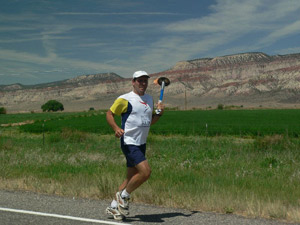
Even when the energy is high and the mind is peaceful, there still is the ever-present reality of the body and its limitations. Pain and even injury can enter into the game and one has to deal with that as we have to keep on moving with very little rest time in order to reach the goal. No one wants to suffer or create dangerous situations to their health so we had a very good medical staff and kept up on all physical maladies that may arise. Even though there were some injuries including my own during the experience, there were no serious enough or life-threatening injuries which kept anyone from trying to finish the race to the end.
Dealing with my own pain and injuries, I took the advice of Sri Chinmoy who was concerned when I felt as if I had to drop out after less than two weeks with a painful ‘shin splint' which only really hurts when running. He told me to walk and not to worry about the miles and just to be happy.
‘Being happy' sounds like simple and easy advice that is a common greeting in everyday life. But it is a reality which goes very deep into the spiritual and psychic core of the individual. Perhaps the moon can keep up the pace and distance because it is happy doing so. Not have to use a logical mind, happiness is a natural state of universal energy which keeps renewing and strengthening itself, allowing what seems at first to be ‘extreme' just to be something quite natural and acceptable. I personally worked quite hard on this concept of ‘being happy' that Sri Chinmoy suggested and the dividends paid off ‘extremely' well.
As a runner for over 30 years, just walking for long distances was not very appealing to me. But with my injury plaguing me and limiting me to just walking, I had no choice and I had to accept this fact and be happy at the same time. This experience lasted over one week, walking and walking, powerfully and dynamically. It kept me in the race enough to keep the hope alive that I could still finish the distance once I could start to run again.
Sometime after passing the 1,000 mile mark and still having almost 2,000 miles to go, I started running again. My injury was healed! But more importantly my mind was healed in a very real and practical way thanks to the wisdom and advice of Sri Chinmoy. Remaining happy while staying in the race while walking and walking and walking not only helped my body to heal its injury, but it also renewed my enthusiasm for being in the race and eventually being able to run.
The first time I was successful at running a whole lap again and then lap after lap with no more shin pain, I felt like a child discovering new worlds. I was so happy and grateful that I could run and run and run. The following week I had the highest daily mileage than all the other runners in the race! Needless to say I did eventually finish the race in just over 51 days and placed 5th which was ‘extremely' satisfying to me.
Before the injury there was tremendous mental pressure and resistance to run and run around and around all day long, day after day. I was not happy and my mind was an obstacle and limited my ability to do what mentally is defined as something extreme. The word ‘extreme' itself seems to inaccurately define and limit experiences which are natural, real and inevitable in the life of this infinite Universe. Some of the experiences in this so called ‘extreme' race actually taught me in a very convincing manner how to go beyond the definition of ‘extreme' itself.
Many other experiences in this race as well as other sporting events can be labeled as ‘extreme'. Doing that just seems to satisfy our minds' inability to fathom the infinite nature of our own limitless life in this infinite Universe. In order to deal with the practical side of life, the human physical and mental dimensions that we experience in limited fashion, we label events and experiences as hard, easy, long, short, extreme and so on.
To plumb the depths of the reality beyond the limiting words and concepts, we must conquer the fear of failure and of our mental misconceptions which limit our experience of this vast Universe. Extreme sporting events seem to offer the opportunity and the necessary support to those who are willing to take on that challenge and go beyond themselves, beyond the limited and limiting mind.
To sum up the essence of the experiences that I and others may have had in ‘extreme' sporting events such as the 3100 mile race, I refer to these simple yet powerfully meaningful words of Sri Chinmoy, the founder of this event and many other Self-Transcendence events: "Run! You can easily challenge the pride of frightening distance."
Extremely grateful,
Arpan DeAngelo
New York, USA
Inspiration-Letters 4
Arts Issue
Dear Reader,
 A few years ago, I went to the Egyptian Collection at the Metropolitan Museum of Art. I went to see one particular artifact - that of a fragment of the head of an Egyptian Queen. Only the mouth and the chin remain of the bust, but the grace and fluidity of the image is practically unmatchable. The stone, yellow jasper, is exceedingly difficult to work with, and I cannot account for the incredible mirror-like finish of the piece.
It’s a famous image; I knew it from books long before I ever saw it. But there was something haunting about being in the very presence of this 4,000 year old sculpture, created by a genius whose name I will never know.
The modern artists, especially Picasso, have pointed to the arts of the ancient world, and also of Oceania and Africa, as an important source of inspiration. That’s not surprising as great art has always celebrated and strengthened our human oneness.
To be a human being means to have a constant thirst for self-transcendence. Through art we seek truth, contact with the divine or simply a broader understanding of life. My meditation teacher, Sri Chinmoy, has created thousands of paintings and sketches which appeal to me through their sheer simplicity and harmony. Like the artists of the ancient world, Sri Chinmoy allows himself to be a channel for a higher force to express itself. He creates, also, for the sheer joy of creation. What a breath of fresh air in our mercenary global art scene!
We are all artists. I think the simplest form of art is to laugh. It’s amazing that, confronted with the hard facts of human existence, if ever we can laugh at them. Humor, like art, transcends time and culture. Great art makes us humble, but it very often also makes us laugh at the amazing mess we “higher” animals make with our meddling in nature’s plans.
I hope the pieces here inspire you as they have inspired me - to see the whole world inside your heart, and all human history encoded within Keats’ magical lines:
Beauty is truth, truth beauty - that is all Ye know on earth, and all ye need to know. (From “Ode On a Grecian Urn”)
Mahiruha Klein Editor

Myth And Moment
by Jogyata Dallas
Photography! Now there’s an exotic theme and intriguing challenge for the bluestockings and literati of Inspiration-Letters. Next month we’ll be asked to ‘write a passionate rebuttal of Stephen Hawking’s gravitational entropy theories on the Big Bang origins of the universe’ or something equally unpredictable – all to keep us on our toes.
Come to think of it, though, I actually have owned a couple of cameras over the years. The first I left under the goalposts on a rugby field while a group of us rushed up and down the field shouting at each other ( yes, playing frisbee) - when I returned for my camera it had gone, disappeared out of my life with it’s happy, morally bankrupt new owner. The second was given to me very generously in New York by a friend and I spent the long flight home swotting up on the instruction manual - when I got back, thoroughly expert in all aspects of it’s functioning, I found it didn’t actually work. But all this at least qualifies me to say a little on the subject, doesn’t it?
We take our camera and peer through a small rectangle at the fluid passing of life unfolding all around us - a white swan moving silently as a paper boat on a dark lake; a group of huddled friends posing on a cold mountain; the sun falling slowly into the beauty of evening clouds. Images and memories, immortalized moments salvaged from the long sweep of time.
I like the sepia brown, out of focus, grainy photos of the box-Brownie era more than the realism of today’s photos with their painstaking fidelity to detail and cold clarity and precisions of colour. The former are more useful and thought provoking and convey a sense of time passing and the mythology of our lives. Here’s one of the infant Jogyata circa 1957, my runner-up entry in our Auckland Sri Chinmoy Centre’s fiercely contested ‘Most Beautiful Baby Competition’ - cute as pie with my button nose and dimples all over and brown cardy. Grown people have been known to sigh. From different stations in time we stare at each other, me and I, one looking forward into the unknowable future, one looking back at what that future held and became. You wonder, how far have I come, what have I learnt, what other things lie waiting? What a long journey from there to here where I find myself now. Every single atom of my body is different. Holding the photo in both hands and staring at it, trying to work out in what sense this was ever me. Like a surveyor’s peg struck into a landscape to measure topography and altitude and space, a photo of ourselves from long ago is a defining marker in our personal history. These odds and ends of photos that turn up from our past are signposts in some inner landscape against which other insights can be measured and understood. But what, but what?
I don’t much regret that most of my personal photos—there never were very many - have been lost over the years and where, looking back, my life seemed to have veered too far off course, I was often the architect of their demise. The English novelist Lawrence Durrell wrote that we live lives based upon ‘selected fictions’ - where one of the fictions of my personal history became too unpalatable in retrospect, all photographic evidence was consigned to the purgatorial bonfire.
Among the surviving odds and ends, each little freeze-frame moment plucked out of time seems now quite fascinating. To see oneself, or others dear to you, as we actually were, perfectly preserved on film as though cryogenically frozen in 2D, and now a clue to certain existential questions. Tiptoeing among the surviving detritus, tiny windows into the mystery of our personal evolution, I feel like an anthropologist stumbling across the preserved footprints of a dinosaur on a dried up lake bed, marveling at a long ago reality. Flipping through a dog-eared, last surviving family album - already ransacked and depleted by gleeful, shrieking relatives - I ponder over these glimpses of the past, as though by looking deeply enough, or long enough, some understanding that feels so close might emerge off the pages. By arresting time we can also reclaim it, relive it, flesh out each image from the past with all the memories of the mind. Take this image, this memory - my father gazes back at me from a far off time, dressed in his brown corduroys and faded tartan shirt, sitting in his favourite armchair and tamping tobacco into his pipe. My mother, solicitous and kind, brings his slippers, stokes the fire, announces dinner. She allows me to have my pudding first if I promise to later eat all my greens. I promise, and tuck into plum cake and icecream. My sister, sensing parental partiality, kicks me under the table and gloats at my loud ouch. I remember, I remember.
Am I still somehow the same, was everything meant to unfold like this? You flip through the album looking for clues like a Beagle searching for rabbits, searching the bric-a-brac of the past for insight. Had it not been these, would other possible lives have led to the same destination - or to unimaginably different endings? Is our journey forward pluralistic, all the different routes we might have taken inevitably converging at the same end point—or not? I ask because so many of the big things of our life seem founded upon tiny, utterly capricious moments.
Take this photo for example from 1980. As randomly as a feather carried on a breeze, I crossed a city street one day late in that year and wandered into a café in search of a cooling drink - and that was how, in an utterly fortuitous, whimsical moment, I first encountered Sri Chinmoy. That profound and life changing moment seems so capricious. Might the breeze have carried me as easily through another doorway to a different end? I don’t know. But photos give us a clue as to our soul’s intention. And the river, to mix our metaphors a little, always seems to find it’s way to the sea.
Here’s another snap of my father in his last days, lying fully clothed in his bed with a hand-knitted balaclava over his head to keep out the cold - he watches me with lacklustre, faraway eyes and I peer at him through the camera lens, coaxing a tired smile. Days later when the slowing gasps of his breath ended, I sat there with a lifetime of memories and held his hands until the fingers turned cold, hugged his rough face and adjusted the woolen hat as though to warm his cold ears before kind nurses finally shooed me away. Inside the death of anyone you love is all the grief of our race, the timeless sadness that attends the end of life and teaches the beginnings of compassion.
Then to walk aimlessly down hospital corridors where others are weeping at their own private tragedies and consoling each other, escaping out into parklands where schoolboys play cricket under a big blue sky. I like looking at this photo though every time its pathos jolts the heart - yet so much of feeling and love and memory and what it means to be a human being is rediscovered here, or lost if it wasn’t for this little treasure from past times.
Photography, like all art, is essentially autobiographical. We film what we see but we also reveal how we see – the signature and imprint of ourselves is unmistakably there in our themes, our choices, our perceptions. The thankfully vanished albums of my long ago were filled with hunting scenes and wild places – this is what I saw, this in part is what I was. This history has fallen into the sea, replaced by kinder things and new selected fictions. The photos we keep of our history reveal much of ourselves and the things that have most shaped us, touched our hearts. Perhaps our lives are the sum total of all our most intense moments. My private gallimaufry of snaps - permanently disarrayed in random tattered envelopes – reveals an equally tangled mind that recognizes only few compass points and constants: my Guru’s smiling face the lodestar, watching me from a gallery of portraits in my room. And my wife Subarata – six years since she left the world and her presence still fills my life, poignant in photos from childhood to last breath. How well I remember her sudden tears and quick emotions, the sad months of her last illness. Sometimes on lonely nights you wander among these albums and photos of your life as though to reconnect with something lost and not replaced, a void that only God can fill.
It’s odd that photos - images and illusions of life - can help us see life more clearly. Pictures and film lack the third dimension of substance and depth and also the sensual, tactile dimensions such as fragrance and touch, and then life itself. Hold a flower up against the photo of the flower and this is clear. No photo of our dear teacher Sri Chinmoy will ever capture what it is like to stand before him in meditation, any more than the breathtaking panorama of a mountain or a clear night sky can be caught on film – our favourite photos are only those that most approximate.
At times when we are lost to the world or out of sorts we can look at our photos and smile again, haul ourselves back up. For disciples, a treasured photo of their teacher brings out the bright colours in their consciousness and acts as a portal into the secret and sacred universe of the soul, a touchstone to reality.
And in nature photography, a good image lifts us out of a world dulled by urban living and humdrum repetition to bring beauty and surprise, to really see once again. Both art and nature lift us out of the banal where we get caught, into new ways of seeing and realms of fresh beauty and delight.
Jogyata Dallas Auckland - New Zealand
My Grandfather’s Mysterious Visitors
by Kamalika Györgyjakab
Who were they and why did they come?
I was about to write a winter story with lots of snow and even more ice when the message came: our Mahiruha would like some essay on art. OK, I will try. But it is so hard to get rid of this winter, not only the topic of my would-be story (postponed till...), but also of the real one outside. March began with an abundant snowfall. That Friday afternoon I stumbled in knee-deep fresh snow on my two miles long way home from the place where the bus-driver dropped me off saying he simply couldn’t drive any further across this all-white hilly landscape. Two weeks later the waking spring still clenches its teeth and freely allows the wildest winds to ravage all over the villages and fields. The thick overcoats and completely windproof, waterproof jackets are still on us as the days grow longer and the nights become shorter.
It was a similar enduring hopelessness that enveloped us about twenty years ago, too. When will it end finally? And how? Will it end at all? These were the questions we silently asked ourselves day after day back in the communist era in Transylvania. But now, at least I know what I didn’t know at that time: every winter ends. It is a law that cannot be overruled or changed. Not even by the harshest, coarsest, rudest dictators. Neither by their armies, security apparatus, whistle-blowers, squeakers and bootlickers... Every winter ends one day, even the intellects’ and souls’ darkest frozen encagement - time...
Many questions of mine have been answered since those black days in Romania. Except the ones I asked on that winter day: who were those three and how did they come? I am afraid I will never get to know this. If my grandfather was still alive, I could ask him. But chances are high that he wouldn’t know it either. My grandfather was a man of lands, of grains and fields and forests and horses, he hadn’t read too many books until he grew too old to make hay.
He knew however more things than I could find in the books available in our mother tongue at that time. He was already an adolescent when the First World War broke out. Seventy years later, after a mug of beer he would still remember some of the songs sung in another age, in another country, yet in the same village. He grew into a man and he grew old in the same town, but around him the borders changed two times, so he changed passport and nationality, but not mother tongue, neither conscience nor religion. He knew every tree in the forest, every road around the town. He knew every river and brook, every forest pathway. He showed me the places where battles were fought, today’s potato fields watered once upon a time with our forefathers’ blood when Tatars invaded and scorched up our villages, when my ancestors refused the Habsburg rule, when they boldly went against the Austrian-invited allies from the Russian tsar’s army... when they lost all they could lose: their horses, cattle, sons and freedom.
My grandfather remembered the times BEFORE, before the big red revolution sequestrated his hardly earned properties, before his forests became the state-owned hunting grounds of the dictator and the bosom-friends of the latter one, before the “Comrades” forbade our language, before artists emigrated because they no longer could speak up, before food and fuel was rationalised to monthly portions distributed after night-long queues in front of the almost empty shops...
And he spoke to me. That was the root of all problems. He told me the truth. Thus he made me dangerous. By telling me, who he and my other forefathers were, he told me also who I was. That made very clear to me, who and what I was NOT. It was good and also perilous to know this at a time our dictator decided to eradicate 3000 Transylvanian villages for they were useless, obsolete and above all, proved a past that should be erased from history books. By God’s Grace this project could never be realised, but for some years the sword of Damocles kept hanging above our heads.
But long before that, when I was really still a child, we had that long and heavy winter. Towards the end of it, it still looked as if it had just started. In those days, cars were not allowed to circulate at all between November and March, for there was no gasoline. For us kids, this annoyance of our parents meant rather an unbothered roaming in neck-deep snow on the roads themselves after each abundant night-long snowfall. In a March or late February morning like this I ventured on the long and really arduous road to school. One kilometre of stumbling and raising my feet high all the time, covering the last section with totally wet boots and socks. Before leaving I asked my granddad to make me a snowman by the time I got back home. Apart from asking him once to buy me a toy – a painted bird that one could wind up like a clock and that would move around then – I don’t remember asking him anything ever.
I didn’t ask, because although we were sharing the same family house with my father’s parents, my mother was terribly upset with my paternal grandparents. My ever-open compassion-hearted mother, who would always send much-treasured food and delicacies to my poorer schoolmates or to needy neighbours, was very unforgiving whenever it came to her father-in-law. The reason of her staunch, inveterate and unceasing reproachful attitude was that my grandfather had had a hidden amount of money, and when the time came in 1977 he had given it away for a good cause forgetting to allocate a single penny to my parents. Ten thousand Romanian “Lei”-s were a significant sum in the nineteen seventies, more than a yearly salary of an average state-employed accountant like my mother. My parents didn’t have a home of their own. My mother’s parents gave everything they had to my mum, this is how my parents could buy a car. My paternal grandparents gave nothing, but at least they allowed my parents to have two rooms in their house. My mum would have loved to move away from there and live her own life and the mentioned money would have helped my young parents considerably. However, fate compelled my mother to sacrifice her dream of independence. The entire amount went away in an unexpected manner and thus my grandfather bought himself a place fifteen years later on the wall of my room in Budapest. He was the only family member of mine who managed to secure himself (or rather for his photo) a fix spot on a wall decorated by pictures of lotuses, snow-capped mountains, cosmic gods and famous rock climbers. Until the day I moved away from Budapest and stashed all my things in boxes he was hanging there on a framed black and white picture, on horse-back, proud, straight-backed, smiling, as a young father of two small children looking into a brighter future. Little had he known then on September 13, 1940 about what was yet to come. With a radiant face he looked as if he had thought, that yet there was a shortcut to the future.
How did he manage to gain my appreciation? In March 1977 a severe earthquake left the country in rubble. The capital, Bucharest was the most affected, but our town wasn’t spared either. The reconstruction lasted for years. Day after day I would be seeing the ruins of an already run-down fortress and the collapsed dome of our community church, the focal point of the lives of my fellows, the ethnic minority Hungarians of Transylvania. This church was built in the times of the Renaissance, at a place of a yet earlier smaller chapel. The first mention of the settlement dated back to 1321 A.D. and since those early days, whenever an enemy approached the place it was behind the walls of this small fortress that the local population, above all women and children could find shelter. Inside the walls the white church was first a Catholic church and when the waves of Protestantism invaded Transylvania, it was converted for ever. Its gothic shape, pure, ascetically plain white walls are my first memories of talking to God and also, of learning the history of man’s quest for a religion closer to God. These memories include also a hidden side-wall relief work representing the head of some big-eyed humanlike-being with Latin inscriptions underneath, some text from the fifteenth century of which at that time I only understood one single word “Daczo”, a still occurring Hungarian surname, probably that of a noble person or some leader of those bygone times.
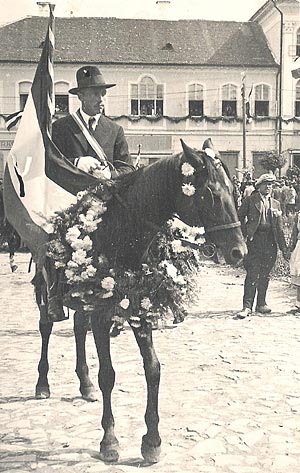
After that dream- and wall-shaking, howling night in March 1977 only heaps of broken stones cried into the wind. Obviously, there was no money to start it all over again. The communist state would definitely not afford to sponsor the reconstruction of a minority, state-alien, irredentist, separatist, what worse, RELIGIOUS community building in the middle of the most feared Hungarian enclave of Romania. Out of question. It was German and Dutch volunteers and village communities that came with their big hearts and donations to enable the local priest and my irredentist, grandfather to buy and mix cement and to lay stone upon stone. Over seventy years old, my regime-fiend grandfather would put up his helmet day after day and go along with other volunteers to build the fortress and church back. In addition to that, he dug out that secret money and donated it in its totality for the reconstruction costs.
More than twenty years later, each time I visit my hometown and light-heartedly spend probably much more money there than those long-inflated ten thousand Leis, I walk home over the hill and I see the fortress, the tower of the church and the graveyard nearby. And I know that the earthly rests of my grandfather have a calm, unharassed sleep there. Regardless of my poor mum’s sacrificed freedom, he did the right thing. The church-tower is still standing erect there and can be seen from far.
So, it was this grandfather of mine to whom I said that winter morning: “Please, build a snowman for me by the afternoon.” I thought, I could ask him this favour, after all he had both time and snow beyond measure. Off I went along the almost tunnel-looking pathway to school and then to a school-theatre rehearsal. I reached home sometimes in the late afternoon, but still in daylight, since it was March already. The moment one enters our yard-gate one has an encompassing view of our entire yard, the two flower-gardens on its two sides, the backyard with hens and our dog as well as the barn at the end of it. So, basically I could see in the first second whether my snowman was there or not.
Well, it wasn’t there. What I saw made me run closer. Instead of a snowman, consisting of a huge snowball upon which there would be another, somewhat smaller snowball topped by a yet smaller snowball decorated with coal eyes and carrot nose, as one can expect from any decent snowman, I found there three statues. Aristotle, Socrates and Plato. Or Demosthenes, Cicero and Seneca. Or they could have been Marcus Aurelius, Julius Caesar and Octavian, or Martin Luther, Jean Calvin and Zwingli Ulrich, or why not, Michelangelo, Leonardo da Vinci and Rafael? Maybe Transylvania’s great governors from the hoary past, Gabor Bethlen, Istvan Bocskai and Ferenc Rakoczi? Or Goethe, Schiller and Rilke, perhaps George Mallory, Edmund Hillary and Tenzing Norgay, mayhap even Robert Frost, Norman Mailer and Allen Ginsberg... whoever. But definitely not some ordinary people. Three men, three busts on completely smoothed surface, perfect flat pedestals, three noble visages, far-penetrating eyes, bold cheekbones dashing against an unknown medium, all three of them looking into the same direction as they were lining up one next to another.
Who were they and how did they come? What message did they bring along for the ephemeral time between a heavy snowfall and the first spring sunbites? They were there mute, nobly raising their heads, not searching my regard, but rather looking somewhere far behind and above my head, and my grandfather next to them, just finishing with the last touches of his smoothing board. He had been working on my snowmen, his statues since I left in the morning. He used no carrot, no coal, no coloured material, only snow, water and smoothing or plastering tools. He wiped his front and with a smile inaugurated and gave over his artwork to me. Then he went into the house for he had cold. I was staring at the three visitors flabbergasted. Me, the ten year old proud owner of three white Carrara marble statues in the backyard standing with my feet growing roots into the snow beneath...
Then I had to go inside too, the dusk came with chillier breezes. I don’t remember much of that evening. One thing I find still strange though. Although my grandfather had never ever even drawn a sketch, neither my father, nor my mother seemed to be surprised at all, they left the wonder unmarked. Just as if it were so normal that we have three busts of three exceptional fellows in our backyard. Just as if my grandfather was a Rodin in disguise. Well, he wasn’t. He was a man of truth, of lands and forests, of arable fields and hard work, a man of horses and bicycles and also of a good beer sometimes. A man of stonesolid faith. A servant of the church, an expert of grains and herbs and cows... But he was definitely not an artist.
Just two days after that deep snow session my wonderful statues were reduced to small forsaken stubs soaking in icy water. I am the only one to know that on a late winter afternoon Aristotle, Socrates and Plato paid a voluntary visit to my grandfather, or were summoned by him there for my sake. Of course, they could have been Marcus Aurelius, Julius Caesar and Octavian, or Martin Luther, Jean Calvin and Zwingli Ulrich, or why not, Michelangelo, Leonardo da Vinci and Rafael as well. I don’t remember their faces well enough to compare them now to illustrations representing famous people of the past. But I do remember the smoothness and white nobleness of their faces. They definitely were there, maybe all simply to tell through their short-term snowstatue-carrier that every winter ends one day. That this is a decree which cannot be overruled by dictators and superpowers.
Oh yes, maybe that’s what they had to convey. Or, otherwise, who were they, and why did they come? Who will they visit next?
Kamalika Györgyjakab Hungary
Written to A Muse
by Abhinabha Tangerman
"Euterpe glanced her fingers o'er her lute, And lightly waked it to a cheerful strain, Then laid it by, and took the mellow flute, Whose softly flowing warble filled the plain: It was a lay that roused the drooping soul, And bade the tear of sorrow cease to flow" (from "An Ode to Music" by James G. Percival)
She is capricious, fickle, hard to please. She lets you wait for her in desparation for many long hours - and decides not to come. Then the next day she suddenly comes, unexpected, unannounced. Queen of arbitrary appearances, mistress of magical moments, empress of eloquence, embodied by the unseen, subtle thought-wave tickling the brain, instilling in the subtle sense a heightened awareness of the divine reality. She is inspiration. She is the Muse.
If we look her up in a dictionary or an encyclopaedia we come to learn that there were originally nine muses, representing the nine goddesses of arts and science. None other than Zeus was their father. He graced them with melodious names, fitting to their high positions: Calliope, Clio, Erato, Euterpe, Melpomene, Polyhymnia, Terpsichore, Thalia and Urania. A temple erected in their honour was called a 'Mouseion', a name we now give to the venue where the fruits of their inspiration can be found: the museum.
It was not wise to contend with these high-learned gals, as the daughters of king Pierus found out when they entered into a singing competition with the muses and were badly defeated. The muses were not satisfied with victory alone, for legend has it they changed the nine princesses into magpies. The Sirens - mythological creatures with the body of a bird and the head of a woman - whose enchanting and spellbinding songs issued from their rock in the sea sent many a sailor to an early sea-grave, also tried their luck and pitted their musical skill against that of the muses. The Sirens suffered not only defeat, but also the loss of their feathers, as the muses plucked them out to make crowns out of.
The lesson learned is that one should not compete with muses. But instead of competing with them, one can invoke their presence and let their inspiration's flow create works of wonder and beauty, whether in painting, poetry, literature, music or drama. Homer's famous opening lines of the Odyssey still serve as a strong testimony to the idea that the muse of inspiration should be invoked first and foremost in the artist's creative life: "Sing to me, o Muse, of the wise man who traveled far..."
It sometimes makes one wonder why certain periods of history are blessed by an exorbitant amount of creative inspiration and flourish with an abundance of refined and soul-stirring art, whereas other periods seem almost deprived of true artistic beauty and lack a higher inspiration and vision. Could this be explained by the suggestion that the artists of these more prosperous times had more faith in the guidance of the muse and consciously or unconsciously invoked her presence? Or by the assumption that the muse herself was more active in these periods, scattering her seeds of inspiration freely about, and more withdrawn in others, retired behind the walls of her castle on the Olympus, unseen and unheard by mortal eyes and ears? Do we invent the gods or do the gods invent us? An eternal question to which no clear-cut answer has been provided. Perhaps it is a little of both.
But enough 'musing' on her rich tradition and past, for the past - as they say - is dust. What you and I want to know is how we can successfully invoke the muse here and now; how we can tempt or persuade her to descend from her pink cloud and mingle with our crying efforts, so that we can create something beautiful, something worthwhile, lasting and satisfying. For too often have we endured her cold silence and the empty hours of her absence. Too often were we to rely on our own limited faculties, forced to be satisfied with mediocrity. Yet when she finally shows herself, she leaves too early, before her work is properly done and we are left with two sublime lines of poetry or a few inspired brush strokes while the rest of the painting and poem are doomed to the well-meaning sweat of our human brow, missing their promising claims to immortality.

So how can we capture the muse permanently and bind her to us irrevocably? When looking at and observing the lives of the great Masters of art, there seems to be only one answer: one needs to practise diligently, ceaselessly and untiringly. Practise makes perfect, as the old adage goes. It seems a terrible cliché, but then again, what is a cliché? A cliché is nothing other than a core truth too often heard and too little practised. Hence it loses its hidden truth-power, becomes tedious and from tediousness quickly grows into a despised cliché. But its essence is truth, changeless and eternal. Practice makes perfect. There you have it.
Van Gogh practised, Vermeer practised, Rembrandt practised. Shakespeare practised, Milton practised, Whitman practised. They all worked hard and gained the muse's blessings. No magical formulas then, no secret mantras or ancient rites to win the muse's favour? No other way to her Olympian castle but through toil and labour? Perhaps not.
Yet there are hopeful words of wisdom for those who long to be in her close company. For there might be another way open to us, a hidden path, a shortcut to the muse's dwelling. This shortcut is revealed by someone who seems an intimate friend of the muse, having written thousands of books and poems, created over a hundred thousand paintings and composed many thousands of songs. Someone whose artistic fruits are aglow with a special, uplifting and otherworldly light and beauty: spiritual teacher Sri Chinmoy. Sri Chinmoy has encouraging words for the budding artist:
"Right now you are at the mercy of inspiration. If you don't have any inspiration you cannot write anything. ... But if we have become very highly developed seekers, then we acquire the capacity to compel the bird of inspiration to stay with us for as long as we want. Anyone can develop that capacity, provided he prays to God, meditates on God and devotes himself to the inner life." (from: "Sri Chinmoy Speaks, part 9")
In the end the answer is a calling to our deepest soul: to connect ourselves with the very Source of creation deep within us and establish a vibrant link to its fountainheads of ever-flowing inspiration. A lofty task indeed. Let us try!
Abhinabha Tangerman The Hague - The Netherlands
Image: Detail from "The Allegory of Painting", The Muse Clio - by Johannes Vermeer
Paris, Je t'aime!
by Sharani Robins
Such a francophile in my younger days, at long last I visit France. I went to Paris for several days with the Sri Chinmoy Centre and it fulfilled my dreams and expectations beyond my imagination! I felt and appreciated that "Je ne sais quoi!" in every aspect of the culture. I have never seen such density of beauty in every detail, every building, every direction you look. Hemingway was right when he said in his book "A Moveable Feast" that once you experience Paris it will stay inside you for the rest of your life.
Contrary to the stereotype, we also found people to be most helpful and not put off by our being Americans speaking English. After we came down the hill from Sacre Coeur on a vertical tram, we needed to find a subway station to get back to our hotel near the Montparnasse train station. We asked a lady "metro?" and it was pretty funny. She looked at us rather baffled as we said metro about a half dozen times. Suddenly a light bulb went off in her eyes and she said, "Ah, metro!" You see we were pronouncing it with emphasis on the first syllable especially the first two letters like the word let, pet or set. She pronounced it with a flourish of a rolled r and an emphasis and elongation of the second syllable that made me think of the word Bordeaux with a nicely rolled r.
As soon as she realized what we needed, she very kindly explained where the nearest station was (I forget but it was probably a combination of simple English and French for her answer to us). I understand some French so it all started to blur together for me. I knew I was like a duck to water when my American companion answered a question of mine with the word no and in my head I saw the word spelled as no with the n on the end of it (French spelling non). All superlatives have long since been exhausted over the years in regards to Paris so rather than repeat them yet again I settled on the metaphor of Paris being a ballet dancer. I was a ballet fiend as a kid and lived, ate and breathed ballet dancing. As I got older, the ballet school I studied at took it all pretty seriously and I had to make a decision to either dive in further or according to their preference just quit. Excelling in school meant a lot to me too at that time so I ended up quitting my study of ballet. Plie, releve, grand jete et change! Au revoir!
Paris is like a ballet dancer because every little movement in ballet has to embody grace and beauty. The act of simply walking across the floor or raising your arms has to be accomplished with intense grace, style and beauty. In fact, people used to kid me because I couldn't walk with a normal gait outside of class - they said I always seemed to prance with a little spring to the feet when just walking. This my friends is a telltale sign of a ballet dancer.
So in every little detail Paris contains that same kind of grace and beauty. Whether the food, the art, the architecture, the clothing/fashion, all is permeated with an underlying and delicate beauty. Like a ballet dancer crossing the floor even as an art form, so too Paris manages this in its mere existence. I find it more than easy to see why so many writers, artists and intellectuals from America became expatriates in Paris in years gone by. Oh to be a fly on the wall at Shakespeare & Co. and to rub elbows with Gertrude Stein and others.
Finally, can you imagine me saying all this and I didn't even go to the Louvre or the Orsay Impressionist museum? We only made it to one museum - the Rodin museum but that alone was overpowering in its impact. I think I could go back to that museum countless times and still receive something from Rodin's sculptures. It wasn't really spring yet in Paris but it was in the Rodin museum gardens that I found one lone flowering tree to frame Les Invalides (where Napoleon's tomb is) in the background of the picture. Heaven, I was in camera heaven!
The world around me seemed so drab after I got back that Mother Nature had to present a spectacle of light and clouds and rain while coming home from work. As if a line was drawn in the sand (sky), the area that I was driving out of was dark, dark purple/black and stormy with steady rain. Ahead of me on the other side of the line in the sky it was mostly clear and the sun was emerging from a few clouds as it set. As it descended towards the horizon , dazzling columns of light radiated up to the sky right through the clouds.
Because it was raining where I was at and the sun was up ahead, I put on my rainbow chasing cap and did eventually see and photograph a partial rainbow once I got to Providence. Rainbows have brought me back to the charm of coastal and somewhat rural New England. Bloom where you're planted they always say. But guaranteed to bloom for sure if you're ever planted in Paris. My photos of the trip can be viewed at my "American in Paris" album.
Sharani Robins Rhode Island - USA
Reflections on Picasso and Masaccio
by Ed Silverton
A few years ago I had the good fortune to visit Barcelona for a week and feast my eyes and heart on that city's rich visual heritage. During this time I visited the Picasso museum, which chronicles his life by displaying drawings, paintings and sculptures selected from his prolific output. It does appear true that in his youth he could draw as well as many a master before him. `Conventional' in execution, his early drawings are testament to his huge talent and skill, which he used in various ways throughout his career.
As Picasso went through life, he seemed to be searching for a way to draw like a child again and produce works that had the simplicity and spontaneous magic of a child's creation. However, there is a period in his life around 1922-23 when he produced the works that I love the most. I have a card entitled `Mother and Child', a reproduction of a Picasso whose original is currently in the Baltimore Museum of Art that is so beautiful it almost makes me weep to see it. It shows two figures so utterly at ease with each other, in a soft and tender exchange that it conveys perfection in contentment and mutual self-absorption.
Softness and tenderness are two qualities that actually rarely appeal to me in the art world, which is funny as these heart qualities often come to the fore when I'm trying to do something myself. Maybe it's because so much of what is in the art- world does not appeal to me that I welcome the `justice-light' aspect of powerful art. I imagine it cutting through the dross of mediocrity and soppy sentimentality that is often seen in works alluding to something higher or deeper but lacking any solid foundation. How can I say this? Well I can only go on my inner feeling when I look at art and if a piece moves me then I am grateful and encouraged, and if it doesn't move me, then I move on.
I would like to recommend Masaccio (1401-1428) to anyone that has not heard of him. He is regarded as the first great painter of the Italian Renaissance and greatly influenced those who came after him. I love his work not because of his ground-breaking use of perspective, but for the power and emotion that underpin them. Two of his pictures that move me most profoundly are frescoes painted for the Brancacci Chapel, Italy. They are: `Saint Peter Baptizing' and `The Expulsion of Adam and Eve from Paradise'. These contain a volcanic energy that simmers and boils, barely contained within the painted surface of the works. It came as no surprise to me that he was a deeply spiritual person and his religious works reflect this. In contrast, many of those who came after him produced work that was technically more advanced and refined but lacking spiritual depth. Michelangelo had power, Raphael had refinement, Leonardo had vision, but Masaccio had Purity and for me, Purity wins
Ed Silverton Bristol - England
Image: "Mother and Child" by Pablo Picasso, 1922, (Baltimore Museum of Art)
The 'Way' Of Photography
by Pavitrata Taylor
The editor asked Mr. Pavitrata Taylor, a seasoned, expert photographer, to share his views about the philosophical aspects of photography. The questions and Pavitrata's answers follow.
Is there a ‘Way’ of photography? Photography is amorphous; it is all things to all people. For me, photography is a celebration of life. Some would say, ‘That guy has too much time on his hands.’ However, you can only start with yourself, and reveal your own hopes and aspirations through your art. If there is such a thing as a ‘Way’ in photography, I would say it is defined in the phrase: ‘To be a pilgrim through the visual world’. That is how my good friend Uranta puts it. I like that, I like it a lot. It implies an integrity of outlook, a dignity and depth of purpose that I believe should always be invested in one’s creative perceptions. I also like it because it goes beyond photography; you don’t have to know anything about cameras to be that pilgrim. However, photography can certainly help in focusing one’s awareness, to develop an inner eye through which the beauty of the seen world is transposed and revealed.
Photography is at once practical and mysterious. See something that interests you. Click. Take the picture. It can be as simple and perfectly workable as that. However, if you aspire to remain in a visually perceptive consciousness, things happen on another level; you start to understand Henri Cartier-Bresson’s evocative quote: ‘Every circumstance has its defining moment; the good photographer will be aware of it before it happens.’ It sounds strange - pretentious even - but good photographs do seem to quietly present themselves. In certain situations one can just feel there is a fine photograph nearby. Sometimes the backdrop is there, but an element is missing - you don’t know what it is yet, but often if you simply wait, something will happen that will complete your untaken photo. Eyes need a distance, but they also need a place to rest, a touchstone that draws the photo together or complements the whole; perhaps someone moving through an otherwise still place, or a small and bright object in a vast space, or maybe a point of stillness in a busy scene.
On the other hand the heart will have its way - the concept of the well-composed photo may be confounded by our feelings about people, places, and events. We would all rather have an ordinary photo of someone or something special to us than an amazing photo of something or someone we have no feeling for. My Scottish gran was an exceptional person with rare qualities. My favorite photo of her is a small, faded, tattered snapshot I took when I was sixteen - it has no artistic merit whatsoever but remains one of my favorite photos.
Which is better- digital or film? For convenience, editing, speed, control, web, email etc, the answer has to be digital. For quality, color and ‘presence’, then I would say film. In my experience, a good negative scanner and a well-exposed negative, with careful post-processing, will give better results than digital. It’s not all about resolution; it’s also about quality of color and subtleties of tone. Digital images often seem to have an inherent ‘flat’ feeling to them. The best quality of all is from a projected slide, it really is the closest you can get to the original view. However, the ‘original view’ may not be what you want.
The other problem with digital photography relates to some of the points mentioned in the answer to the first question. Rather than honing one’s visual and technical skills to the point where the photo is realized at its most perfect moment, with hundreds of images now available on modern memory cards, there is a tendency to just take lots of photos. We all do it, and it doesn’t make us better photographers, it just tends to make us more obtrusive and intrusive. At grand events we go into overdrive, snapping and chimping - even taking photos just to check the exposure level! I am the worst culprit here, and ‘fess up to the fact. The only plea I have in my defense is that I refuse to put any camera into drive mode, whereby one holds the shutter and it just keeps taking pictures continuously. I salvage a little dignity by at least taking each photo individually! It’s surprising how much more careful and considered our digital photographs become when we only have a few possible images left on the memory card! Then we frantically start chimping to see what we can delete to make more space so we can just go into digital overdrive again! What a game! Digiots, aren’t we just? Digital idiots! You have every right to laugh at us! Until you get your first digital camera that is, and you become a chimper yourself!
On the plus side, digital cameras do make the process more sociable - the joy of sharing with others the photo just taken. It may be also be that people are relying on you to take a good photo of an unrepeatable event, and in that case the digital aspect helps in ensuring you don’t let people down. The control aspect is important. Anyone who has had their negatives lost or damaged by a lab will appreciate the relative security of the digital image. The other great thing about digital images is that they can be copied without loss of quality. You could, on the other hand, see this as a curse: the uniqueness of a single negative or slide is lost, and that which was once totally original has become endlessly duplicated, each replication identical to the first.
What makes a great photographer great? I read something today that made me chuckle. ‘A great photographer is someone who doesn’t show you their dud photos.’ There is truth in that. Photography, being so easy and accessible, is very enchanting. But after a few years you look back on your previous output and wince. A while ago I went through photos from my first few years with a camera. While patiently looking through several thousand slides, prints and negatives, deludedly thinking, ‘Ah, let me once again peruse these pearls,' I came up with only thirty competent photos, of which just five were good enough to print! In the end only one of these got enlarged, which is the picture of a clown waiting for a bus. I do even have some ‘issues’ with that one picture, but it’ll have to do, as they say.
My photography got a lot better once I started working in black and white. I took far fewer photos, knowing each one required darkroom time - but the ones I did take had a considered and thoughtful feeling about them, helped by the fact that I was able to work on them in the darkroom to get what I wanted. I don’t actually think you have to go through all this bupkas to produce great photographs as though it is some arcane art form for which you have to suffer! I just try and make up, with patience and determination, what I lack in talent!
I would say it is difficult to produce consistently good photographs without a thorough technical knowledge of your camera. You also need an ongoing awareness of composition, tone, form, and the way light works. To get the photo you want time after time, you need to be able to visualize the way you’d like it to ultimately look before you press the shutter. The photo you really want may be very different to what is actually there. It is that ability to take what you see and change it into what you can imagine that defines the photographer as an artist: the sum of experience condensed into a heartbeat. For all that, whatever you do to the image afterwards will not turn a poor photo into a good one.
For any serious photographer then, I would say that the original image from the camera is just the starting point. The darkroom or the editing program then become the tools whereby you actually begin to resolve this image with your original vision for the photograph. Whatever way you work, in the end your picture is just a set of shapes and colors on paper or screen. First of all these have to work together as an abstract arrangement. Underneath the illusion of the subject matter of great photographs or paintings you will invariably find a coherent balance where all the elements of form, tone, and light come together in harmony. I guess it’s a classic idea of visual aesthetics, and if you aspire to it your photos can only improve.
For all that, there are photographs that are haphazard - where the subject matter is so powerful in its immediacy that it renders irrelevant all the rules about what is or isn’t a good photo. One of the reasons that I like Henri-Cartier-Bresson so much is that he had the rare ability to combine both aspects; to capture a seemingly ordinary and random event in an exquisitely balanced and resolved way. His work shows a real mastery of visual synchronicity. It also reveals that in some way perfection can be found in the simple events of everyday life, if you know how to see them. To ‘see’ like that you really have to be fully alive in each moment. That is the exhilaration, the joy of photography - and for me that is where photography and spirituality meet.
Pavitrata Taylor London - England
The Universal Language
by Barney McBryde
It is often said that the arts form an international language - a language that transcends the spoken languages of humanity, that unites where there can so easily be division, that communicates fluently where there can so easily be misunderstanding
* * *
There are those who go to art school chiefly to drink red wine and air their pretensions at parties. Certainly I did both as much possible, but I also applied myself strenuously and with dedication to the work - I was going to make the most of my time there.
We did little purely academic work - mostly we rolled up our sleeves and made art - but once a week we had an art history lesson and for that I think in the course of a year we had to write two essays. One I wrote about the Fauves, the Nabis, ‘Le Talisman’ painted on a cigar box and all that. The other I wrote about Alphons Mucha - the great Czech artist, the man who more-or-less invented art nouveau.
Writing that essay introduced me to an artist who impressed me hugely and who was to influence my own art to a large degree in future years.
Eight years after writing that essay I found myself standing on a pavement in Prague, my finger hovering over a doorbell above which in neat script was written the, to me, improbable name - ‘Mucha’.
When I plucked up courage to push that bell, an elderly woman put her head out an upstairs window and we shouted at each other for a while before she disappeared. Fortunately she reappeared at the door and even more fortunately she spoke impeccable English which meant she more-or-less understood when I explained that my brother was married to a woman whose grandmother was her cousin. This was a fact that I had only recently learned.
Admittedly it wasn’t a great link, but, since she herself was Alphons Mucha’s daughter-in-law, it did mean that Alphons Mucha’s son’s wife’s mother’s sister’s great-grand-daughter’s husband’s brother was. . . me - could I come in and take a look around?
It wasn’t actually the studio Mucha had worked in - that had been commandeered by the communists for an embassy - but it did contain many of his possessions - his easels, his brushes, his furniture, his stuffed owls - and a great deal of his art. For me to be guided by this genteel old woman around the house was an impossibly special event.
Hanging on the wall amongst the other art were several paintings of a small boy - his round, angelic little face framed with golden curls. My guide gave him a fond, octogenarian smile and said, ‘. . . and this is my husband.’
Art not only speaks across space, across cultures and languages, it speaks across time. It is a time machine by which the past may communicate with the present. By means of these daubings on canvas, Alphons Mucha could communicate to me a hundred years in the future his ideas, his feelings, his dreams, his aspirations; could move and provoke and influence me and my view of the world. Here in this room he could present to this woman the man that she had loved, borne a son with and buried - and introduce him to her as he had been long before she even met him.
A few days later I was on a bus wending its way deep into the Moravian countryside.
That road to Moravsky Krumlov was a road to another world - narrow, winding, lined with trees and little allotments and small orchards and green meadows and wayside shrines to Christ and His mum and Saint John Nepomuk. We passed through villages with unpaved roads and a drain down the middle of the main road.
The village of Moravsky Krumlov was a little more substantial. It was here that Alphon Mucha’s much-ignored magnum opus, his series of twelve enormous paintings of Slavic history - ‘the Epic of the Slav People’ - was housed in a large and dishevelled chateau on the outskirts of the village. As it said on my 40Kc ticket to get into the chateau - ‘From 1963 the cycle, thanks to the town of Moravsky Krumlov, has been installing on local castle. Extraordinary interpretation of paintings and their eventful destiny attract notice of the present visitors.”
In Moravsky Krumlov nobody spoke English. I mimed my way into getting a room at the Hotel Jednota and some food at the shop.
When I arrived at the chateau, there was a guide showing a bus-load of school children around. I was touched to see them sit on the floor before a vast painting as an old lady talked so gently to them of the epic past of their own nation.
Those of us who suffered under the disability of being foreigners had to make do with a few photocopied sheets of paper as our guide. They were in French, German or English and explained some things . . . but made others more mysterious with their peculiar style:
The painting of the early days of the Slavs was described - ‘They were peasants than hunters. Thus gaining some property they were attractive for nomadic tribes from the east and the regardless Goths from the west’; St Cyril was described notably as protecting the Slavs from the ‘violet Christianisation carried out by the Germans’; the Painting of Tsar Simeon of Bulgaria was noted for the technique used - ‘the whole picture is painted in Byzantine many coloured and made-up way’; there were even some moral exhortations - ‘Peter Chelcicky advances him repressed his anger and blames him for not to repay evil for evil, because if he resists the evil, the evil is multiplied in the world only.’ Sound advice . . . perhaps.
Language divided us but art spoke across the divide.
In the end one needed no written explanation. The power of the art spoke direct to the eyes and heart of the viewer, sweeping one up in the artist’s broad vision of life.
Neville Chamberlain - British prime minister - said of Czechoslovakia before the Second World War that it was a far away country full of people of whom we know nothing. Wandering, a mute alien, around the streets and fields of Moravsky Krumlov, or deciphering the halting attempt at communication across a language barrier in that art catalogue, I often felt he was actually right. But the art - it spoke with the eloquence and passion of a native speaker. Words were finally superfluous. The language of art was doing its job.
Barney McBryde Auckland - New Zealand
Image: "After the Battle of Vitkov 1420" by Alphons Mucha
Memories Of Collecting
by Mahiruha Klein
It’s really hard for me to let go of objects that have sentimental value for me. Unfortunately, being a sentimental slob, that encompasses just about every damn thing I own!
Oh no, I can’t let go of this copy of The Hitchhiker’s Guide to the Galaxy! My uncle bought it for me after I came in second at the debate-and-speech tournament in Yardley (fifteen years ago!). Or- true, this potted plant has been dead for a year but it lasted longer than all the other ones I forgot to water!
Am I alone in being a maniacal collector of things I don’t really want? Do other people who don’t own record players belong to LP clubs?
I guess I can salvage some dignity in that I have rather high-brow tastes in what I collect. Six copies of the complete works of William Shakespeare, for example. And, incredibly enough, they’re all the same. But the covers are different and I guess that justifies my expenditure.
When I go to Europe to see my sister, I bring back lots of Euros. I keep them in a drawer and I go through them every once in a while, admiring the shiny coins. They are of course useless in America, but sometimes I go to my local health food store and ask them if I can buy my granola in Euros. Usually they think it’s funny.
My mother, like me, was a collector. An amateur art dealer, she collected mostly neo-Expressionist pieces. I dislike most modern art movements intensely and was happy when people would come to our in-house gallery and take away the hideous paintings and give us money for them. She promised me she wouldn’t display any art in my room and that made me happy!
I don’t have a lot of things to remember my mom by. I have a few photographs of my bar mitzvah, where she’s smiling at me, with her hands on my shoulders. I also have a big portrait of her, painted when she was just a little girl. It’s a painting of a small, quiet child with beautiful green eyes. I keep it in my closet and look at it from time to time. Perhaps I will send it to my sister, and I will just keep the photographs because they give me more joy.
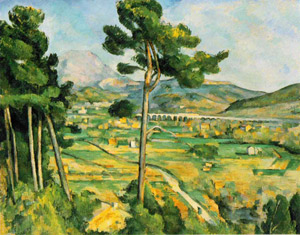
I’m happy I don’t really hoard art, at least. That gives me lots of freedom to go to the art museum, to see really great works of art. At its best, it teaches us not only how to see, but also what happiness and fulfillment really mean. Perhaps that’s why I love and admire Cezanne and Gaugin so much. Not being trained in art history, I cannot give any weighty or considered reasons as to why I feel so drawn to these artists’ works. I can only say that Cezanne imbued his paintings with the most remarkable details. His work is always endlessly interesting and captivating. There is always more to see.
Gaugin inspires me because he traveled all the way to Tahiti for the sake of his artistic journey. Now that’s commitment! And his paintings are so different from anything else; so mysterious and otherworldly and yet so solidly grounded in the technique of the Old Masters that I never get tired of them.
Maybe art is about acceptance. Life can be tragic, confusing and unsettling. Art is an opportunity for us to face the difficulties of life and to make sense out of them. A constructive response to suffering, we create a garden out of the debris, a rose rising up from the dirt. We can reformat or reformulate our troubles to discover Cezanne’s skies and Gaugin’s beaches inside them. We can transcend ourselves, and I think our journey towards perfection is the most beautiful art of all.
Mahiruha Klein Philadelphia - USA
Image: "Mont Sainte Victoire" by Cezanne, 1885-1887
Inspiration-Letters 2
A forum for inspired writers with a multitude of backgrounds and interests
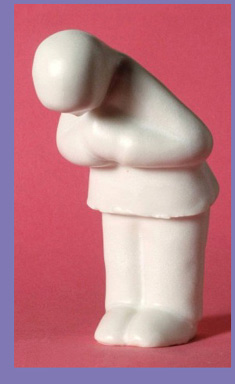 Dear Reader,
Last week I visited the Metropolitan Museum of Art in Manhattan. I often go there to look at the work of my favorite painter, Cezanne. To me, his work is inexhaustible in its complexity, richness and feeling. I’m particularly fond of the way he is able to take ordinary subjects- a small mountain, a peasant, an old cottage, and depict them in a way to make them endlessly appealing and interesting.
There is something awesome about being in the presence of monumental creativity, such as Cezanne’s. No reproduction, no computerized image can ever capture the magic of his original work.
Inspiration-Letters seeks to offer interesting and original articles on any topic. Authentic, well-written prose is hard to find on the Internet; and we hope that our magazine may help to fill that gap. We warmly welcome our fellow word-lovers and yarn-weavers to join us in this great project.
The word “letters” immediately implies disclosure or revelation. “Inspiration” ultimately derives from the Latin word “inspirare”, ‘to breathe in’. Taken together, the phrase “Inspiration-Letters” suggests a magazine that features uplifting personal narratives. But, like most literary journals, we’re not seeking articles on just one topic or theme. We’re hoping to offer prose pieces which will appeal to readers and writers of all spots and stripes!
Franz Kafka once wrote that “writing is prayer”. And Jean-Paul Sartre expressed in an essay that we never write for ourselves alone. Without a real or at least an intended audience, the writer is meaningless. I sincerely hope that the stories and articles featured here ring true. Like Cezanne, we strive to offer inspiration and joy by telling the simple truth of our lives and dreams.
Sincerely,
Mahiruha Klein - Editor

Yes, it needed painting badly. In the last five years, the white finish had dimmed noticeably. In a photo of it dressed with snow, the verdict was clear. How could this white house look positively grey in contrast with the gleaming white powder? It looked white enough when I first moved in but time marches on for all of us – houses included.
Upon choosing a house painter recommended by several friends, I promptly found myself on a yearlong waiting list. The business was run by a woman and given that it is somewhat unusual for a woman to own a painting business, I decided I could wait. I felt myself a kindred spirit to her as the first-time owner of a house that did not include the more typical female equation of homeowning as part of marriage or inheritance of family property.
When the anticipated job was only a few months away, I began in earnest to choose colours. Light blue was a favourite among my spiritually-minded friends but that was the colour of the house directly across the street. I could just picture trying to give directions to the blue house and the inevitable resultant confusion. How about light yellow, a colour I had already used lavishly inside the house? Yet the more I researched the topic of exterior house paint, the greater my sense that I better paint the house the same colour it already was – white. That still left the shutters to be decided at least.
While out for a walk or jog, I would carefully analyze the houses in the neighborhood and try to picture the colour of various shutters against the backdrop of my house. I felt drawn to a shade of blue that had an American colonial flavor but I never found this colour against a white backdrop. I would squint my eyes and try to picture it - alas it just didn’t fit. Maroon perhaps? This colour appeared as an accent on many houses in my environs. I came back to the task on each successive neighborhood jaunt because a sense of closure eluded me.
One morning while out running, I stared yet again at all the maroon shutters and told myself how good they would look since my door was already painted maroon. Surely this must be the choice. Unexpectedly the answer came from within. As distinctly as if having a conversation with a person, I heard my house tell me to set aside the matter of the shutters and hear that it wanted to be painted green instead of white. Luckily the house’s choice of colour was not shocking since I do like the colour green. Nonetheless, it certainly gave me a shock in its means of conveyance. Somewhat stunned about what had just happened, I pondered that perhaps a house is as alive as a person in its own fashion.
As I considered it further, it had almost seemed right from the start that the house possessed a spirit which mostly delighted in the righting of its state of disrepair. It badly needed renovations when I purchased it, but I saw nothing but brimming potential in its abundance of windows, a nice yard with trees and the surrounding pleasant neighborhood. Sure enough, its hidden beauty surfaced as renovoations proceeded. And sometimes if too many aspects of the house were changed at once, a distinct discomfort seemed to emanate from it. Perhaps rapid change was just as difficult for houses to tolerate as it often is for people. This sensation is what first gave me the notion that the house had its own personality and presence.

That day when the house made its personality known once again saw the end of my housepainting indecision. I felt comfortable overlooking the voices of “experts” insisting the house should remain white. No, if the house wanted to be green then green it would be. It was settled. Because I hoped to do the house in only one coat over the aluminum siding, the house painter explained the shades of green that I could realistically choose from. Thus, it was painted light green with a contrast of dark green shutters.
Does a story immersed in the mundanity of what colour to paint one’s house and shutters have any redeeming lesson in it? A closer look at my nagging uncertainty provides a clue. This long-lasting uncertainty about what accent colour should go with white hinted that I was concentrating on the wrong choice.
People, places and things have a certain rightness and internal rhythm meant uniquely for their own flowering. If we stray too far from finding this rhythm, we are apt to be haunted by inexplicable discomfort. With tools such as silent meditation and prayer, finding that place of “meant to be” beckons more easily. Along the way, guiding messages will whisper to us from all manner of teachers if we listen carefully. When at last discovering the rightness of life, the all too still breeze of peace finally stirs in the depths of our being.
When I started meditating and intuitive powers blossomed, I never imagined that they would include this type of an inner message from my house. I’m glad I could hear its wishes. The very day it was painted it looked as if it had never been any other colour. Wearing green sleeves, the house continues like a real friend in my life. So don’t be surprised to find that walls do sometimes talk and people do even sometimes listen.
Sharani Robins
Rhode Island - USA
Day Three: Silent Day
We will have to cross the land of death today. Actually, it is not that bad. The potential risk is not reduced, but the immediate danger is. We are, after all, roped together, and we know enough to keep a fixed distance from each other so that the rope is always tight. If any of us should fall into an unseen and treacherous gap of the glacier, the others will hold him until he climbs out. It should be OK…
I only wish I didn't know the scary feeling that the sight of these gaps and their profound black depths offer when suddenly (as has happened to me many times), the ground gives way below my feet and I find myself above a profound black nothing, with only my upper body leaning against some fragile snow-wall of the crevasse, with my legs having no support to stand on or to push against. But unfortunately I do know what this feels like and I would do anything to avoid repeating those falls.
We walk upwards in utmost silence, amidst snow and ice and yet more snow and dirty white slopes framing this deserted landscape of the upper, vertical part of the glacier. There is nothing else but us, five little slowly yet rhythmically moving dark dots on the back of a seemingly mild snow-covered field. We represent the only life here in the realm of non-life and this makes us more vulnerable, more exposed to all danger. This is a place where one doesn't stop, doesn't wonder, just walks through with utmost cautiousness. I am totally one-pointed and, after a time, my eyes learn to scan the huge tables of snow lying before and beneath my feet, the simple change of its shade indicating unstable or more reliable sections.
I breathe deep, trying yogic ways of breathing, keeping the inhaled breath inside as long as possible. Not easy as we are moving uphill at a steady pace!
And then comes my Guru's advice. While an automatic scanner machine in my head searches for possible risky spots on the snow-covered ground before placing my next foot on it, his voice approaches my heart. “Concentrate on your weight, imagine you have no bodyweight,” he says.
My new mantra suddenly becomes "I am of air, I have no weight". It is fantastic, and moving becomes wonderfully easy. I feel so light. It must be a glimpse of the ecstasy Saint Peter felt when Jesus made him walk on water. I walk with no weight, in intense concentration. I left my bodyweight at the feet of my Guru. Even the weight of my rucksack! A field comes that I cannot avoid; I clearly feel it is only a snow bridge with a hollow gap beneath it. I just have to cross it, the way our guide did it seven meters before me, ten seconds ago. I am walking on a thirty-to-fifty centimeters thick layer of snow stretching above absolutely nothing. But I have no bodyweight anyway. Like a butterfly, swiftly touching the ground I walk across. It feels like walking on water. It actually is walking on water. Two meters later when I feel that I am walking again on something more solid, I try to extend this lightweight feeling to the three companions who are behind me.
Too late. A pull of the rope around my waist and a sudden outcry indicate that the snow-bridge broke under the one right behind me. I hold the rope tightly with my right hand. The leader pulls me strongly towards himself, away from the gap and yells at me in his unusual (at least to my ears) Swiss dialect that I immediately understand: “Move on, move on!” The person behind me safely and really quickly pulls his lost leg out of the gap while I cautiously place my feet one after the other. I offer a second of gratitude to the Supreme Protector. We continue as if nothing had happened.
I won't tell you more of these little happenings, as the journey (across a glacier upwards, then across a pass at 3500 m, then across a glacier downwards and then across a huge moraine and debris of zillions of stones scattered on top of each other) lasted for hours and hours. There is yet one thing I have to tell.
While still at the beginning of this day's journey, still struggling our way up the glacier at the western versant of the mountain, scanning every little place before stepping on it, I remarked the tracks of a single pair of crampons. Whoever wore these crampons must have had an extraordinary sense of the glacier, must have been absolutely confident in distinguishing the places with hollow gaps underneath and the safer sections. There is no hole on the ground nearby these tracks. On a glacier trek one usually sees deep holes all over the pathway across the glacier, indicating that someone (well, at least someone’s leg) had fallen inside when a snow-bridge didn’t resist his bodyweight. The tracks I see here skillfully, amazingly, avoid all risky spots, and lead to reliable snow-fields. After a time, as my own experiences accumulate in recognizing these, I understand that I can perfectly trust these tracks. Also, the leader, just before me in the rope, does the same thing. We follow the tracks and walk quite safely, although extremely cautiously, without a single word or outer sign of communication. Then a thought suddenly puzzles me.
In the hut there was no one else who chose the same route as we five did. All the other climbers went for some other destination today, we being the only ones having planned summit “attack” for the next day. We left the hut before five with our headlamps on. Simply no one walked that path before us today. But these tracks are totally fresh. Usually only half-day old tracks remain visible on the snow-fields of a glacier, for everything that is older than that vanishes when the daytime sun melts the upper layers of snow and the night-time cold freezes a shapeless wet snow again. These crampons have so skillfully walked the track THIS very morning. But the only direction they could have come from was ours, the spikes of the crampons also point that way, and yet we are not aware of anyone else having adopted the same route or same plan before us that dawn.
The other strange thing is that there is only one pair of crampons as if only one person had walked there, or as if two people had managed for hours and hours to perfectly step exactly in each other's tracks, having exactly the same stride for each and every single step. It is impossible. There physically cannot be two people stepping so much alike on such a long distance. And why would they do it? Also, if a single person walked this path here this morning, was he mad? Crossing a glacier alone, completely alone, is madness. Even if this one HAD mastered the gaps and slopes of the glacier then: Who was he, why was he alone and where was he going?
I start sobbing when an answer flashes through my mind. It was neither a solitary climber, nor a madman. It was someone meant to lead us across the harsh sections of this glacier, someone who knew the way and wanted to spare us from erring in vain, someone who wanted us to cross it safely. Therefore he came, marked the unknown path for us with these reliable signs and when we finally crossed and turned to another path, a known road that led to our next hut, he simply vanished. He was sent to lead us through the tough sections…
Day Three: Ceaseless efforts and hitting the wall
The longest and hardest day so far. I slip down a slope of the glacier in the melting, wet snow, but thank God, I manage to stop myself before it comes to pulling the rope. Unlike the others’, MY crampons do not have a snow-repellent plastic bridge and every once in a while I find myself walking on small snowballs as the pudding-like snow accumulates and sticks to the metal. And there is no time to clean it off.
We rhythmically move down a very steep section with visible cracks and gaps all over at the edge of our path. I have an increasingly uneasy feeling, something I cannot explain. I start calling on God to prevent whatever bad thing is about to happen. And then suddenly I hear my own voice shrieking in German ‘Please, slow down a bit!’ It has an immediate effect, but it shocks me: I would have concealed my fear and worry forever, rather then so non-politely yelling at someone who has much more experience on mountains. I would never ever have revealed what a difficulty this fast descent with crampons was for me. And here I am crying out. At that moment when Adrenalin-production is at its top, my soul pops up with gratitude. Without any proof or tangible indication I know that in a few seconds or minutes I would have stumbled and fallen, pulling at least one more of us to roll down towards the bottom of this slope. This forgetful, spontaneous, self-control-less instant saved me at the price of giving up my pride and “I can do it”-obstinacy. Again, I have to admit that I am slow, overcautious, faltering and what not… I am not a climber, just an office employee who goes sometimes in the mountains. Nobody minds it however. And this time there is no fall.
The two glaciers and especially the second moraine take a toll on my fitness and good humor, not to speak of my nerves. Another two hours of erring amidst and on top of a chaotic array of stones and rocks and boulders (I have never seen a bigger chaos than what a glacier’s lower body can produce), of jumping across crevasses and breaches, of guessing the right direction in a thick fog, and I feel finished. The muscles of my right leg and thigh ache at every step. We still need to focus, sometimes we take the crampons off, sometimes we put them on again, sometimes we walk with tight rope, keeping an equal distance between each two of us, sometimes we get closer and take the rope in hand. Focusing on each step is crucial as all we walk and climb on is nothing but heaps of stones of various sizes, thrown on top of each other, as it were, by a furious giant once terribly in a hurry. Most of these stones move as we step on them or are unstably lying or actually hanging on other stones and there are smaller or bigger empty spaces between each two of them. None of us wants to sprain his or her ankle, but we have no time to think twice before placing our foot on the next stone. It is God’s grace that we safely make it through this multitude of stones. But the kind of feeling that marathon runners usually have after thirty kilometers starts to prevail. I know that I am about to hit the wall.
From 2800 meters we have to climb up again an arduous pathway to 3030 meters. Here the mountain guide proves that he has excellent reflexes. At a place where two- to-three centimeters thick ice layers are covered by muddy talus I slip back again, but he immediately halts me with a strong pull. I had fallen less than a foot (33 cm) and in two seconds I find a fixed spot for my legs to take my bodyweight off the rope. It is really reassuring to climb with an expert like this fellow.
However, during the last few meters I already feel very sick and when we arrive to the last hut all I want is an Aspirin.
Later on, towards the evening, when I am recovered I go out again to sweep the nearby mountains with a glance. Phenomenal views await me both upwards and downwards. I finally spot our goal of the next day, the calm and gentle, so called “easy” four thousand meter summit. I am absolutely not pleased by the thought that it is top to bottom wrapped in glacier and only its last two meters are rock.
Day Four: Be Brave!
This day I wake up with my Guru’s voice in my inner ear. I actually get up and not wake up, for I couldn’t sleep all night, so I am happy when finally the first batch of climbers leaves at three o’clock. We have another hour to rest, which I can use for prayer and meditation.
I had dreamt that my teacher, Sri Chinmoy, approached me and said, “Be brave!”- no more and no less.
I remember that in China when I had a wonderful sojourn with my Guru, I offered a picture with a poem on it as a gift (Prasad) to everyone. The poem was the following prayer by Sri Chinmoy:
“My Absolute Lord Supreme,
I must concentrate soulfully
On what I am doing
And not on how or why
I am afraid to do it.
No fear!
Only Your Compassion, Your Compassion, Your Compassion
Is what I need
And what I am
And what I shall forever be.”
- Sri Chinmoy
I remember that just the next day he composed a song with the refrain “No fear” and the refrain “Be brave!” I hadn’t thought of this song since January but now it sings itself in my head. Later on, at the time of writing this story, I am rifling my diary page of January 1, 2005. I scribbled just a couple of sentences my Guru told us that morning, including this sentence (and I am definitely paraphrasing): “I am telling you, fear overcomes you, but if you challenge fear then fear disappears, it will go away.”
So this is the song, and its line: “Be brave!” accompanies me while stumbling from stone to stone in the dark morning across another glacier section of the mountain. I am worried not to hurt my ankles, not to slip down, not to get injured today of all days, just hours before we start our pilgrimage to the summit that I may or may not reach. Then again, I leave it up to God, after all, if He, oh sorry, She doesn’t want it, there will be no way of getting up to the top. As a recompense I can have a glimpse of the first dawning hues of the sky just behind and above the Weismies mountain and then of the sea of clouds floating amidst various chains of mountains. None of us speaks a word, there is a solemnity in our silence and I categorically feel like never in my life. The only feeling I could compare this twilight to is the tight stomach feeling on mornings before my hardest exams. What will happen to me today?
The rest of my tale is a merged memory of our struggling collectively up and up, higher and higher on a steep glacier aggressively caressed by a zillion kilowatt strong sun on its other side and a mild forty kilometers per hour wind on our side, a wind that compels us however to put on all the warm clothes we have. I remember giant crevasses we pass by. In some of them an entire bus could have been thrown without touching its edges. At places I see big broken vertical fields where massive blocks of firm snow had fallen from leaving behind the view of ten-fifteen years of snow layers, stratum upon stratum. At places I see the unfriendly but familiar holes in the snow, reminding me that I walk on a glacier, quasi on empty space covered with melted and refrozen (or “re-melted” and “re-re-frozen”) pudding-like snow. At places I see nothing, I just feel an intense pain in my right leg. I am yearning, craving, moaning for just twenty seconds of rest, just to get the cramps out of that poor muscle. But mountain climbing is not like marathon running because here you cannot just stop whenever and wherever you want, no helpers will bring you food supplements, no massage is given and there is absolutely no way of lying or even sitting down. I sigh and move on, constantly upwards on a sometimes 60-70 degree steep (!) slope. I wonder how on earth the snow stayed there. Normally something that is as steep as this would be an avalanche field and it would definitely not bear a 15 meter thick layer of snow. The rope-head teaches me a new technique of placing one crampon before (and above) the other, something that is less tiring for the legs. But it is too late. I grow tired with every new step. At the same time I know that we have less than five, four, three, two hundred meters of altitude difference, which means that the summit should be within reach.
I think of my Guru again and he comes to my rescue. Breathing in a little rarified air is no longer a problem and breathing so consciously definitely helps. I am a bit revived, although I still move utterly slowly. Let us not dwell on details.
I ask myself why I haven’t opted for table tennis or chess instead of this silly self-torture. At this moment I am yet unaware of the fact that just two hundred kilometers away, my dear friend Dharmaputri, who is a much more advanced and accomplished climber (and also, much more modest than I am) asks herself something very similar while battling with her ice axe against the north wall of Bifertenstock, an alpine challenge not too many women would be able to tackle. She in fact decides never to do that again, just to wander in the hills and knit nice pullovers at home.
The world changes the moment I reach the ridge in the footsteps of the guide and the splendid and spectacular view of anything that can be called a mountain range in Switzerland, Italy and France is below my feet within a distance my eyes can cover. I no longer yearn to play table tennis in a warm club hall. A little later Dharmaputri also reaches the top of that awfully unattractive block of a mountain and decides to postpone knitting to her older days. Things are back in the right order; I am at the right place in the right moment and I want to cry, it is so magnificent. I sincerely enjoy the pushes of the wind and the snow it blows and throws in my face. Around us two colors dominate: white and blue. Familiar.
Twenty more meters and we are at the summit cross, at 4027 meters. One of the most famous Olympic champions of my country wrote once “Only the winners are allowed to cry”. I am glad that finally I can allow myself to cry. I inwardly and quickly bow to the Crucified one looking down from this solidly fixed cross and … I have to fight my tears back as the leader shakes my hand to congratulate, then shakes hands with the others, then everyone with everyone. The solemnity of the moment is gone, I am again in company of four more people and a minute later in company of two more, the French climbers who have summited by a difference route. The summit is too small for seven people, even the five of us had to gather tightly, the ridge itself is just large enough for one person to walk along safely, therefore very soon we have to start descending. But before that I can measure the real size of the Feechopf, Rimpfischhorn, Alphubel, Matterhorn, the Mont Blanc, the Dent Blanche, the Monte Rosa, Jungfrau, Moench, Aletschhorn, and two equally appealing nearby mountains, the easier Breithorn and the beautiful Weismies. Plus hundreds of named and nameless summits, chains, glaciers (including the ones we crossed a day ago), and also cloud-seas concealing Italy and France below their white puffy layers. The neck and head of the Mont Blanc are enveloped in a dark grey overcoat and the closest mountain to the north from us also generates thick and long dirty clouds of the same type. We are lucky to have reached the summit in time, and now we have to leave it well in time, before those clouds reach and hide our slopes. We start a descent and I am increasingly sad. I had thought that I would be the happiest person on earth if I managed to get to the summit of my dream-mountain and now I am a bunch of nerves trying to make it down the steep slope without slipping off and rolling away, pulling also someone else tied in the same rope.
Minutes after we reach Europe’s highest functioning ski trails somewhat lower at 3500 meters and before we take a cable car down to the village, the summit wraps itself into heartless, unplayful, grey clouds. The gift I was given at 10:43 a.m. today is no longer available to others, not even to our own eyes. In the cable car and later on in the train I silently cry. Then I leave a message on someone’s answering machine.
I remember the words of another mountain guide who taught me a glacier course earlier this year: when all cameras fail, the digital cards are full, the battery goes down, the film runs out or the lens breaks, there is still another camera that will perfectly work and no human can ever erase whatever that camera recorded. That camera is the heart. I try to stock as much as possible from all I have seen in this little lotus-shaped Minolta of mine somewhere deep inside.
Four days later I cannot but think with utmost gratitude of my spiritual teacher who helped me through these strenuous days; who understood, inspired and encouraged me, gave me very good breathing tips and meditation exercises.
I also offer my most sincere thanks to Richard, the rope-head and mountain guide who performed his duties as a real service, with perfection, skillfulness and enduring patience. I am sending warm thoughts to my friends Dharmaputri, Anugata, Kripabindu, Divaspati and others whose capacities are far beyond mine (for them this would have probably been an easy trip) and whose inspiration and precious advice I always gratefully accept. Special thanks once more to Dharmaputri whose home was always open to me whenever dirtily, filthily, I descended from the Alps to take a hot shower before embarking on my journey home.
Days after this great altitude tour, when I type these words, I know that saying ‘yes’ was worth it. It was the right thing, the answer I HAD to give. Not because I have seen the world a little from above and I have come to the conclusion that the really great and remarkable things can only be seen from up there or that the world is beautiful if looked at from 4000 meters. No, it is actually the fact that those five days of hardship and those five months of senseless self-torture (uphill running, push-up tryouts, repeating knots, etc.)- were in and of themselves my greatest rewards. According to an old advertisement slogan “no one sent home breath-taking pictures from Base Camp”. Yes, the summit certainly offers a better view if you can attend its call and if Grace taps on your shoulder.
Please, all of you who cannot imagine why we take such risks, try to understand us when we say that you don’t know what you’re missing!
Kamalika Györgyjakab
Hungary
High in the sacred mountains west of Xian in south-western China we trekked to the summits of a number of massive granite towers that form part of a rugged mountain range over 2,100 metres high. In these remote and isolated alpine regions high above the farmlands below Taoist monks and nuns practise their ancient meditative disciplines, as they have done continuously for over 3,000 years.
Living a solitary life in isolated temples perched precariously close to the edges of these vertical rock towers, many of these humble devotees have lived in the mountains for more than forty years. Chinese history records that generations of Chinese Emperors continued their summer schooling high in these wind-swept mountains, trekking great distances to study with these revered scholars.
Down in the valley below we entered the main temple complex after passing beneath an ornate archway that lead us along a climbing pebbled pathway. Climbing still higher we passed over narrow stone bridges, built over a clear mountain stream, then higher into the cool mountain air we passed by ancient temples carrying the weight of winter snow.
Continuing our trek we entered a narrow valley, winding its way deeper into the rock masses. Frozen waterfalls held by the freezing temperatures, hung above us like a pale blue curtain. Dwarfed by the sheer height of the slabs of rock that towered above us we quickly began to climb onto a much steeper and narrower track, hand chiselled into the solid granite bedrock. These steps continue all the way to the top of the highest summit, testimony to the hundreds of years of peasant labour who chiselled these narrow secure footholds. As we steadily climbed pausing only to catch our breath and take in the vista, we noticed further temples much higher above us.
Many of the track sections are nearly vertical, a similar experience to climbing a ladder. In these precarious areas labourers secured hanging lengths of linked hand-forged chains to steady yourself as you slowly climbed, carried loads or rested. In places the track is also extremely narrow as it passes between vertical rock slabs, here the pathway walls have been chiselled wider for safe climbing.
All construction materials for the temples were carried by back up this steep track by peasant labourers. This timeless tradition still continues today as all supplies for the monks and nuns are still hand-delivered this way. On the day we climbed we stood aside as two peasant farmers each carrying an overly large hand-carved wooden lounge chair ropped to their backs passed us on their ascent, a days labour for A$20 for the climb - we wondered how they managed to squeeze between the narrower sections.
High on the sheer rock-slabs monks have hand-chiselled shrines into the bare rock face. Beginning as a small arched entranceway each opens into a large domed room, complete with a shrine, Taoist figurines, a simple wooden bed, intricately carved ceilings and bare walls. Outside overly large engraved Chinese calligraphy characters mark the entrance. To excavate these shrines monks would lower themselves hundreds of meters by hand-made rope down onto the vertical faces from the summits above. Access to these exposed shrines is now up long chiselled step-ways and their hanging chains.
On my second visit to these alpine heights it began to snow, the peaks and valleys filled by mist and swirling wind-driven snow. Climbing by myself in the cold mountain air close to the highest temples I suddenly heard the hauntingly beautiful sound of a flute. I paused for a while and after clearing the snow away from a granite boulder, I sat and quietly listened. This was a very serene moment for here in the peaceful mountain atmosphere, removed from the world and surrounded by fresh falling snow, I quietly meditated allowing the sound of the echoing flute to lift me into a sublime and deep silence. Judging by the depth of snow that had fallen onto my jacket, this experience continued for a long time.
Shortly afterwards I rounded a bend and saw a Taoist monk sitting quietly at his shrine playing his simple bamboo Xiao. Undisturbed by my presence he continued, I smiled and quietly turned away continuing my journey into the falling snow, carrying the haunting sounds of this instrument deep inside my heart.
On my return to Xian I was given one of these flutes by a fellow student of Sri Chinmoy's. I was so thrilled with the kindness and generosity of this gesture, it meant so much to me, the richness of the whole mountain experience, the monks and their simple lives instantly came back to me. But I had never played a musical instrument before, but I wanted so much to learn!
So back in Australia, I looked up the internet and learnt how to play some basic tunes using simple fingering positions. One of these songs is a beautiful Chinese folk-song called - Dragon Children, its still one of my favourites, because it embodies the whole China experience. I had the pleasure of playing the Xiao for some family members, a Chinese student was present at this family gathering. After I nervously finished playing the student very excitingly stood up and yelled in broken English 'Dwagon Child', I nearly fell over, she actually recognised what I was playing, or perhaps she was being very polite, I think the latter, still it was a lot of fun!
What better way to continue the meditative mood of the Xiao, than to now learn how to play Sri Chinmoy's music. I can't begin to describe the total joy and delight this now gives me. I play for approx.1 hour each day, learning more and more songs. Simple they are with my very limited musical capacity but nonetheless, it has enabled me to access a deeper aspect of my spiritual self, and it has given me a totally new understanding of Sri Chinmoy's spontaneous capacity to compose and play.
Who would have thought that it took a trip to China, then a steep trek into these isolated mountains and then a 'chance' meeting with a Taoist monk playing the Xiao to help me fully appreciate the overwhelming joy and beauty of Sri Chinmoy's music - I guess I'm a bit slow!!
Thank you Sri Chinmoy for your whole China experience and a simple bamboo flute that has brought so much into my life and the total simplicity, beauty and power of your music.
I remain eternally grateful to you.
Gratitude, gratitude
Sahayak.
Further research on the Xiao has found that it is one of the oldest Chinese instruments found in excavations throughout S.W. China, dating back around 3,000 years. Approximately the same length of time the Taoists have been living in these sacred mountains!
Sahayak Plowman
Brisbane - Australia
Saturday mornings I eat breakfast at a diner just off the King’s Road in Chelsea. It's like home from home. A cosmopolitan place; you see an interesting cross-section of people there, Europeans, locals, musicians, actors, families, the occasional star. Nobody pays much attention to anybody, yet the ambience is great. The superb food is inexpensive; portions are excellent. The manager and waitresses greet me like an old friend. They are mostly Hungarian. I like them so much.
Just up the way and round the corner, at that stretch of the King’s Road, there are large London Plane trees every twenty feet. Perhaps a lifetime ago those saplings should have been planted further apart. Now the confident branches grow into each other, overhang the road and scrape the buses and tops of lorries.
I always park my bike in the same place, chained to a tall iron post, between two of the huge interlocking trees. Today there is an open-backed lorry parked in the road, which has been sectioned off by bollards down to one lane. There are two guys on the ground and two harnessed in the trees, all with sound-proof headphones. Chainsaws are screaming, bits of wood flying, branches tumbling, sawdust in the air. I go to lock the bike - they haven’t cordoned off the pavement. One of the guys on the ground looks at me through sawdust-covered goggles and shakes his head, as if to say, “That is not a good idea.” The men in the trees stop sawing, glance down, then at each other and also shake their heads. I’m not about to move the bike, although it is brand-new. Something defiant makes me just lock it and walk away, since I have been doing that with various bikes for years before they got here. The chainsaws start buzzing and snarling again. The traffic is backed up; by now the men have moved further out along the overhanging branches and the ground crew have to close the road altogether. Cars are hooting angry horns; traffic coming the other way has stopped. As I leave the pavement is immediately cordoned off. Then a wood-chipping machine in the back of the truck is switched on, and the noise of the branches being processed adds to the cacophony. Walking down the side road I conclude it was stupid and dangerous of me to act as I did. By the time I get to the diner I’ve resolved that small dilemma by deciding it would be even dafter to return and go through the cordon to move the bike.

I have a great breakfast, read the Saturday papers, chimp through a week’s photos on the digital camera, then over coffee talk philosophy with the manager. Coming out of the restaurant an hour and a half later I realize I don’t have McGuffin, my old Scottish scarf, which is forever being lost and found again - once it was gone for ten months. I return to the diner, but it’s not there. I walk up to the main road, having forgotten the entire tree-trimming event. Turning the corner I stop. The trees look stark and bare, like giant shorn-shocked kids just out of a Leviathan barber shop. The road is so peaceful now, there is no traffic. The cutters are nowhere to be seen; they have gathered up the severed branches and have moved the bollards and cordons. The lorry has travelled elsewhere, along with all the apparatus. I stand and stare, just gazing in the silence, then experience an acutely strange sense of being in this world, of perfect place and composure, in my time and on this earth. I’m on my way to somewhere, but I am also exquisitely balanced in a timeless moment. My new blue bicycle, upright, equidistant between two clean bare trees in the pearly October light. A soft woody fragrance pervades the autumn air; a fine film of sawdust coats the empty pavement and the bike. There on the saddle, neatly folded, McGuffin, the missing scarf. Perhaps the woodcutters put it there. Who else would have known it was mine? I am humbled by the kindness of those to whom I was indifferent. The realization is obvious but somehow profoundly reassuring: events unfold when we are not here. They’ve always done so and always will. The camera is over my shoulder, yet the shutter can be but mute to such a mysterious sensation, this mis-en-scene.
Skyward, the light clouds darken in the west to charcoal grey. Pausing, I decide to leave the bike and catch a big red bus up to town. It’s dark when I return under a new compact umbrella in the last of a Saturday’s rain. All the sawdust has been washed away, the city lights and bare trees reflecting in puddles. The pavement, the road, an ultramarine bicycle - everything looks wet and shiny in my freshly-minted world. A night chill is setting in, but the old Caledonian scarf is doing its job well.
Pavitrata Taylor
London, England
The 2002 Philadelpha Marathon was special for me for a lot of reasons, but two stand out in my mind.
I spent the night before the Marathon with my old high school friend, Adil. We hadn’t seen each other in years and it was lots of fun catching up with him and reminiscing about the good old days. We watched old, beloved Dr. Who episodes together and also quizzed ourselves in SAT vocabulary.
Adil’s brother, Ibrahim, was away at college so the family gave me his room for the night. As I was preparing for bed, I noticed a white yarmulke on the nightstand. When I looked on the inside of the yarmulke I read:
“In honor of the wedding of Sharon Smith and Mordechai…”
I remembered Sharon really well because we had both been members of our high school’s Model United Nations club. We had even been chosen by our team captain to represent Japan on the “Security Council” during one session held in Princeton (we had placed third out of thirty or forty delegations). Now she was married and probably a bio-engineer, and I was waiting tables and running marathons.
The second thing I liked about that race was running through my old hometown, Philadelphia. I actually grew up in an obscure suburb with an unpronounceable Welsh name (think of ‘yydych’ and you’ll get the idea), but Philadelphia was always my home city. I rooted for the Eagles and the Phillies and mourned with the rest of the city as they lost, and lost, and lost- year after year.
A famous runner once said that there’s something magical about the streets of Philadelphia. I guess he’s right, because I’ve never run a marathon as fast as I did that year. I felt that the city itself was gently pushing me to go faster, to run lighter and more freely. When I ran past Independence Hall and the Liberty Bell, I felt such joy. Here’s where it all began- the essential idea of human rights that was so powerfully articulated by Thomas Jefferson in his great Declaration.

Philadelphia is a city of such stark contrasts- beautiful skyscrapers next to cardboard shantytowns, gracious museums and gardens sitting next to blocks and blocks of industrial fossils. It’s a strange, haunting place.
Philadelphia marathon watchers are so encouraging and kind. At mile nineteen I slowed to a walk, exhausted and sad. I took an energy bar and ate half of it and immediately felt strong again. When I resumed running, a family of spectators roared with approval. I smiled at them and they smiled back with such open admiration for me.
The Philadelphia marathon was a wonderful chance for me to connect with both my own past and my country’s history. And I was so happy to have had the opportunity to offer homage to my home city, ever-remarkable in its understated beauty.
Mahiruha Klein
Philadelphia - USA
Title photograph and sculpture by Ed Silverton
- ‹ previous
- 201 of 337
- next ›

Except where explicitly stated otherwise, the contents of this site are licensed under a Creative Commons Attribution-NonCommercial-NoDerivs 3.0 Unported License. read more »
SriChinmoyCentre.org is a Vasudeva Server project.